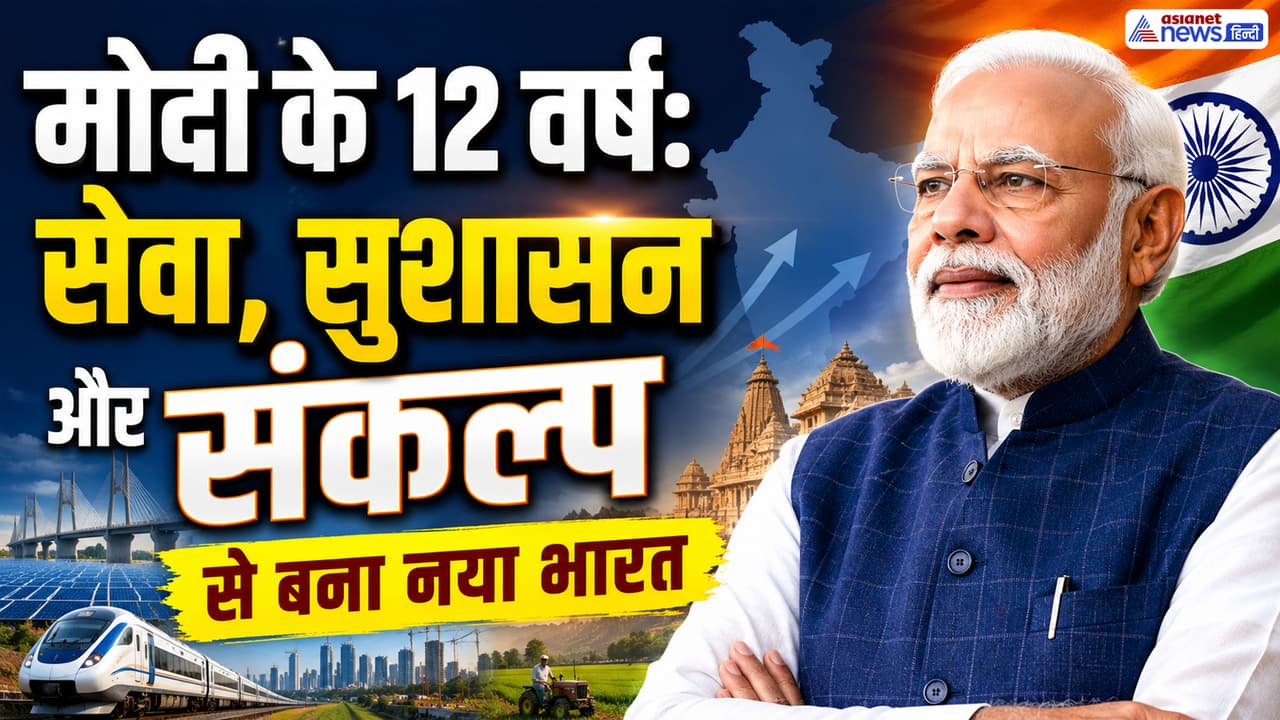
PM Modi@12: After all, how did Narendra Modi become Prime Minister for the third consecutive time? Was the model of service and good governance successful in winning public trust? How far has the vision of developed India progressed? Did digital governance and big decisions change the direction of the country? Know the complete story of building a new India in 12 years.
In the democratic history of India, Prime Minister Narendra Modi assuming the post of Prime Minister for the third consecutive time is being considered an important achievement. Receiving public trust for three consecutive terms is considered to be the result of his working style, decisive leadership, commitment to national security and efforts to strengthen the country economically. Under his leadership, India has established new dimensions of development, self-confidence and global identity.
The thinking and political culture of new India started from 2014
In the year 2014, when Narendra Modi took oath as Prime Minister for the first time, the countrymen not only expected a change of government, but also expressed hope for a new functioning of governance and change in politics. It would be more appropriate to understand the journey of the last 12 years not just on the basis of plans and figures, but on the basis of the broader thinking that influenced the direction and priorities of the governance. If this entire period is defined in three words then they are – service, good governance and determination.
Politics of service: Efforts to bring development to the last person
In the thinking of Prime Minister Modi, service was not limited only to government schemes. Under his leadership, the concept of considering the government as a servant and protector of the people was strengthened. The priority of the government remained focused on extending the benefits of the schemes to the last person of the society.
Efforts were made to keep the poor, farmers, women, youth and deprived sections at the center of the development process. This approach is also believed to be inspired by the ideas of Integral Humanism of Pandit Deendayal Upadhyay. The government has made continuous efforts to ensure that the benefits of development reach the weakest sections of the society.
Good governance model: Emphasis on transparency and digital governance
In the last 12 years, good governance was made the main basis of the governance system. The government paid special attention to making the administration more transparent, accountable and effective. Digital technology was considered not only a symbol of modernity but also a medium of good governance. Efforts were made to reduce the distance between citizens and the government through online services, digital platforms and technological improvements. Continuous work was done towards making the benefits of the schemes reach the common citizens faster by simplifying the processes.
Prime Minister Modi’s dialogue model: direct connection with youth and citizens
Prime Minister Narendra Modi is seen as a leader who considers dialogue as an important part of democracy. His direct communication with different sections from time to time is an example of this. He guides students through programs like ‘Pariksha Pe Charcha’, while maintaining constant communication with citizens across the country through the program ‘Mann Ki Baat’. This style plays an important role in connecting him directly with the public.
Decisive Leadership: Identifying Big Decisions
One of the biggest features of Prime Minister Modi’s leadership has been his ability to take decisive decisions. Taking decisions on difficult and long pending issues and trying to reach their solutions is considered to be the main identity of his tenure. For this reason, his leadership is seen as decisive leadership, which promoted clarity and result based approach in governance.
Vision of developed India and resolve for self-reliance
In the third decade of the 21st century, Prime Minister Modi set the goal of ‘Developed India’ before the country. It is not only the goal of economic development but is also linked to self-reliance, self-confidence and national pride. It has been the continuous effort of the government that India should not only remain a developing nation, but should take its place among the leading powers of the world. This thinking has given rise to new confidence within the country.
Centre’s cooperation in building developed Madhya Pradesh
With the inspiration and guidance of Prime Minister Modi, the Madhya Pradesh government has also set the goal of developed Madhya Pradesh. The Central Government has received support in many important development works of the state. The central government has played an important role in taking forward big projects like Ken-Betwa Link Project, Parvati-Kalisindh-Chambal Project and PM Mitra Park. The Bhoomi Pujan of PM Mitra Park in Dhar by Prime Minister Modi himself was considered a matter of pride for the state.
Infrastructure and investment get new momentum in Madhya Pradesh
Efforts like Bhopal and Indore Metro project, Cyber Tehsil, airport expansion and establishing peace in Naxal affected areas are also seen to be linked with the guidance of the Prime Minister. Along with this, the Prime Minister’s participation in the Global Investors Summit organized in Bhopal in February 2025 to promote industry and investment was also considered a symbol of his special attachment towards the development of the state.
Cultural renaissance and pride in Indian heritage
An important feature of Prime Minister Modi’s tenure has been to strengthen the sense of pride towards Indian culture, heritage and civilization. The construction of Ram temple in Ayodhya, redevelopment of Kashi and promotion of yoga and Indian traditions on international forums are seen as symbols of cultural self-confidence. This is not just a religious viewpoint, but also an attempt to link India’s historical heritage with modern nation building.
The biggest legacy of Prime Minister Modi’s 12 years
The 12 years of Prime Minister Narendra Modi’s tenure cannot be limited to just schemes and achievements. In this period, an effort is seen to link governance with service, administration with good governance and politics with determination. This period is considered a symbol of India’s self-confidence, national consciousness, aspirations for development and cultural renaissance. On this basis, it is being called the period that laid the strong foundation of the new India.
(Author: Madhya Pradesh Chief Minister Dr. Mohan Yadav)