PM Modi concludes his three-nation tour of Indonesia, Australia, and New Zealand. The visit elevated India-NZ ties to a Strategic Partnership, enhanced defence cooperation with Australia, and boosted cultural collaboration with Indonesia.
PM Modi Concludes Landmark Three-Nation Tour
Prime Minister Narendra Modi on Saturday concluded his three-nation visit to Indonesia, Australia and New Zealand. He departed for India after wrapping up a landmark visit to New Zealand, which elevated their ties to a Strategic Partnership and unveiled an ambitious roadmap for cooperation across multiple sectors.
Sharing an update on X, the Ministry of External Affairs (MEA) said, “A visit that deepened bonds, strengthened partnerships and shaped a shared future. After concluding substantive discussions and overseeing key set of outcomes in New Zealand, PM Narendra Modi departs for India.”
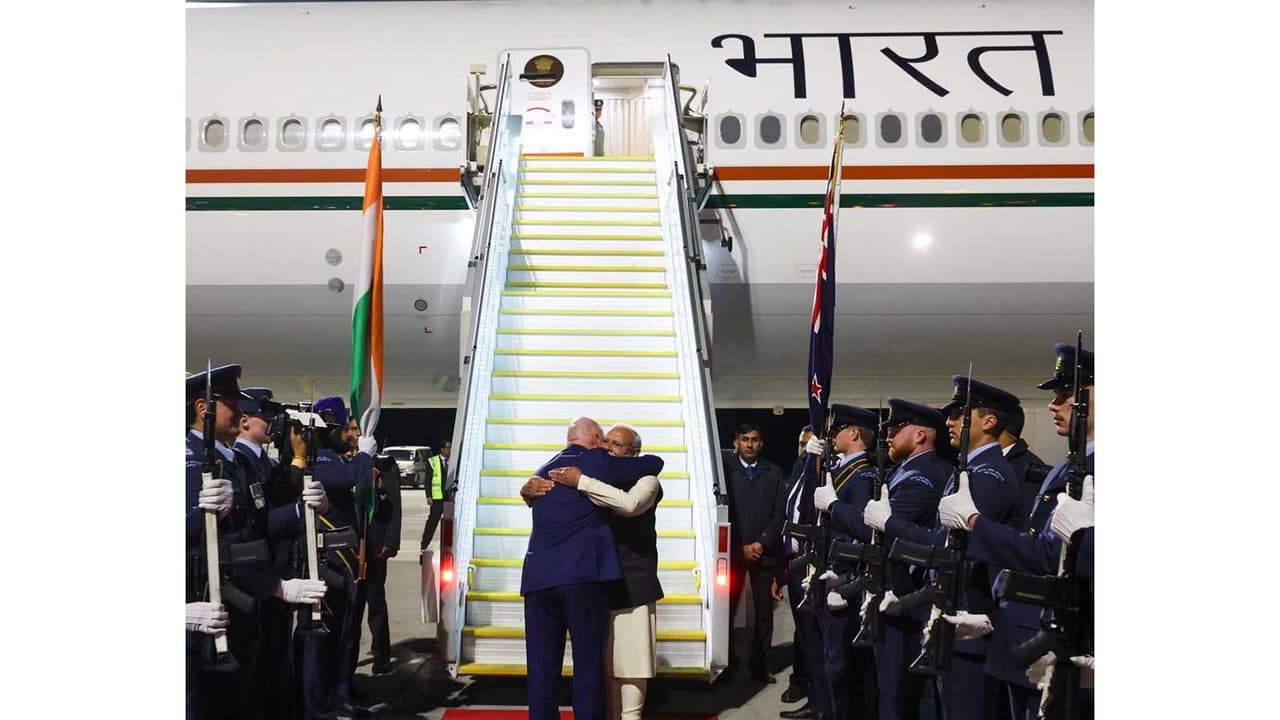
New Zealand Prime Minister Christopher Luxon, in a special gesture, personally came to see off PM Modi at the airport. “In a special gesture, he was seen off by PM Christopher Luxon at the airport. Prime Minister Narendra Modi’s three-country visit to Indonesia, Australia and New Zealand delivered significant outcomes advancing cooperation across several sectors including trade, technology, security, education, innovation and people-to-people exchanges among others,” the MEA post added.
India-New Zealand Ties Elevated to Strategic Partnership
Prime Minister Modi’s two-day official visit to New Zealand, held on July 10-11 at the invitation of Prime Minister Christopher Luxon, marked the first visit by an Indian Prime Minister to the country in 40 years. During the visit, PM Modi was accorded a traditional Maori welcome at Government House in Auckland, featuring customary rituals symbolising peace, respect and welcome, before inspecting a ceremonial Guard of Honour.
The two Prime Ministers held extensive bilateral discussions in both restricted and delegation-level formats, covering the entire spectrum of India-New Zealand relations, including trade and investment, defence and security, maritime cooperation, agriculture, education, sports, tourism, culture, innovation and people-to-people ties.
The leaders agreed to elevate bilateral ties to a Strategic Partnership and adopted the India-New Zealand Strategic Partnership: Roadmap to 2030, which provides a comprehensive framework to guide cooperation across ministries and stakeholders over the next four years.
In a post on X, Prime Minister Modi said, “This has been a great year for the India-New Zealand partnership. Earlier this year, our nations concluded a Free Trade Agreement in record time and now, we have elevated our ties to a Strategic Partnership. Next up, we wish to double bilateral trade by 2030!”
Key Agreements and Outcomes
As part of the visit, India and New Zealand announced 18 key outcomes spanning defence, maritime security, trade, disaster management, agriculture, education, culture, tourism, sports, science and clean energy.
Defence and Maritime Security
Among the major agreements signed was a Memorandum of Arrangement on Maritime Cooperation between India’s Ministry of Defence and the New Zealand Defence Force to strengthen dialogue, coordination, information sharing and joint activities in the Indo-Pacific.
The two countries also concluded an Implementation Arrangement on Hydrography and Nautical Cartography, enhancing cooperation through navigational chart production, hydrographic data sharing, training and capacity building.
An Arrangement on Mutual Logistics Support between the Indian Navy and the New Zealand Defence Force was signed to facilitate reciprocal logistics assistance during approved operations and exercises.
Security and Disaster Management
To enhance security cooperation, both sides agreed to establish a Joint Working Group on Counter-Terrorism, aimed at strengthening information sharing and coordinated efforts to combat terrorism.
India’s National Disaster Management Authority and New Zealand’s National Emergency Management Agency signed a Memorandum of Cooperation focusing on disaster risk reduction, earthquake resilience, tsunami preparedness, coastal hazard mitigation, policy dialogue and capacity building.
Economic and Cultural Cooperation
The two countries also signed a Memorandum of Cooperation on Animal Husbandry and Dairying, promoting technical collaboration, knowledge exchange and adoption of best practices in the livestock sector.
In tourism, both governments signed a Memorandum of Arrangement to boost tourist flows, strengthen economic cooperation and deepen cultural understanding, while also encouraging airlines to commence direct non-stop flights between India and New Zealand.
A Joint Action Plan on Sport was unveiled to expand collaboration in high-performance sports, sports science, sports medicine and athlete development.
India’s National Maritime Heritage Complex (NMHC), Lothal, and the New Zealand Maritime Museum signed an arrangement to collaborate on the development of the maritime heritage complex through mutually agreed projects. The two countries also concluded an Arrangement on Cultural Cooperation to promote exchanges in arts, heritage and cultural initiatives.
Trade and Energy Goals
As part of the Strategic Partnership, India and New Zealand agreed to work towards doubling bilateral trade to NZD 7 billion (approximately ₹35,000 crore) by 2030 and reaffirmed their commitment to ensuring the early entry into force and effective implementation of the recently concluded India-New Zealand Free Trade Agreement.
Both sides also agreed to establish a Maritime Security Dialogue to enhance cooperation and information exchange, while New Zealand joined the maritime security pillar of the Indo-Pacific Oceans Initiative (IPOI) to collaborate in combating Illegal, Unreported and Unregulated (IUU) Fishing.
In the clean energy sector, New Zealand joined the Global Biofuels Alliance, strengthening international cooperation on sustainable biofuels and energy transition.
Agriculture and Scientific Collaboration
The visit also saw the launch of an Agricultural Productivity Partnership under the Free Trade Agreement, including a Kiwifruit Action Plan and the establishment of two Centres of Excellence in Nagaland and Uttarakhand to support agricultural innovation, education and skills development.
Scientific cooperation received a boost through an MoU between the National Centre for Polar and Ocean Research (NCPOR), Goa, and the University of Canterbury, establishing collaboration in Antarctic research, academic exchanges and capacity building.
Another agreement between NIFTEM-Kundli and Massey University aims to strengthen cooperation in food technology research, student mobility and academic collaboration.
The Joint Statement issued after the talks said both leaders shared an ambitious long-term vision for the Strategic Partnership, aimed at strengthening existing cooperation mechanisms; exploring new opportunities across trade, agriculture, defence, innovation and people-to-people ties; and enhancing coordination on regional and multilateral issues.
State Visit to Indonesia
During his time in Indonesia as part of his State Visit from July 6 to July 8, PM Modi held wide-ranging bilateral talks with Indonesian President Prabowo Subianto. The two leaders reaffirmed their commitment to strengthening the India-Indonesia Comprehensive Strategic Partnership, with discussions covering political ties, defence and security, trade and investment, technology, maritime cooperation, connectivity and regional issues.
A key highlight of the visit was the joint inauguration of the restoration project of the nearly 1,000-year-old Prambanan Temple, a UNESCO World Heritage Site, marking a significant milestone in India-Indonesia cultural cooperation and reflecting the shared civilisational links between the two countries.
Leaders’ Summit in Australia
Following the Indonesia visit, PM Modi travelled to Melbourne, Australia, on July 9 for his third visit to Australia. He participated in the third Australia-India Annual Leaders’ Summit with Australian Prime Minister Anthony Albanese, where the two leaders reviewed the progress of the six-year Comprehensive Strategic Partnership.
The summit resulted in a Joint Declaration on Defence and Security Cooperation and strengthening collaboration in defence, Indo-Pacific security and military interoperability.
Australian Prime Minister Anthony Albanese announced that the BBL 2026-27 season will begin in India, with Chennai’s MA Chidambaram Stadium set to host the opening fixture in December. The announcement was made alongside PM Modi in a joint statement. Cricket Australia later confirmed that the Melbourne Renegades will face the Perth Scorchers in the historic season opener on December 12. The match will be the first BBL fixture to be played outside Australia.
India and Australia also expanded cooperation in critical minerals, clean energy, trade and investment. Additionally, both countries finalised the administrative arrangements to enable the export of Australian uranium to India for exclusively peaceful purposes under International Atomic Energy Agency (IAEA) safeguards, reinforcing their commitment to energy security and strategic cooperation. (ANI)
(Except for the headline, this story has not been edited by Asianetnews Editorial staff and is published from a syndicated feed.)