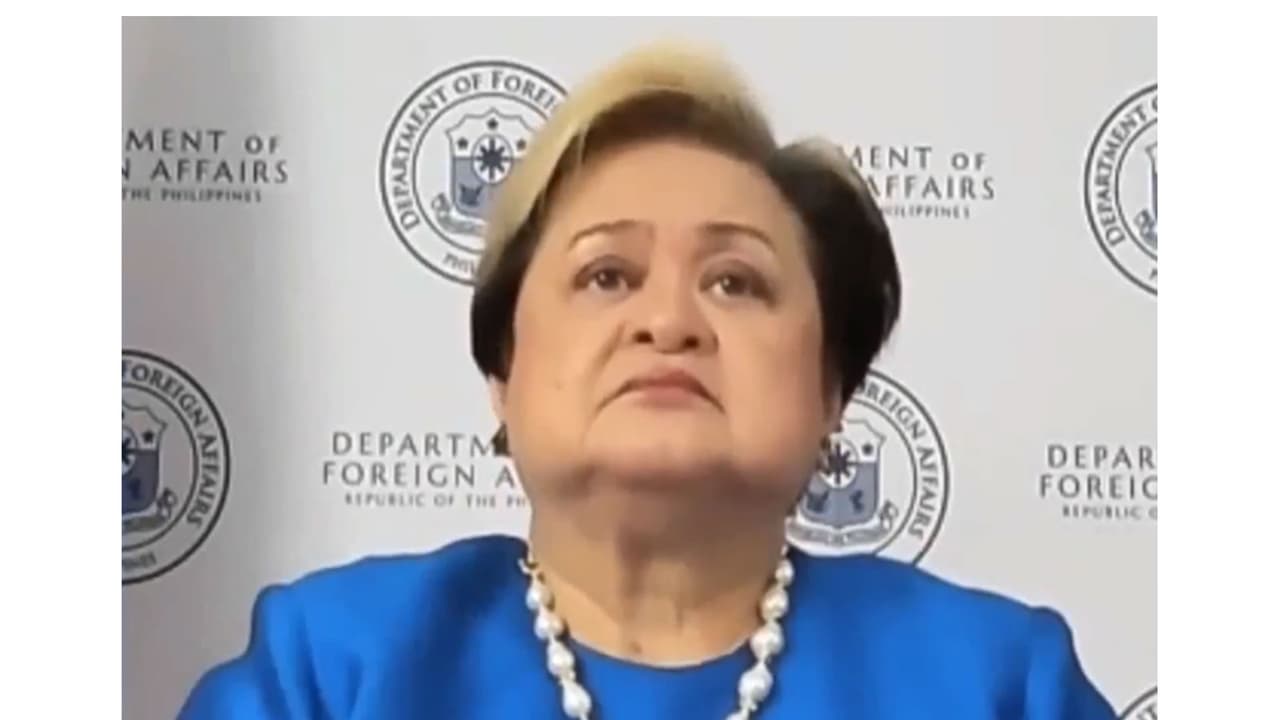
Philippines Foreign Secretary Ma Theresa P. Lazaro thanked India for its support on the 2016 South China Sea arbitral ruling. She expressed hope for a Quad summit in November and highlighted the importance of maritime cooperation with Quad partners.
Philippines Foreign Secretary Ma Theresa P. Lazaro on Tuesday expressed gratitude for India’s support and acknowledgement of the 2016 arbitral order on the South China Sea, while noting that she is hopeful of another Quad summit meeting in November.
Speaking exclusively to ANI on the recently concluded Quad Foreign Ministers’ Meeting held in Manila in July on the sidelines of the ASEAN-related meetings, Lazaro said the Philippines was “very gratified and happy” to have hosted the meeting and expressed optimism about a possible summit in November. “We are very gratified and happy that the meeting was held here in Manila last,” Lazaro said. “Hopefully, there will be a summit meeting in November. I’m looking at it from a positive point of view.”
India’s Support on South China Sea Ruling
On maintaining a rules-based order in the Indo-Pacific, Lazaro highlighted India’s position on the 2016 arbitral order, saying the decision continues to guide the Philippines on several issues it faces. “We thank India for the support it has given and the acknowledgement of the 2016 arbitral order. The results of the arbitral order are really very important because this is now what is guiding us in many of the issues that we are facing,” she said.
On July 12, 2016, the arbitral tribunal adjudicating the Philippines’ case against China in the South China Sea ruled overwhelmingly in favour of the Philippines, determining that major elements of China’s claim, including its nine-dash line, recent land reclamation activities and other activities in Philippine waters, were unlawful.
India has noted the award of the arbitral tribunal constituted under Annex VII of the 1982 United Nations Convention on the Law of the Sea (UNCLOS) in the matter concerning the Philippines and China. New Delhi has maintained that it supports freedom of navigation and overflight and unimpeded commerce based on the principles of international law, as reflected notably in UNCLOS. India has also said that States should resolve disputes through peaceful means without the threat or use of force and exercise self-restraint in activities that could complicate or escalate disputes affecting peace and stability.
Maritime Cooperation and Quad Partners
Lazaro also stressed the importance of support from Quad partners amid tensions in the South China Sea, particularly naval port calls and maritime coordination. “The support given by many countries, and of course India, is very important. The port calls of Indian naval ships and other port calls, per se, are again very important. The maritime domain, the fact that there is some kind of coordination among the vessels that visit the Philippines again, is very important as part of our discussion of our maritime cooperation,” Lazaro said.
In July, India joined its Quad partners in advocating peace and stability across the Indo-Pacific while reiterating “unwavering support” for “ASEAN unity and centrality” amid growing Chinese military muscle-flexing in the South China Sea.
Quad’s Commitment to Regional Stability
External Affairs Minister S Jaishankar, US Secretary of State Marco Rubio, Australian Foreign Minister Penny Wong and Japanese Foreign Minister Toshimitsu Motegi convened for the Quad Foreign Ministers’ Meeting in Manila, following their previous interaction in New Delhi in late May. In a joint statement issued after the deliberations, the Quad reiterated its commitment to reinforcing a free and open Indo-Pacific and highlighted ASEAN’s critical role in regional governance. “We are deeply invested in the region’s success and in cooperating with ASEAN and its member states,” the foreign ministers stated.
The ministers evaluated regional challenges and explored avenues to bolster practical implementation of the ASEAN Outlook on the Indo-Pacific (AOIP), focusing on maritime and transnational security, economic prosperity and security, and critical and emerging technologies, along with humanitarian assistance and emergency response. “We are united in our conviction that peace and stability in the Indo-Pacific maritime domain underpin the security and prosperity of the region,” the joint statement noted.
Philippines’ Priorities as ASEAN Chair
Lazaro also outlined the Philippines’ priorities as ASEAN chair, with the country nearing the end of its chairship and preparing to host the ASEAN summit in November. “We are now almost at the end of our chairship, as the ASEAN summit will be held here in November. We’re expecting the Prime Minister [Modi] also to take part in the ASEAN-India summit,” she said.
She said the Philippines’ ASEAN chairship has focused on three pillars — political issues, maritime cooperation and the economic front. “We have been focusing on the three pillars of our ASEAN chairship — One is political, then it is maritime cooperation, and on the economic front, we have finished discussions on the framework for digitalisation. We are very conscious of the growing ageing population, and there will be a high-level meeting, and the results of which will be out,” Lazaro said. (ANI)
(Except for the headline, this story has not been edited by Asianetnews Editorial staff and is published from a syndicated feed.)