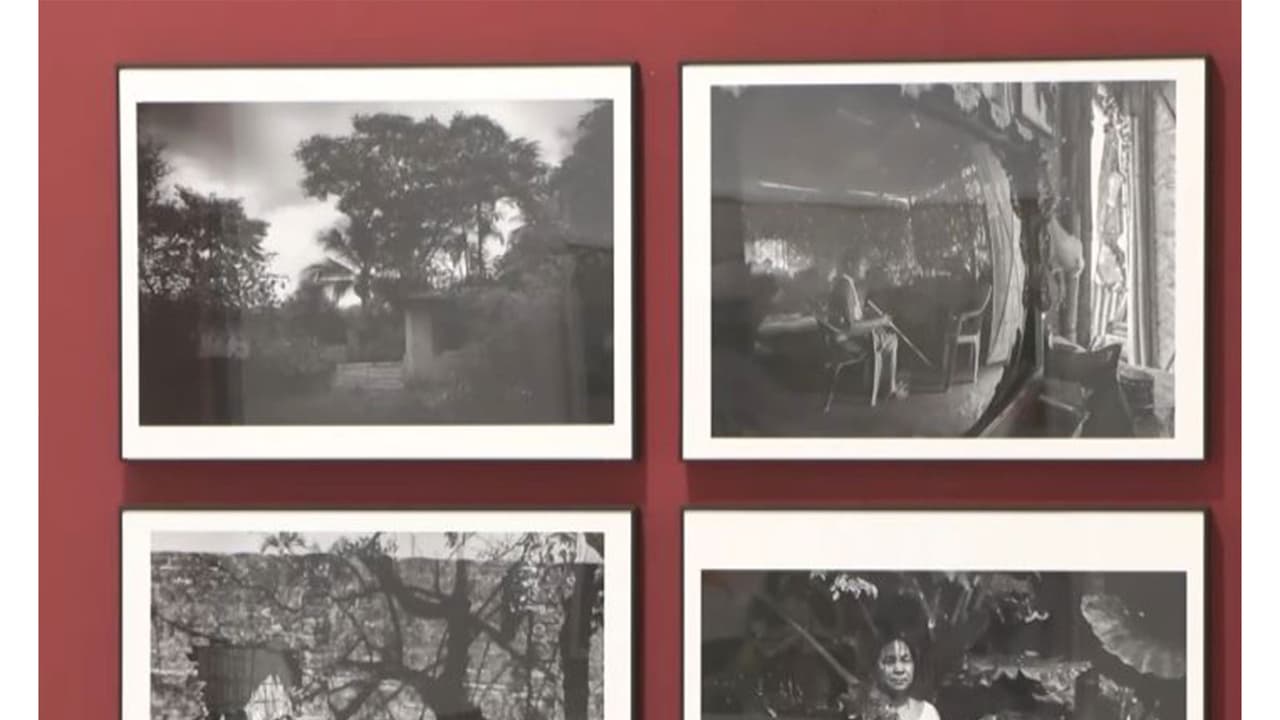
A new art exhibition ‘Paradise Promised’ at Bikaner House, New Delhi (Sep 14-16) showcases works exploring the concept of paradise. The exhibition is a culmination of a residency in Himachal Pradesh, featuring artists’ take on the theme.
Artists’ Interpretations of Paradise
The exhibition features works created during the residency alongside works by artists whose practices resonate with its central theme.
Dhiraj Pednekar: Paradise Lost and Found
For Dhiraj Pednekar (36), the landscape of Himachal became the starting point for thinking about paradise. Observing the flora and fauna around him, he began looking at the coexistence of plants, shrubs, grasses and fungi as a form of paradise. “But when you take these things from that particular paradise, what you see is the lost paradise,” Pednekar says. His works also respond to the environmental scars left behind when landscapes are disturbed. During his stay in Himachal, he encountered what he describes as “wounded patches” of landscape, including areas affected by landslides. His practice increasingly explores the intersection of art and ecology, moving between drawing, sculpture, performance and video.
Kodanda Rao Teppala: Art in the Ordinary
For Kodanda Rao Teppala (46), art is rooted in the ordinary. His works created during the residency draw on daily life, human beings, nature and animals. He describes them as reflections of the conversations and experiences of everyday existence. His restrained, pastel-like palette is deliberate. Teppala says he is drawn to subtle and harmonious colours because they carry a sense of sensitivity and cultural reflection. His works may appear simple at first glance, but, he says, the process is layered and technically demanding, often requiring repeated stages of working and reworking.
The Diverse Meanings of Paradise
The diversity of approaches is central to the exhibition. Rather than offering a single definition of paradise, Paradise Promised asks what an ideal world means to different people — and what is lost between its promise and its realisation.
The curatorial premise looks at how the idea of an idealised state can shape individual aspirations and collective behaviour, even as societies move further away from achieving it. It draws upon philosophical, spiritual and cultural ideas of paradise while examining the tension between promise and reality.
The inaugural residents include Rekha Hebbar Rao, Veer Munshi, Kodanda Rao Teppala, Sheena Maria Piedade, Digbijayee Khatua, Dhiraj Pednekar and Lina Vincent. Works by Shailesh B R, Akshata Mokashi and Dhiraj Rabha are also part of the exhibition, aligned with the curatorial theme.
A Platform for Conversation
For Bhandare, the larger purpose of TKCF extends beyond exhibitions. “The idea behind the Foundation is to provide a platform for conversation without social barriers and awkwardness that exist in everyday interactions between stakeholders of the creative community,” she says, emphasising the need for people from different experiences and disciplines to have a space where they can contribute meaningfully.
Artist Veer Munshi, reflecting on the residency, sees such a space as particularly important for multidisciplinary practitioners — a place where interaction itself can generate new material and build greater social consciousness.
Paradise: A Multifaceted Concept
At Bikaner House, that exchange has now taken a physical form. The resulting works range from intimate observations of nature to reflections on displacement, urbanisation, ecological fragility and changing social structures. Together, they suggest that paradise may not necessarily be a distant, perfected destination. It can also be a landscape we inhabit, a memory we carry, a community we imagine — or something that disappears when the relationship between people and their surroundings is disrupted.
‘Paradise Promised’ is presented by the Knowledge Convergence Foundation (TKCF) at Bikaner House, New Delhi, from September 14 to 16, 2026. (ANI)
(Except for the headline, this story has not been edited by Asianet Newsable English staff and is published from a syndicated feed.)