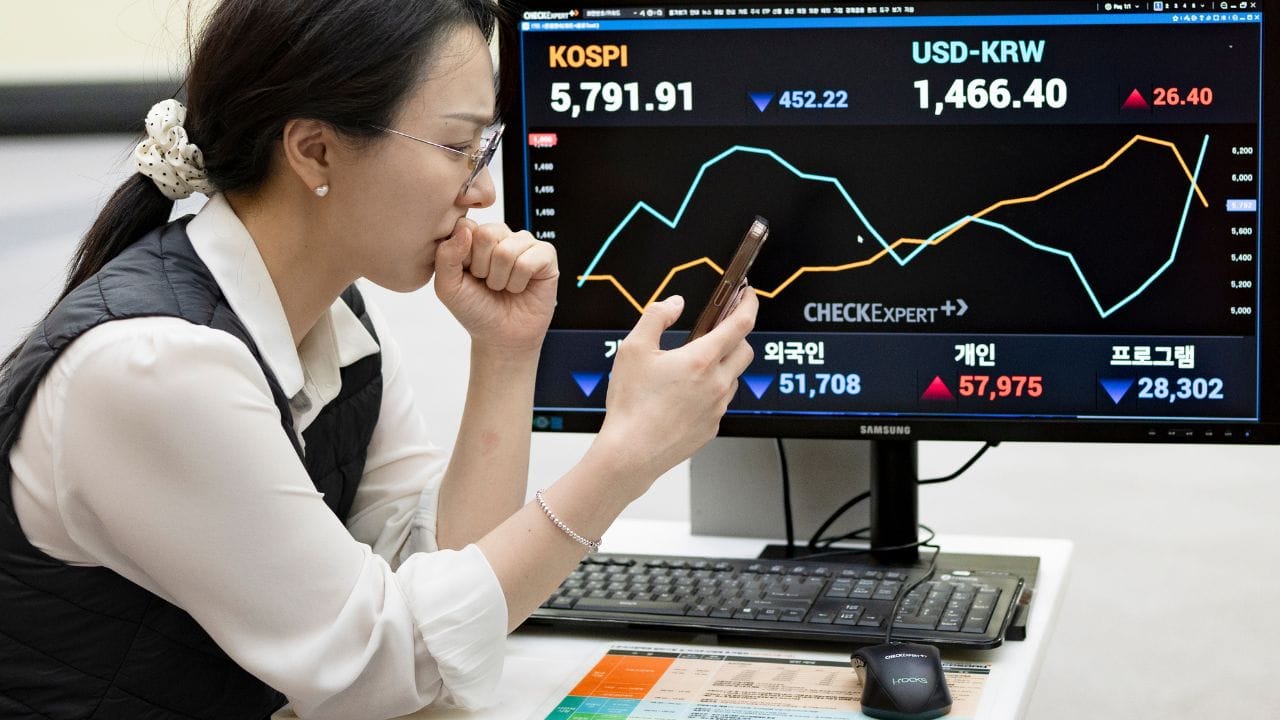
A big decline has been seen in the South Korean stock market.
Not even 6 months of the year were completed and the Korean stock market created a stir in the world. Cospi had given returns of more than 120 percent to investors in just 170 days. The special thing is that in the early days of June, the Korean market had overtaken the Indian stock market and made its presence among the top 6 largest markets of the world. But who knows, the picture is going to change completely in a month and a half. The same AI on which the Korean stock market made its presence felt is currently causing major devastation in the Korean stock market.
If we look at the figures, the Korean stock market has fallen by about 44 percent from its peak. Whereas by the time the Korean market closed, it was about 40 percent below its peak. The main reason for this huge disaster in Kospi is being considered to be the decline in the shares of AI based Korean company SK Hynix. On the basis of which the index had created history in the first half of the year 2026. The special thing is that from the peak till now more than 2 trillion dollars have been wiped off from the total market cap of the index. Let us try to understand the fall in Kospi in detail.
Scene of devastation in Korean market
South Korea’s Kospi index, which was in the news for its meteoric rise earlier this year, fell more than 11% on Wednesday. This led to huge loss of investors’ wealth as the earnings results of major chip maker SK Hynix failed to impress the market.
On Wednesday morning Kospi was seen trading below 5,300 points. It was down about 44 percent from its highest level of 9,386 in June. Due to which it has come into the situation of ‘technical bear market’ (a period of continuous decline in the market). Despite recent declines, South Korea’s stock market remains the best performing in Asia.
Due to the huge fall in Kospi on Wednesday, trading had to be halted for 20 minutes, as has often happened during market fluctuations this year. The decline came after SK Hynix reported a six-fold increase in its earnings—which was partly driven by a $44 billion increase in asset-value—but it fell short of the market’s high expectations due to the AI boom.
SK Hynix shares fell more than 14%, while Samsung Electronics shares fell 10%. These two chip-making giants together account for almost half of the index’s weightage (importance) and have contributed almost two-thirds to the index’s growth this year. As soon as these shares fell, Kospi also fell.
South Korean government took charge
The government of South Korea is engaged in taking measures to save the wealth of investors from the falling stock market. Finance Minister Koo Yun-cheol said on Wednesday that the government is reviewing measures to stabilize the market, including changing rules related to single-stock leveraged ETFs. Some experts say that these products further increase the fluctuations in the market.
Earlier this month, the Finance Ministry had said market volatility had increased due to profit-taking by foreign and institutional investors, rebalancing of portfolios and changing expectations around the global artificial intelligence sector. The ministry said in a statement that the increasing concentration in the semiconductor sector has become a cause of fluctuations in the financial market, as the effect of fluctuations in the chip sector is increasing on the entire stock market.
South Korean President Lee Jae-myung recently said that our domestic stock market is quite unstable. He said that since the country’s stock market has seen a historically unprecedented rise in such a short period of time, it will take time and ups and downs to stabilise.
Authorities took steps to cool the speculative environment earlier this month and announced a ban on new listings of leveraged exchange-traded funds (ETFs) linked to individual stocks. This sudden move comes just two months after regulators approved these funds.
What will happen next?
Nomura believes that the sharp decline in South Korea’s equity market was due to heavy selling by foreign investors, lack of institutional support and volatility caused by the rapid growth of leveraged ETFs and recently launched single-stock leveraged products. The international brokerage firm said that we believe that despite strong corporate fundamentals, volatility has increased due to these reasons.
Nomura said that in our view, as the market ‘de-leveraging’ (debt reduction process) progresses and foreign selling pressure subsides, the next phase of Korea’s re-rating is likely to be supported by corporate share buybacks and treasury-share cancellations. He further said that this can become a new structural source of demand and can help Kospi reach the target of 10,000-11,000.
According to Reuters report, Eurasia Group analysts wrote in a research note that Seoul will learn to live with stock market volatility. He further said that, however, the huge daily fluctuations do not have much to do with the fundamentals of the market. Corporate profits remain at record highs.
Citi recently downgraded South Korea’s stock market from ‘overweight’ to ‘neutral’, citing increased volatility in AI-related chip stocks, whereas it was ‘overweight’ for the last one year. Despite the rating downgrade, Citi said it remains structurally positive on the long-term artificial intelligence investment theme.