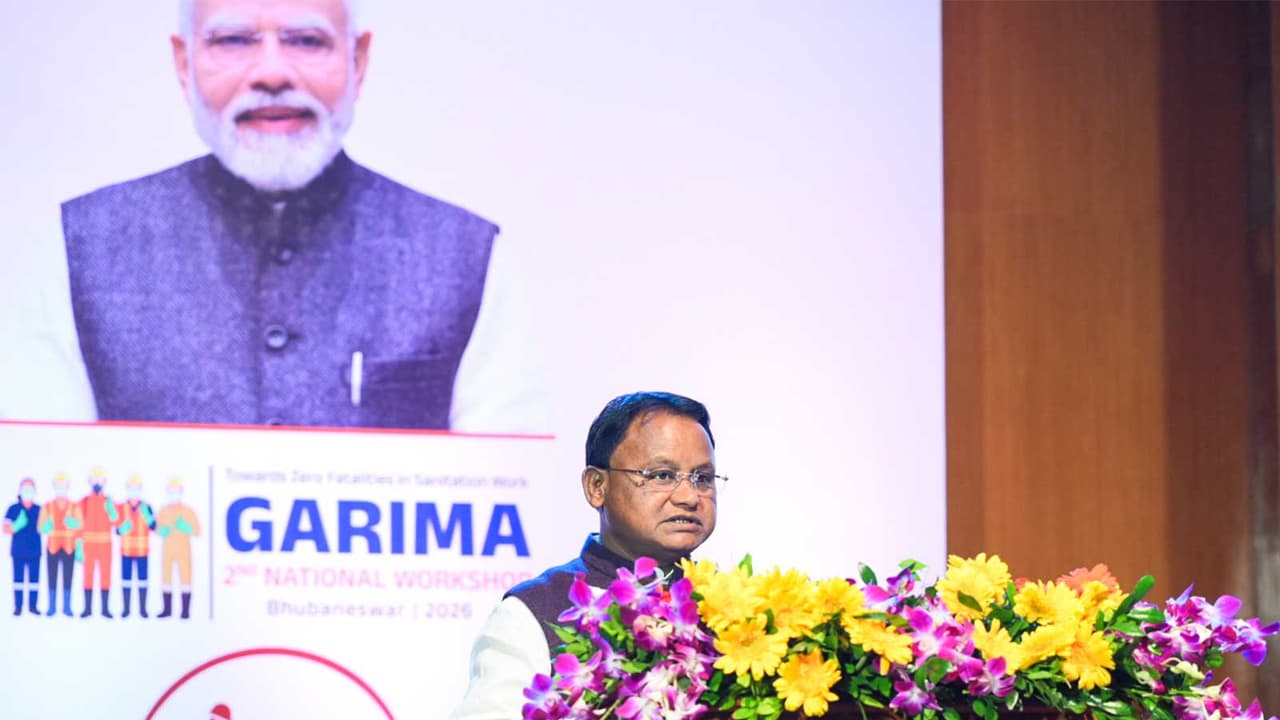
Odisha CM Mohan Charan Majhi inaugurated the National GARIMA Conclave 2026 in Bhubaneswar, focusing on ‘Mission Zero’ to end sanitation worker deaths through technology and mechanisation. He also distributed financial aid to workers’ families.
Odisha Chief Minister Mohan Charan Majhi on Saturday inaugurated the second National GARIMA Conclave 2026 in Bhubaneswar, highlighting the state’s efforts towards ensuring the safety, dignity and human rights of sanitation workers. The conclave, themed “Mission Zero: Ending Fatalities in Sanitation Work,” focused on achieving zero fatalities in sanitation operations through mechanisation, advanced technology and safer working practices.
During the event, CM Majhi inaugurated an exhibition showcasing advanced equipment and technologies aimed at making sanitation work safer and more mechanised. He also handed over work orders under the Pradhan Mantri Awas Yojana (PMAY) to sanitation workers and distributed financial assistance under insurance schemes to families of deceased sanitation workers.
CM Majhi Highlights National Cleanliness Movement
Addressing the conclave, CM Majhi said Prime Minister Narendra Modi brought cleanliness to the centre of national discourse after 2014 and transformed it from a government programme into a people’s movement. “PM Modi did not merely tell the country to maintain cleanliness; he himself picked up the broom. Swachh Bharat Mission transformed cleanliness into a social responsibility and linked it with women’s dignity, the dignity of the poor, public health, human dignity and national pride,” he said.
The Odisha CM said initiatives such as NAMASTE are promoting mechanisation and safer practices in sewer and septic tank cleaning. “PM Modi taught us to pick up the broom. Now, we have to pick up the machines,” Majhi said, stressing the need for technology-driven sanitation practices.
Mission Zero and ‘Garima Diwas’
Speaking about the GARIMA Mission Zero initiative, Majhi said the state government aims to ensure that sanitation workers do not face any threat to their lives while carrying out their duties. He said Odisha will observe the last Saturday of August every year as ‘Garima Diwas’ and added that modern technology, including helmets, oxygen support systems, cameras, drones and artificial intelligence, will be used to improve the safety of sanitation workers.
“Odisha has announced that the last Saturday of August will be observed annually as ‘Garima Diwas’… our mission is Mission Zero, meaning ensuring that sanitation workers face no threat to their lives while cleaning sewers. To achieve this, we are utilising modern technology and machinery…modern technology includes helmets, oxygen support, cameras, and other safety equipment…drone and AI technologies are being employed to safeguard the lives of sanitation workers,” said CM Majhi.
Financial Aid and Support Measures
The Chief Minister added that financial assistance of Rs 20 lakh has been provided to families of sanitation workers who lost their lives, along with provisions for permanent housing, mobile phones and medical facilities. “Provisions have been made to provide financial assistance to the family of any worker who loses their life. We announced this initiative last year, and today, financial aid totalling Rs 20 lakh…under this initiative, they are being provided with permanent housing, mobile phones, and medical facilities,” said CM Majhi.
State’s Commitment to Safety and Mechanisation
Odisha Additional Chief Secretary of Housing and Urban Development Usha Padhee said the state government is working towards creating a safe working environment for sanitation workers under the Mission Zero initiative. She said, “We have made sure that mission zero, where anybody who is working in the sanitation sector has a very safe working environment”
“No death while working in the sanitation sector would be allowed by the state government,” Padhee said, adding that the focus is on achieving 100 per cent mechanisation, especially in hazardous cleaning activities. She said the government has established Standard Operating Procedures (SOPs) under which safety hazard-related work must be carried out through mechanisation only.
She added that efforts are being made to provide training, Personal Protective Equipment (PPE) kits and expand mechanisation through service providers, government procurement and Urban Local Bodies (ULBs).
“We have already established SOPs stating that all work involving safety hazards should be done through mechanisation only, and we have achieved almost 100%…we are reaching out to private organisations to make them abide by these do’s and don’ts, which is where we will be focusing,” said Padhee
Social Security and Training
Padhee further said sanitation workers will be covered under social security measures, including housing support and insurance schemes. “We have tied up with various sanitation service-providing organisations, and with scientific interventions, we would like to have 100% mechanisation…training the sanitation workers, providing them with PPE kits, and expanding mechanisation through service providers, our own procurement of machinery, and through ULBs under the Garima Initiative…under the social security network, we will provide them housing, cover them under various insurance networks,” she said.
Centre Lauds Odisha’s Initiatives
Secretary, Ministry of Social Justice and Empowerment, Sudhansh Pant, praised Odisha’s GARIMA scheme and Mission Zero initiative, calling them commendable steps towards ensuring the safety and dignity of sanitation workers. He said the Centre’s NAMASTE scheme and Odisha’s GARIMA scheme both emphasise mechanisation to minimise human entry into hazardous sanitation work.
“The Garima scheme and the Garima Mission Zero initiative launched by the Odisha government represent a highly commendable step…while there is a national-level NAMASTE scheme, which includes various welfare measures for our sanitation workers, septic tank cleaners, and rag-pickers to ensure their safety, dignity, and well-being, Odisha implemented its own state-specific scheme for them…both the Government of India’s NAMASTE scheme and the Odisha government’s Garima scheme place immense emphasis and priority on mechanisation,” he said. “The aim is to minimise human entry into these tasks and maximise the use of machines. If entry becomes unavoidable in an emergency, it must be undertaken with full safety kits and all necessary precautions,” Pant added. (ANI)
(Except for the headline, this story has not been edited by Asianetnews Editorial staff and is published from a syndicated feed.)