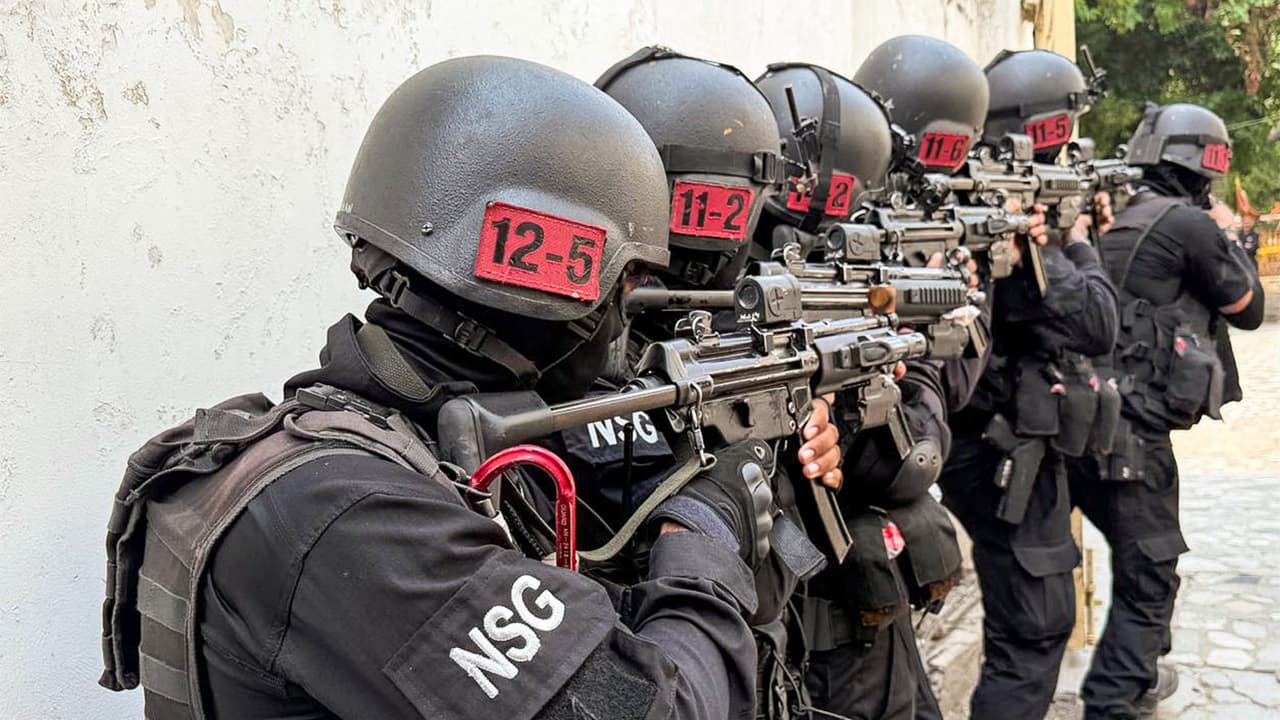
India’s elite counter-terrorism force, the National Security Guard, is set to open its seventh regional hub in Ayodhya by September end, covering Uttar Pradesh, Bihar, and Madhya Pradesh to enhance security and response to terror threats.
NSG’s Seventh Regional Hub in Ayodhya
India’s elite federal counter-terrorism and contingency force, National Security Guard’s seventh and the latest regional hub is likely to be opened in Uttar Pradesh’s Ayodhya city by September end covering areas of responsibility across the state as well as nearby Bihar and Madhya Pradesh among other key regions in emergency situation, specifically during terror attack, top officials in the government told ANI.
With the opening of the new regional hub in Ayodhya, the NSG commandos at this Centre will always be ready and available to provide a strong response to any sudden terrorist attack in their zone.
Six NSG hubs are already established and operational in Mumbai, Chennai, Kolkata, Hyderabad, Ahmedabad, and Jammu, where commandos of the force are stationed.
The opening of the NSG’s new regional hub would help and streamline proper training engagements arranged by the force with anti-terror units established within police forces across Uttar Pradesh and other Central Armed Police Forces deployed in the state.
Apart from its responsibility to pitch in during terror attacks, the NSG continuously focuses on conducting tactical training with cutting-edge technology and police forces to enhance their skills and ensure the fitness of its personnel in the fight against terrorism.
Officials, requesting anonymity, told ANI that all the preparations linked to the opening of the NSG’s regional hub are almost ready and the date would be announced after clearances from the Uttar Pradesh government, led by Chief Minister Yogi Adityanath and the Centre.
“If things go as per the schedule, the latest and seventh regional hub of the NSG will be opened by the end of next month (September). The opening of the NSG’s regional hub in Ayodhya would enhance India’s security in line with the Centre’s vision of a quadrilateral and impregnable security grid,” one of the officials said, adding Union Home Minister is most likely to attend the opening of the event, as he had earlier announced about the new NSG hub in Ayodhya.
An NSG team under the supervision of a Group Commandant-rank officer will be available round the clock for 365 days of the year at the Ayodhya regional hub, said the official.
Future Vision and Announcements
While addressing the 41st Foundation Day celebration of the NSG in Gurugram’s Manesar last year in October, Shah had announced the establishment of a new NSG hub in Ayodhya.
In the event, Shah had also announced that in the coming days, the Modi government will bring significant changes to the NSG’s operations. He had also mentioned that the resolute, courageous, and strategic manner in which NSG personnel have fought against terrorism, delivering results, is etched in golden letters in India’s security history.
Noting whether it is the Mahakumbh, Puri’s Rath Yatra, or any religious event; Shah had also said that the Modi government will not only equip the NSG with cutting-edge technology but also bring significant changes to its operations in the coming days.
NSG: History and Mandate
With the three principles of Sarvatra (everywhere), Sarvottam (Supreme), and Suraksha (security), along with Samarpan (dedication), Saahas (courage) and Rashtrabhakti (patriotism) as its virtues, the NSG has fought a significant battle against terrorism in the country for four decades.
Since 1984, the NSG has safeguarded the nation with bravery and capability through operations like ‘Operation Ashwamedh’, ‘Operation Vajra Shakti’, and ‘Operation Dhangu’, as well as during the Akshardham attack and the Mumbai terrorist attacks.
The NSG personnel have conducted reconnaissance of over 770 critical locations across the country and created a data bank with strategic plans to counter potential terrorist attacks. Moreover, the NSG has meticulously planned the security of hospitals, religious sites, other vital institutions, waterways, and the Parliament of India.
Formation and Structure
NSG is the Ministry of Home Affairs’ nodal national counter-terror force to deal with anti-terrorist activities in all their manifestations. The NSG is a force specially equipped and trained to deal with specific situations and is therefore to be used only in exceptional circumstances to thwart serious acts of terrorism.
The Union Cabinet in 1984 took a decision to create MHA’s nodal national counter-terror force comprising of personnel who are highly motivated, specially equipped and well trained to tackle the various manifestations of terrorism. In June 1984, a nucleus consisting of the Director General of NSG and other essential elements was sanctioned and steps were initiated to raise the force.
A bill for the creation of this organisation was introduced in the Parliament in August 1986 and it received the assent of the President on September 22, 1986, and the NSG formally came into being from that date.
The basic philosophy of NSG is swift and speedy strike and immediate withdrawal from the theatre of action. NSG has been given the specific role to handle all facets of terrorism in any part of the country. The NSG was modelled on the pattern of the SAS of the UK and GSG-9 of Germany. It is a task-oriented force and has two complementary elements in the form of the Special Action Group (SAG), comprising Army personnel and the Special Ranger Groups (SRG), comprising personnel drawn from the Central Armed Police Forces and state police forces. (ANI)
(Except for the headline, this story has not been edited by Asianet Newsable English staff and is published from a syndicated feed.)