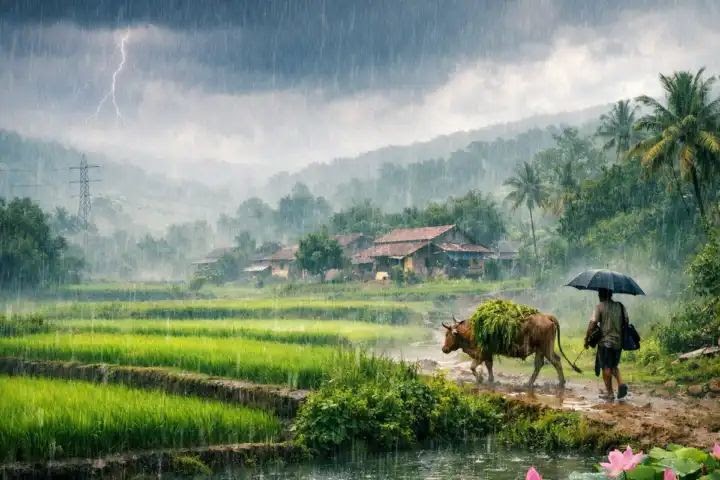
According to a study by NIT Rourkela, the mood of monsoon in India is going to change completely. Scientists have found that about 3 million years ago, monsoon rains in India were much more dangerous than today.
At that time the temperature of the earth was very high. Now exactly the same atmosphere is being created again. Research shows that due to global warming in the future, the amount of rainfall in India will increase significantly. The most surprising thing is that the peak time of monsoon will change. Till now July was considered to be the month with the highest rainfall. But in the coming years, August may become the rainiest month. This change is giving huge signals for India’s economy and agriculture.
Why is the rainiest month of monsoon changing?
This report published in the International Journal of Climatology shows that with increase in temperature the ability of the air to absorb moisture increases. NIT’s Assistant Professor Nagaraju Chilukoti and his team have done a deep analysis on this.
He compared the mid-Pliocene period with today’s time. At that time the earth’s temperature was 4 degrees more than the industrial level. Today we are again moving towards the same situation.
According to research, the warmer atmosphere is now able to hold more moisture. For this reason, a shift is being seen in the monsoon months. The team found that the flow of moisture over the Indian Ocean and land areas is becoming very strong.
This is the reason why now more incidents of cloud bursts and heavy rains can be seen in August instead of July. This shifting can completely destroy the traditional cycle of monsoon.
Will the increasing heat weaken the monsoon or make it more dangerous?
There has always been debate about this matter among scientists around the world. Some believe that the heat will reduce rainfall, while others consider it a sign of strength. The study of NIT Rourkela has clarified this contradiction to a great extent.
- Research says that in the past the monsoon was strong due to strong winds. But the reason for increase in rainfall in future will be the ‘extra moisture’ present in the air.
- 80 percent of India’s rainfall comes from monsoon only. The livelihood and agriculture of crores of people depend on this. If the rainfall pattern changes, the economic stability of South Asia may be in danger.
- The water level in big rivers like Ganga and Brahmaputra may rise suddenly. This will not only increase the risk of floods, but drainage systems in urban areas may also fail.
How will the lives of farmers and the water management of the country change?
The findings of this research are not just on paper, but their ground effects will be very deep. If the timing of rain changes, farmers will also have to change their crop cycle. Till now farmers have been sowing relying on the July rains. But if it rains the most in August, the entire irrigation plan may fail. There will also be a fear of standing crops getting ruined due to heavy rains.
Scientists say that the government will now have to re-look at its water management policies. Flood and drought warning systems will have to be made more advanced. Urban planners will now also have to build drains and bridges keeping in mind the heavy rains of August. This report is like an alarm for policy makers so that they can strengthen disaster management in time.
How prepared are we for future challenges?
Professor Nagaraju Chilukoti says that ‘the past is the real key to understanding the future’. We have seen how extreme heat during the mid-Pliocene period made rainfall intense. Now we are on the same path. This study is not just a warning, but an opportunity. If we start climate preparation now, we can avoid major losses.
For an agricultural country like India, every day of monsoon is precious. Excessive rainfall in August can also increase soil erosion. We have to re-evaluate the capacity of our river dams and reservoirs.