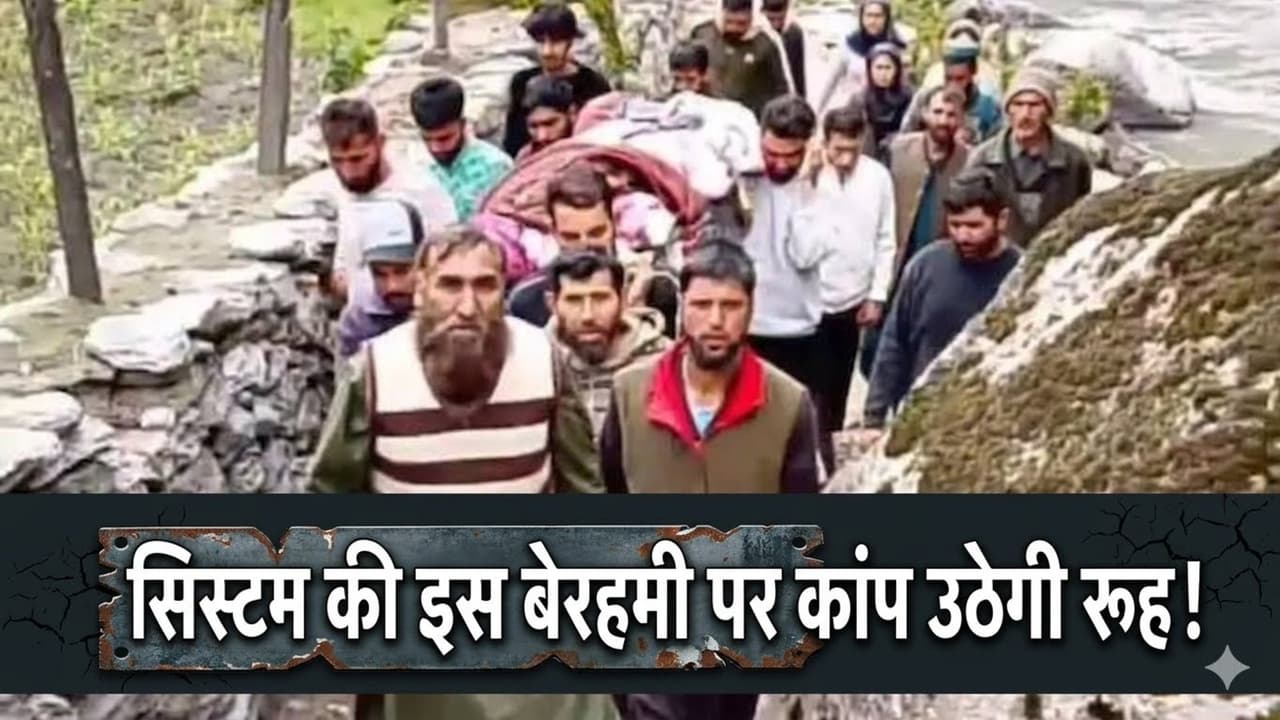
Did a pregnant woman have to fight to the death for 120 km because there was neither an ambulance nor a doctor on the way? Did the dangerous journey of Margan Pass take away the life of an innocent child even before birth? Is Marwah Valley, with a population of 30,000, still deprived of specialist health services? After all, how many more mothers will have to be carried on the shoulders, only then will the health system wake up?
Jammu Kashmir News: Kishtwar district of Jammu and Kashmir is known for its natural beauty, but what happened on Saturday in Deharna village of Marwah tehsil of the same district, shocked the entire humanity. In the afternoon, when a woman named Shaista Begum suddenly started labor pain, the family lost their ground. Neither an ambulance nor any vehicle could come to the village, because there were no roads to walk there. The family had very little time to save the suffering pregnant woman. Without wasting a moment, the family members lifted the woman on their shoulders and started covering several kilometers on foot on rocky, rough roads. Amidst the silence all around and the height of the mountains, while fighting to save their loved ones, these shoulders were directly facing death.
Hope in Ruin: Was There Really a Messiah?
After hours of struggle and screams, the family somehow reached the main road. From there, he dug into his pocket and hired a private car and ran towards the Primary Health Center (PHC) located at Navapachi. He hoped that the doctors would end his problem as soon as he reached the hospital. But, as soon as he reached the doorstep of the hospital, he lost his senses. There was not a single gynecologist present in that entire health centre.
30 thousand population, still no specialist doctor
More than 30,000 people live in the Marwah Valley, but even today specialist medical services are not available here. This PHC, which was called the hope of the population, proved to be just a white elephant. Time was slipping away like sand and as there was no specialist doctor in Marwah Valley, a decision had to be taken in which the difference between life and death was very small. Local people say that PHCs often run without doctors and serious patients are referred hundreds of kilometers away. In winter, when the Margan Pass is closed due to heavy snowfall, the entire valley is cut off from the outside world for months.
The bloody journey of ‘Margan Pass’: The last test of 120 kilometers
Now there was no way to turn back. Nasir Hussain Lone (the woman’s husband) put his entire life’s savings at stake. He immediately decided to go to the Government Medical College in Anantnag, which was a full 120 kilometers away. This route was not a common route, rather it passes through ‘Margan Pass’. The month of May was about to end, but there was still snow on the sharp turns of this pass. On one side there were cold winds, dangerous ditches and on the other side a mother suffering inside the car. As the train was moving ahead, the breathing of the baby in the womb was gradually stopping. In the midst of this extremely difficult and scary journey, the feared accident happened. Even before reaching the hospital, the innocent child died in his mother’s womb.
“Let us pray to God that these mountains do not take them away from us.”
This dreadful tragedy has exposed the administrative claims. Helpless husband Nasir Hussain cried: “Every pregnancy here is like gambling with death. We have a hospital to name but no doctor. When labor pain begins, we carry our women on our shoulders and pray to God that these mountains do not snatch them away from us.”
The biggest question: How many more lives will be lost?
During winters when Margan Pass is closed due to heavy snowfall, this entire valley is cut off from the world. An elder of Deharna village tearfully asked a bitter question to the system, “How many more mothers will we have to carry on our shoulders before the government listens to us? How many more children will we have to lose?” Today the people of Marwah are demanding only two things – a doctor and a 24-hour ambulance, so that next time no mother’s womb becomes empty.