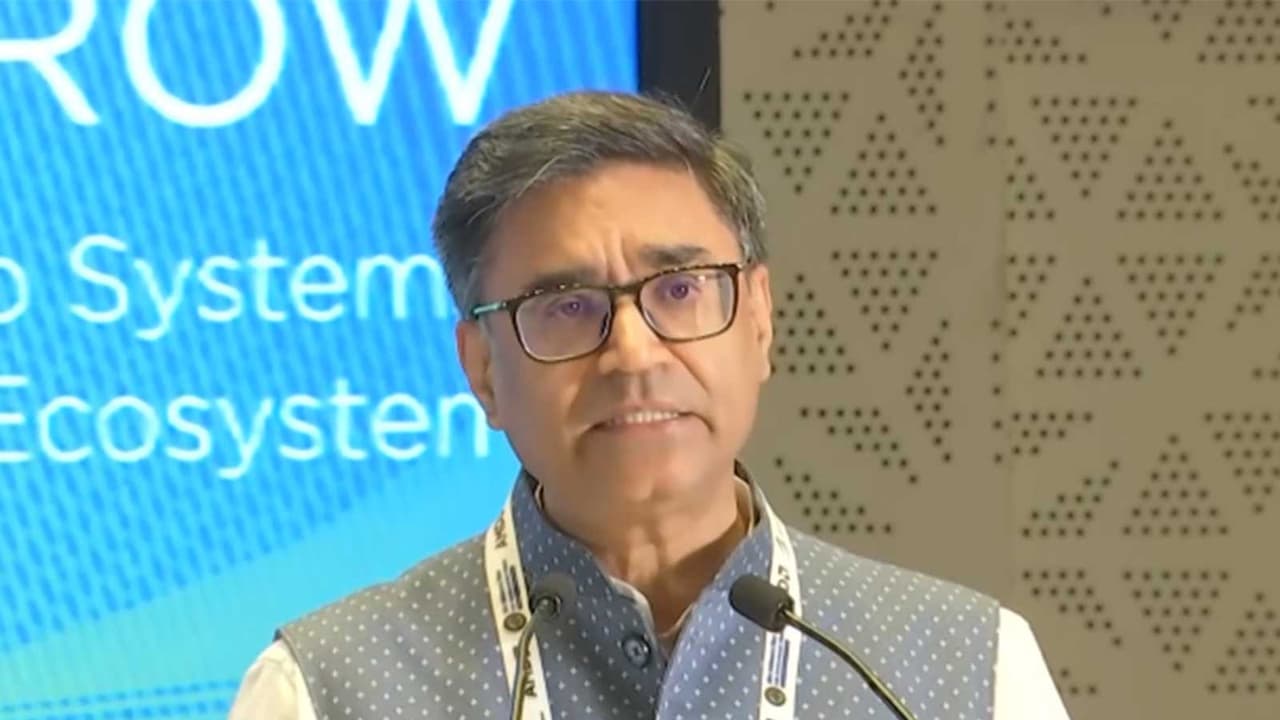
Foreign Secretary Vikram Misri emphasised international partnerships for resilient semiconductor supply chains at SEMICON India 2026. He stated that ‘no nation builds a chip alone’ and called on companies to build ‘with India, not merely in India’.
Foreign Secretary Vikram Misri on Friday emphasised the importance of international partnerships in building resilient semiconductor supply chains, saying that “no nation builds a chip alone” and calling on companies to build “with India, not merely in India.”
Addressing SEMICON India 2026, Misri began by expressing gratitude to the India Semiconductor Mission and the organisers for providing him the opportunity to address stakeholders from different nations and communities gathered at the event.
‘No Nation Builds a Chip Alone’
“For me, this occasion is about one thing, and one thing alone. And I think I heard that word being mentioned just before I came on, and that is partnership. And that is why I want to speak today about why no nation builds a chip alone, and what makes partnerships durable, and where the opportunity lies for companies willing to build with India, not merely in India,” Misri added.
He said semiconductors, once a relatively hidden industrial component, have become a measure of “economic capability, technological maturity, and national standing”, while stressing that even advanced countries cannot build the entire semiconductor ecosystem independently. “But no country, however advanced, can build one alone,” he said. “Taiwan alone produces over 90 per cent of the world’s most advanced chips. Yet, even that rests on design software, tools, and materials developed elsewhere. The chip, therefore, could be the most collaborative object industry has ever produced. The nations that will lead this century, and those that know precisely what to build at home and whom to build with abroad,” he added.
Drivers for Partnership in the Semiconductor Industry
Explaining the factors driving partnerships in the semiconductor industry, Misri said that no single geography possesses every link of the value chain and that supply chains have consequently developed around reliable relationships. “No geography holds every single link. So the industry has organised around coalitions, rooting supply chains through relationships that have proven reliable over time. And I underline the word reliable,” he said.
The Global Value Chain
He identified the structure of the semiconductor value chain as the first reason for partnership, noting that different stages of production are spread across countries. “The first is that the value chain itself compels partnership. Design talent sits in one country, equipment in another, fabrication in a third, materials in a fourth, assembly in a fifth,” Misri said.
The Need for Diversification
He also said that concentrations in the semiconductor ecosystem create a need for diversification, not as a matter of confrontation, but as a measure of sound industrial practice. “The second is that concentration, wherever it occurs, is worth diversifying away from, not out of suspicion, but as good industrial practice. Consider the numbers: a handful of countries, sometimes a single one, account for most of the world’s rare earth processing and advanced node manufacturing concentrations that emerge from specialisation, not design,” Misri added.
“Now, any rational business leader knows the principle: one credible source is a single point of failure, and therefore an eminently avoidable situation. The sensible response is not confrontation, but building credible alternatives, and that’s the second word I underline: credible,” Misri added.
Government Support and Incentives
He further highlighted the growing role of governments in supporting semiconductor capabilities and said the technological frontier had become a shared national project as well as an opportunity for companies. “The third is that the race to the technological frontier is now a shared national project, an opportunity for companies, not just a contest between states,” he said.
Misri pointed to semiconductor initiatives in the United States, China and Europe, noting that governments were working to ensure their industries remained competitive. “Governments everywhere are moving to keep their industries in the race. This is the logic behind the United States’ commitment of over 50 billion dollars through its Chips Act, behind China’s sustained investment in domestic capability, and behind Europe’s ambition to capture a fifth of global manufacturing capacity,” he said.
“This is also the sentiment behind India’s own SEMICON India program. For a company, this is a landscape thick with incentive and willing partners, and that’s the third word I underlined: incentives,” Misri added.
Shaping the Future Ecosystem
He also stressed that technical norms, certification regimes and interoperability protocols would influence the future semiconductor ecosystem. “Whoever helps write the technical norms, the certification regimes, and the interoperability protocols shapes the terrain on which everyone else will build for a generation,” Misri said.
SEMICON India 2026 brings together the global semiconductor ecosystem on one powerful platform and continues to drive strategic collaboration between industry, government, academia, and start-ups. The 2026 edition marks a significant expansion, with 500+ exhibiting companies from over 20 countries, showcasing cutting-edge technologies, innovations, and solutions across the entire microelectronics ecosystem. (ANI)
(Except for the headline, this story has not been edited by Asianetnews Editorial staff and is published from a syndicated feed.)