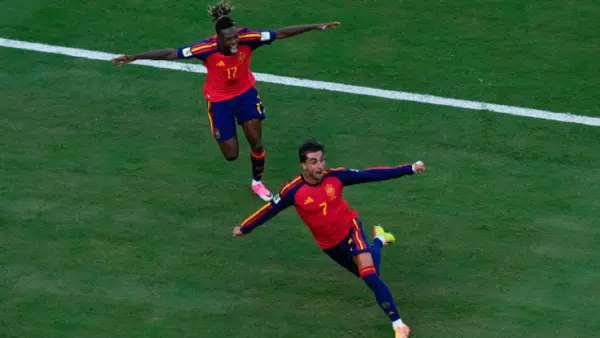
Final of the World Cup. 0-0.
Nahuel Molina glanced over his shoulder. Nico Williams lingered a few yards behind. Should a cross arrive from the opposite flank, Argentina’s right-back assumed he would have it covered.
Molina set himself to meet Pedro Porro’s delivery. Then came the chill. Williams was no longer behind him. He was in front.
Molina had been beaten by the sprint.
It is what Williams does. Second among Spaniards on top speed, third on number of sprints per 90 minutes.
He scores, creates, dribbles and dances. Mostly, though, he runs.
He runs because two others once walked.
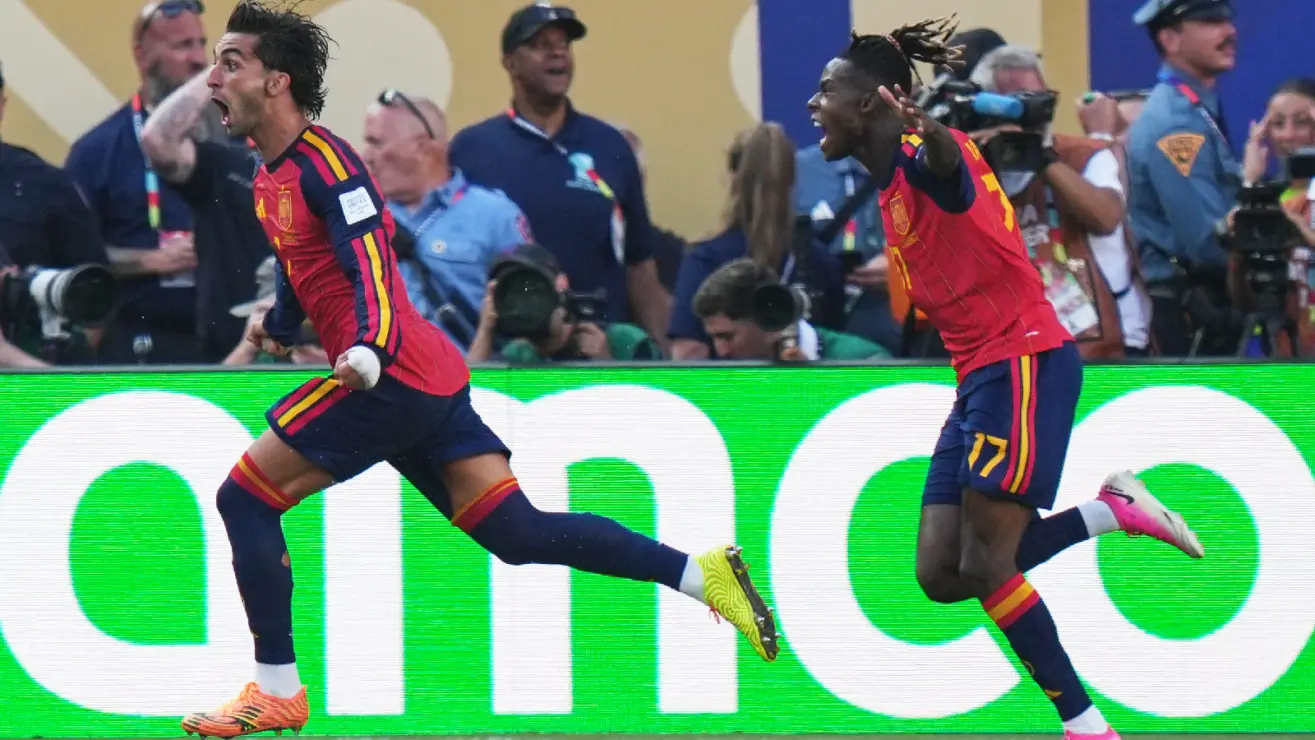 Spain’s Ferran Torres, left, and Nico Williams (17) celebrate after scored the winning goal in the World Cup final soccer match between Spain and Argentina in East Rutherford, N.J., near New York, Sunday, July 19, 2026. (AP Photo/Stephanie Scarbrough)
***
1994. Akim Oda, eastern Ghana.
Maria Comfort Arthur and Felix Williams wanted a life their jobs – hairdresser and electrician respectively – could not provide. England, they had learned, was a thriving hub for Ghanaian immigrants – Haringey, Southwark, Croydon.
“Go to Spain instead,” suggested a friend. “It’ll be a lot cheaper.”
Cheaper, it was. What they were not told, however, was the excruciating pain their 5,000-kilometre journey entailed. They would cross most of the Sahara Desert on foot. Temperatures touched 50°C. If sand could melt flesh and char bones, it would.
Nico always knew his father limped. Only later did he learn the injury originated in that desert.
Maria, three months pregnant with her elder son, Inaki, was convinced she would not make it to Spain. Along the path that crossed five nations – Burkina Faso, Niger, Algeria, Morocco, and finally, Spain – she would bury – literally, not metaphorically – many friends. In the hunt for a better life, many sacrificed the one they had.
She did, however, make it to Melilla – the autonomous Spanish city nestled in Morocco. Only to be caught by the civil guards. There would not have been a Spanish fairytale without the lawyer who suggested the Williams destroy every document that could trace them back to Ghana, and claim they had fled the Liberian civil war. Only this way would they be eligible to seek asylum.
Felix found work in a chicken slaughterhouse. Maria took whatever jobs she could – pizzeria, supermarket, airport. Inaki would become Athletic Bilbao’s first Black star, and Nico one of the brightest talents the nation has ever produced.
The talent was displayed at the Euros. A goal in the final against England. This World Cup had been crueller – predominantly owing to injuries. Sports hernia at the start of the season, hamstring issues towards the end, and then a contact injury in the World Cup game against Uruguay.
“Today is one of the worst days of my life,” he had said after the game, disconsolate. Sunday was one of his best.
***
105:33. New Jersey.
The angle was acute when Williams met Pedro Porro’s cross, but the rare opportunity of being a national hero at 24 beckoned. Seductive as it was, he – perhaps to the surprise of Argentine goalkeeper Emiliano Martinez – laid off his header in the direction from where the ball had come.
Growing up, Williams had been raised on one maxim. It was his mother Maria’s favourite saying, the one Iñaki has tattooed on his arm.
“If you want to go fast, go alone; if you want to go far, go together.”
Heroes are usually remembered for choosing themselves.
Williams chose the better option. Ferran Torres.
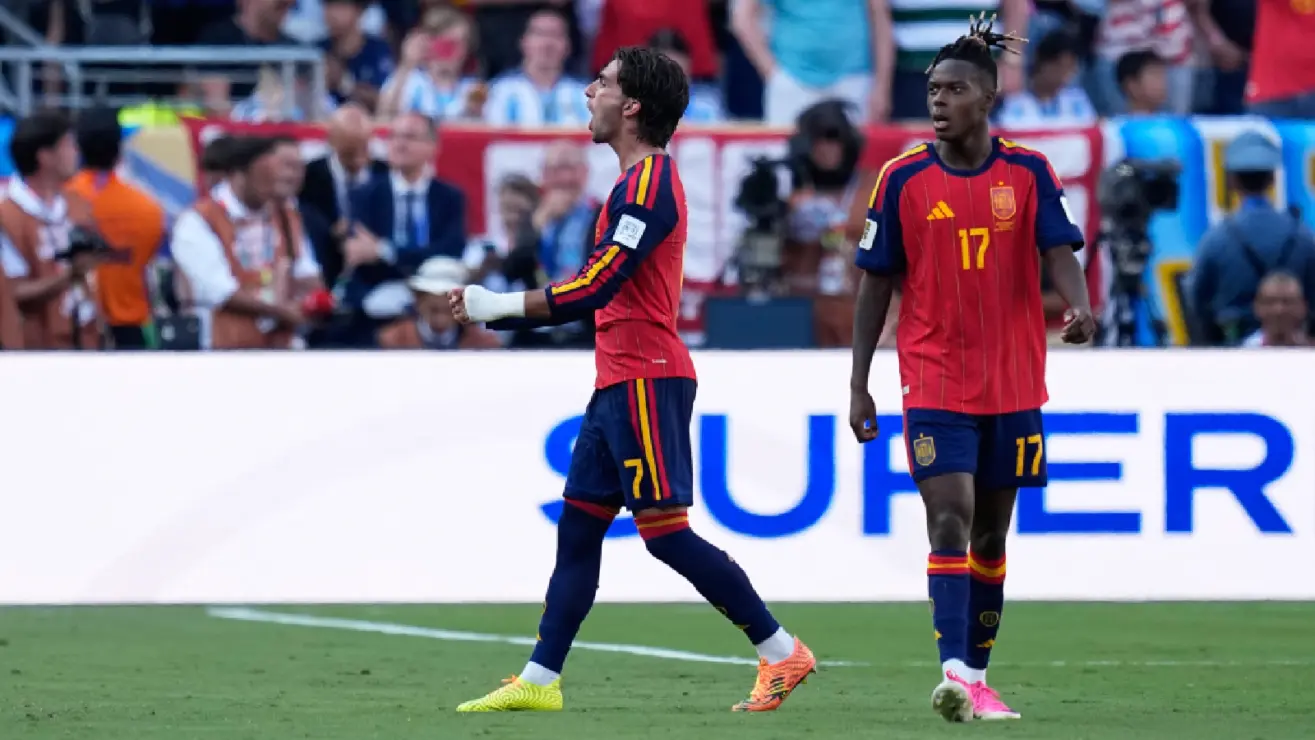 Spain’s Ferran Torres, left, celebrates next to Nico Williams after scoring the opening goal during the World Cup final soccer match between Spain and Argentina in East Rutherford, N.J., near New York, Sunday, July 19, 2026. (AP Photo/Ashley Landis)
***
2024. Barcelona, northeastern Spain.
A rare season without a trophy. A 4-1 El Clasico defeat in the Supercopa de España. Same scoreline against Paris Saint-Germain in the Champions League.
When seasons unravel at Barcelona, blame rarely remains unclaimed. Ferran Torres became its custodian.
Signed for €65 million when the club could scarcely afford such extravagance, he had scored only 25 goals in his first 113 appearances. 0.22 per game.
The vitriol was relentless. Social media became a conveyor belt of ridicule. Torres muted much of it, but not enough. He did not want to play football anymore. The joy had left him, and all that was left was an existential burden.
“I fell into a bottomless pit; I didn’t know how to get out. I was at a place where I had lost all confidence in my abilities. When you’re in that place, you have no desire to do anything. I even lost the joy of playing football.”
Torres sought therapy.
Wait, a psychologist? Is football – the male variant, at least – not supposed to be all about machismo, masculinity, bravado? Why could Ferran not smash into someone to feel better, as Roy Keane would have it?
He never cared enough about stigma. Equally unashamedly, he declared himself a Swiftie, once naming Taylor Swift’s Blank Space among his favourite songs.
‘Oh my God, look at that face // You look like my next mistake.’
One could imagine Keane, if he were to discover these lyrics, twitching his eyebrows.
The sessions helped. In the next two seasons, he would score 40 goals in 94 matches. 0.43 per game.
“This (seeking a psychologist) should not be a taboo subject. I don’t go to a psychologist because I am sick. I go to get a perspective outside of my family and inner circle, and to vent. Sometimes, letting your feelings out sets you free.”
***
105:36. New Jersey.
Torres’ shot nestled into the roof of the net. Spain has the second star on the jersey – courtesy of their two stars.
One – a self-proclaimed ‘citizen of the world’ – broke the shackles of geographical borders. The other broke the shackles inside his mind.