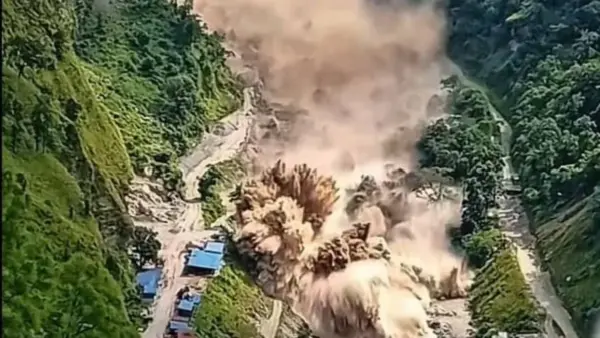
What was a devastating flash flood in Nepal has now turned into a global climate debate. The flood killed more than 1,000 people and caused extensive damage across the Himalayan country.
But Kathmandu is now arguing that the cost of such disasters should not fall entirely on vulnerable countries like Nepal.
Nepal’s foreign minister has said major greenhouse gas emitters should bear greater responsibility for the consequences of climate change. At the same time, the government has approached an international climate fund for financial assistance.
But there is an important complication: scientists have not yet established that climate change directly caused the mountain collapse that triggered the disaster.
How The Disaster Unfolded
The tragic event started in the Himalayas on August 26 when an amount of rock and ice fell off in the region near the border between Nepal and Tibet.
The material flowed down into the Lhende Khola and further on to the Bhotekoshi and Trishuli river basins.
The ensuing flood brought water, stones, mud and other debris to the downstream territories, bringing destruction.
Nepal’s Department of Hydrology and Meteorology claims that according to satellite pictures supplied by the Chinese side, there could be more than one mountain hazard at work here.
Namely, senior divisional hydrologist Binod Parajuli says it was an ice avalanche, permafrost and a rockslide.
That is why the disaster was not just a typical river flood.
Nepal’s Death Toll And Damage
The number of casualties has been high.
According to Nepal Police, there have been 1,066 deaths and about 4,606 people missing as of Wednesday, though the casualties are not the same reported by China. In addition, the floods have caused damages to houses, roads, bridges, and critical infrastructure including hydroelectric facilities.
The damage will have a huge cost for Nepal, which is a country that has scarce resources compared to other leading economies of the world.
Nepal’s Finance Minister Swarnim Wagle has put the cost of reconstruction at about $4-$5 billion.
Nepal’s Argument: Those Who Pollute More Should Pay More
The Nepalese government feels that it is impossible to see the disaster in isolation as a national crisis alone.
The foreign minister of Nepal, Shisir Khanal, feels that countries like the US, China, and India have been responsible for global carbon emissions much more than Nepal.
This is the view of climate justice that he is following, which means that the countries which are less responsible for global warming should not face the entire costs in case of climate risk to their nation.
According to him, Nepal is looking forward to moving from its previous traditional concept of simply asking richer nations for help.
But Did Climate Change Cause This Particular Disaster?
This is no question that Global warming is a reason for devastation, but the Nepal floods has no scientific evidence that global warming is changing the Himalayan environment.
There is strong scientific evidence that global warming is changing the Himalayan environment. Rising temperatures are affecting glaciers, snow cover and frozen ground at high elevations.
However, that does not mean every glacier collapse or landslide can automatically be attributed to climate change.
The August disaster appears to have involved several forces, including ice, rock and permafrost. Researchers still need to establish how much each factor contributed to the collapse.
An assessment by the Stimson Center has suggested that warming at high elevations could have weakened the glacier and surrounding rock. However, it also cautioned that climate change should not be treated as the only explanation for such a complex event.
Why Mountain Disasters Are Difficult To Attribute
Extreme weather events and the impact of climate change on them can be studied quite easily by scientists nowadays.
In the case of a heat wave, for instance, it is possible to make conclusions concerning the role of global warming based on comparisons with temperature measurements throughout history.
However, a collapsed mountain is much more difficult to investigate.
Scientists have to evaluate the condition of the glacier itself, its rocks, permafrost temperatures, precipitation rates, movement of the slope and many other geological aspects.
The key point is to understand their interrelations before the collapse happened.
It takes significantly more time to investigate such an event.
Earthquakes Add Another Layer Of Complexity
The Himalayas are naturally prone to landslides, avalanches and other geological hazards.
Nepal’s experience after the 2015 Gorkha earthquake is a reminder of how quickly seismic activity can destabilise mountain slopes. The earthquake triggered major avalanches and landslides in several parts of the Himalayas.
This does not prove that an earthquake played a role in the August disaster.
But it highlights why researchers have to consider several possible causes before reaching a firm conclusion about what made the particular slope collapse.
Nepal Has Already Approached The Loss And Damage Fund
Finance Minister Swarnim Wagle and Forest and Environment Minister Geeta Chaudhary have sent a request to the board of the Fund for Responding to Loss and Damage.
The government has argued that the disaster is exceptional and that the scale of the damage is beyond Nepal’s ability to handle alone.
The request is important because the Loss and Damage Fund is designed to help vulnerable developing countries deal with climate-related impacts that cannot simply be prevented through adaptation.
Nepal is therefore seeking to use an existing international climate-finance mechanism rather than waiting for the entire scientific debate to be settled.
Aid And Compensation Are Two Different Questions
Nepal’s position also needs to be understood on two separate levels.
The first is immediate humanitarian assistance.
After the floods, India and China provided technical support, including personnel and aerial reconnaissance. Nepal has publicly acknowledged this assistance.
The second is long-term climate finance and compensation.
That argument is much more difficult because it involves questions about scientific attribution, international climate-finance rules and responsibility for global emissions.