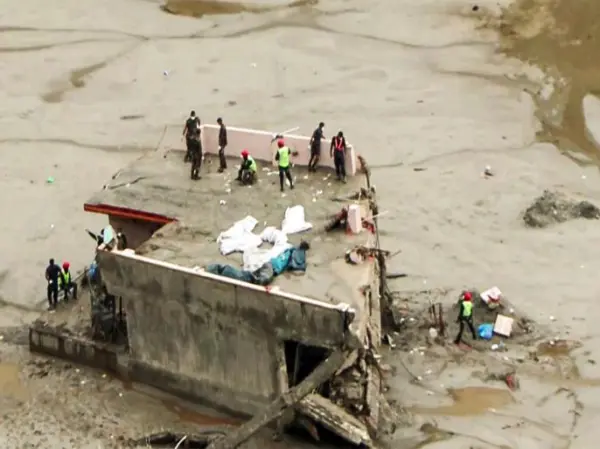
Kathmandu [Nepal], September 1 : The death toll from the devastating flash flood in Nepal has reached 1,003, according to an official update released by the National Disaster Risk Reduction and Management Authority (NDRRMA) as of 1 PM on Tuesday.
The recovered bodies, which include unidentified human remains, have been found across eight districts: 321 in Chitwan, 216 in Nawalparasi East, 170 in Nawalparasi West, 95 in Nuwakot, 65 in Gorkha, 57 in Dhading, 41 in Rasuwa, and 38 in Tanahun. To manage unidentified remains, bodies have been transferred to 21 hospitals across various districts, with details posted on official government web portals and social media channels.
The report highlights that 3,916 people remain missing following the disaster. Local administrative reports indicate that 1,558 people are missing in Nuwakot and 865 in Rasuwa, alongside 639 workers from hydropower projects, 583 foreign nationals, and 164 Nepali citizens traveling with foreign groups.
Missing security and administrative personnel include 45 members of the Nepal Army, 25 from the Nepal Police, 13 from the Armed Police Force, 15 from the Customs Office, and three each from the Immigration Office, Langtang National Park, and the Quarantine Office.
Large-scale rescue operations have successfully saved 11,884 people to date. Aerial rescue operations conducted by the Nepal Army account for 3,782 evacuated individuals, including 273 foreigners and 3,509 Nepalis. The Nepal Army has completed 592 helicopter flights, including 41 on September 1 alone, while private sector operators from Kathmandu have completed 29 flights. A total of 279 individuals were reported injured, with 168 already discharged from hospitals and 2,740 receiving medical treatment from Nepal Army medical teams.
Additionally, NDRRMA outlined critical response developments across flood-devastated regions, detailing high-risk subterranean search-and-rescue operations at hydropower sites alongside ongoing transport corridor repairs.
Specialised teams comprising Nepal Army personnel, the Armed Police Force, and Nepal Electricity Authority staff, supported by international experts, continue complex operations inside flooded tunnels. At the Trishuli 3-A Hydropower Project, a 90-person crew located the Crown Head section and cleared 10 meters of mud, but heavy water discharge from an initial test drill forced personnel to drill at a secondary location to gain safe access. At Trishuli 3-B, an excavator was airlifted via helicopter to support a 47-member search force.
Search teams led by Nepal Army officers and foreign experts penetrated 300 meters into the Haku tunnel head and 250 meters into the Mailung tunnel tail at Upper Trishuli 1, navigating through 3 to 4 meters of dense, swampy mud. Specialised Collapsed Structure Search and Rescue units reached 57 meters inside the Chilime facility, while additional teams extended searches 200 meters into Rasuwagadhi and 150 meters into the Langtang project tunnels. Across hard-to-reach terrain, Nepal Army ground forces remain active across seven dedicated zones in Nuwakot district, supported by 18 helicopter shuttle flights focused on rescue and extraction.
Significant efforts are also underway to restore destroyed transport links and infrastructure. Road crews are clearing debris and conducting repairs on the large river bridge along the Galchhi-Devighat corridor, while technical surveys have commenced for a replacement Bailey bridge after the Tadi River structure was swept away.
Clearance crews have advanced past the cliff zone near Dhunge Bazar toward Betrawati, though a 300-meter section of the remaining 2.8 km stretch was completely washed away, leaving the river flowing through the former roadbed and forcing teams to map alternative bypasses.
To sustain essential traffic and movement, authorities have opened several alternative access routes. Light vehicles are operating along the Bahunbesi-Lachyang-Parchyang-Dhunche route as well as the Betrawati-Rasuwa bypass via Dhikure, Phedibesi, Chogate, and Borembhyang.
Standard traffic continues along the Bidur-Chogate, Borembhyang-Lachyang-Jirokilo-Dhubbesi stretch and the Koloni-Buddhasinghghat road. Meanwhile, heavy machinery supplied by Bidur Municipality is clearing the Bidur-11 Thapatar-Betrawati section, with additional clearance initiatives underway to reopen the Chogate-Borembhyang-Dandadhara-Patikharka route for heavy transport.
NDRRMA noted that a force of 21,314 security personnel is deployed across the disaster zone, comprising 9,199 from the Nepal Army, 7,912 from the Nepal Police, and 4,203 from the Armed Police Force. Emergency relief materials are moving continuously into affected areas, with 37 trucks and 37 Bolero vehicles dispatched by road, supplemented by 77 relief flights conducted by the Armed Police Force to locations in Rasuwa and Nuwakot, plus nine additional helicopter deliveries. To provide temporary support, 3,453 displaced citizens are staying in holding centers located in Nuwakot, Rasuwa, Kathmandu, and Dhading.
Financial aid from the Government of Nepal includes NPR 10 million each allocated to Rasuwa and Nuwakot, NPR 5 million to Dhading, and NPR 67.5 million distributed among 15 affected local governments. Essential services and supplies are steadily being restored in the disaster zone. Nepal Telecom has made all 110 damaged towers operational, while Ncell has restored 75 of its 78 damaged towers. Fuel stocks in the region stand at 42,000 litres of diesel, 18,000 litres of petrol, and 6,000 litres of aviation fuel.