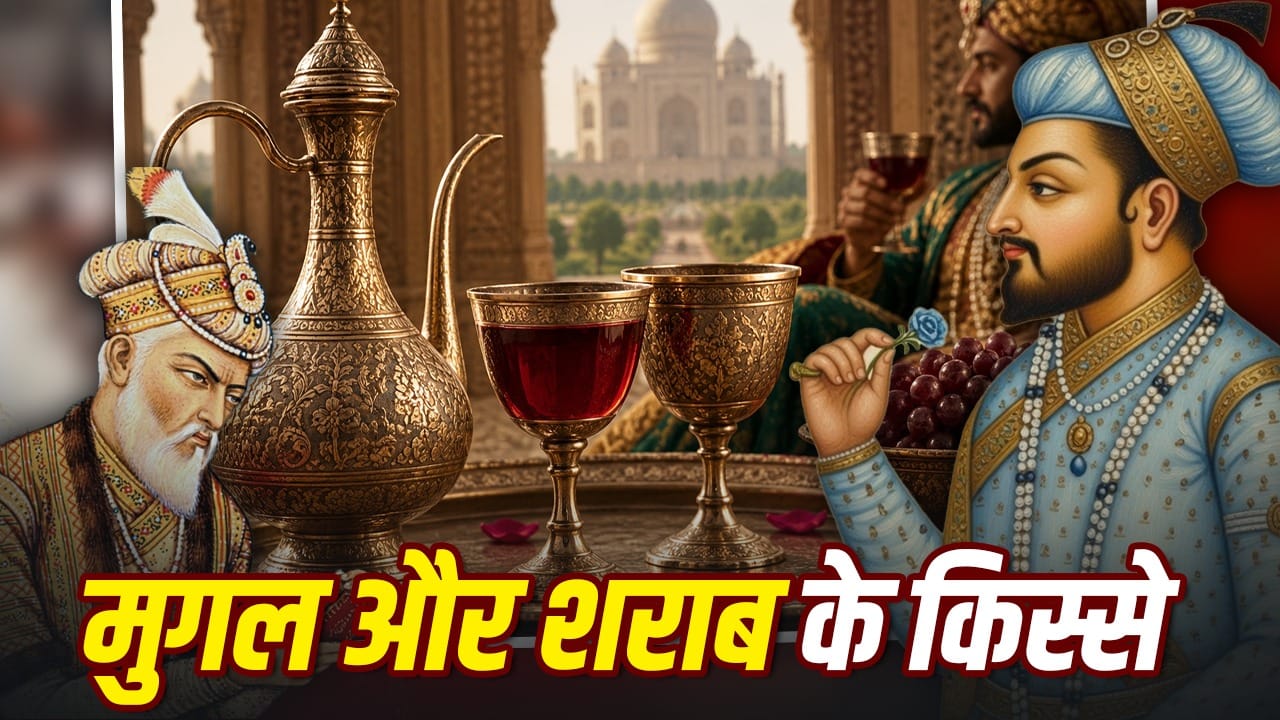
During the Mughal era, there were several attempts to ban liquor.
Apart from Aurangzeb, no Mughal emperor abstained from alcohol. But interestingly, many of them made efforts to ban liquor during their rule. Even Jahangir, who was usually intoxicated with alcohol and opium, issued orders to stop it. It is a different matter that they failed in this. Even the failures of Aurangzeb’s government, who is remembered for his strictness and autocracy, include the decision to ban liquor.
On one occasion he had said in irritation, “There are only two people in India who have abstained from alcohol – one is himself and the other is Qazi-e-Mumalik Abdul Wahab.” However, Qazi was also not behind in this hobby. It is a different matter that in front of the king, he was successful in maintaining the image of the Ulema who was a follower of Islam and considered alcohol prohibited. Read some stories related to the thinking of Mughal emperors regarding alcohol.
Used to drink himself and stopped others!
This is an interesting paradox of Mughal history. Many Mughal emperors used to drink heavily. Alcohol and opium became the cause of fatal diseases of some people. Many princes remained so engrossed in its intoxication that at a young age they either became incapable of anything or retired from the world. But even the drinking king was not unaware of its dangers and disadvantages. Despite drinking himself, he kept trying to keep Riya away from it. Apart from the concern for people’s health, problems in maintaining law and order and peace in public places, there were also religious ideals behind this. To deal with the challenge of creating ruckus after drinking alcohol especially on festive occasions and small disputes turning into major conflicts, orders for restrictions were issued from time to time. But in practice they were ineffective.

Alcohol and opium were the causes of fatal diseases of many Mughal emperors. Photo: AI Generated
When Babar repented
Babar, who laid the foundation of the Mughal Empire in India, has openly described his addiction to drinking alcohol in his autobiography “Baburnama”. In this he has mentioned about alcohol gatherings at many places, gatherings with friends and the effects of intoxication. But before the battle of Khanwa in 1527, there was a big change in Babar’s thinking regarding alcohol. He decided that he would not drink anymore. He did not stop here. All the expensive liquor standards were broken.

Mughal emperor Babar.
In the next step, he appealed to the officers and soldiers of his army to give up alcohol. His appeal was immediately effective, because before he could stop others, he himself had abstained from alcohol. Historians are of the opinion that this decision proved helpful in boosting the enthusiasm and morale of the army from a religious point of view. Historians Stanley Lane-Pool and S. M. Jafar has considered this as the turning point of Babar’s life.
Akbar: Drink a little – but not everywhere!
In the pages of history, there is more mention of the use of opium among Humayun’s hobbies than alcohol. But there is no mention of any effort being made to ban liquor during his brief reign. Akbar, the most successful emperor of the Mughal dynasty, did not shy away from alcohol but he was not a heavy drinker. Abul Fazl has written in Ain-e-Akbari that he was in favor of restraint. Akbar did not impose a complete ban on alcohol. But several measures were taken to limit its use. In this case, liquor was sold under license. Sale allowed at fewer places in the capital.

Mughal emperor Akbar. Photo: Getty Images
Strict action was taken with the intention of discouraging public intoxication. It was considered bad form to reach the court drunk. Historian Irfan Habib writes that Akbar’s aim was not complete prohibition but social control over its use.
Prohibition of alcohol was one of the initial orders of drunkard Jahangir.
Among the Mughal emperors, Jahangir is discussed the most in the matter of drug addiction. Due to her addiction to alcohol and opium, the reins of her rule usually remained in the hands of Mallika Noorjahan. In his autobiography Tuzuk-e-Jahangiri, he has confessed that in his youth he used to drink about twenty cups of alcohol every day.
He wrote, “I started drinking alcohol at the age of eighteen and the quantity increased so much that I started drinking several cups day and night.” He further admits that when his health deteriorated, he reduced alcohol consumption and started taking opium on the advice of doctors.

Jahangir.
Of course, he claimed that later he reduced its quantity to five cups, but many other historians do not agree that he ever reduced his drinking. It is interesting that Jahangir, who himself was a heavy drug addict, issued his famous twelve orders while ascending the throne, one of which was to ban the manufacture and sale of liquor and other intoxicants.
Historian Dr. Beni Prasad has written that this order was more of a moral ideal and had nothing to do with practicality. Jahangir admitted in his autobiography that he could not give up alcohol completely. In the opinion of many historians, excessive alcohol and opium use had a very bad effect on his health and was a major reason for his untimely death.
Shahjahan: No abstinence – not too much
Unlike his father Jahangir, Shahjahan was restrained regarding alcohol. He drank but was not drunk all the time like his father. The French traveler François Bernier, who was in India during Shah Jahan’s last years, writes, “Shah Jahan was not a slave to alcohol like his father Jahangir. He drank alcohol occasionally, but with utmost moderation.”
Italian traveler Nicolao Manucci has written that Shah Jahan was certainly a lover of luxury, but did not indulge in excessive drinking. Historian Satish Chandra has also written in his book Medieval India while comparing Jahangir and Shahjahan that Shahjahan was relatively more restrained in his personal life. But Shahjahan, like his father Jahangir, did not issue any order for prohibition at the government level.

Emperor Shahjahan.
There is no surviving royal decree from his reign that imposed a general ban on the manufacture, sale and consumption of liquor throughout the empire. Although Shah Jahan was a ruler who personally followed Sunni Islamic values. Therefore he did not encourage the trade and open consumption of liquor in public. Historians indicate that there was an emphasis on moral discipline in Shahjahan’s rule, but he did not adopt a comprehensive religious policy like his son Aurangzeb. Liquor was available to foreign traders in his court.
Prohibition of liquor was also among the failures of Aurangzeb.
Among the Mughal emperors, Aurangzeb tried to ban alcohol and public trade in other intoxicating substances. Unlike his ancestors, he stayed away from drug addiction. As a ruler, he wanted to take Riya to his own path in this matter, in this hope, after 1658, he tried to ban the public trade of liquor, cannabis and intoxicants by issuing several decrees. However, it generally failed in its implementation. According to the French traveler Bernier, both the pagans (Hindu) and the followers of Mohammed (Islam) have declared alcohol as haram.

Mughal emperor Aurangzeb.
Of course, it remained a bit difficult to find him in Delhi. But despite this, alcohol addiction remained uncontrolled in India. Aurangzeb banned the sale of liquor in many places. Action was taken against public drinking. Muhatsib (moral inspectors) were appointed who kept a watch on liquor, gambling etc. Bernier and Manucci have written that despite the restrictions, the clandestine trade in alcohol continued and alcohol was available in settlements.
Qazi is also not behind!
According to historians, effective administrative control over liquor and other intoxicants was difficult in the vast empire. The prevalence of alcohol was widespread in the army and the rich class. There was a continuous supply of liquor by foreign traders. Country liquor distilleries continued to operate at the local level. Obviously, in such circumstances, despite the King’s wishes, the percentage of success in prohibition of alcohol and other drugs remained marginal.
According to a British ambassador, Asad Khan, who was Aurangzeb’s Vizier-e-Khas from 1676 to 1707, and other officials of the court used to crave for alcohol every day. Nouris wrote that he sent liquor and especially scales to Assad. Aurangzeb himself had abstained from alcohol and other intoxicants, so he expected the imperial officers to follow in his footsteps. But when he felt disappointed in this matter, on one occasion he said in irritation, “There are only two people in India who have abstained from alcohol. One is himself and the other is Qazi-e-Mumalik Abdul Wahab.” However, Qazi was also not behind in this hobby.
It is a different matter that the Qazi was successful in maintaining his image in front of the Emperor as a follower of Islam and an Ulema who considered alcohol prohibited. Italian traveler Nicolao Manucci wrote, “The emperor made a mistake by taking the name of Qazi Abdul Wahab, because I myself used to send him bottles of cheap quality liquor every day. He drank it with such secrecy that the emperor did not even get a clue.”
Also read: Neither father’s love nor rights, why did Aurangzeb become Shahjahan’s enemy?