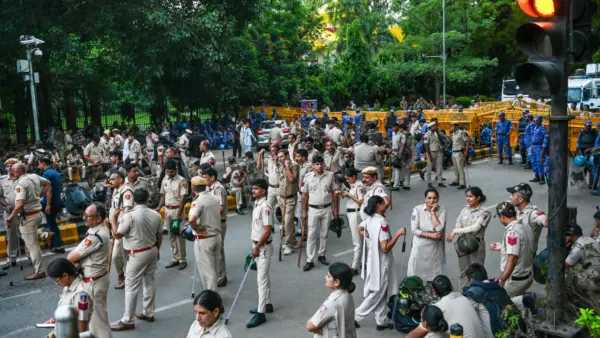
New Delhi: All Standard Operating Procedures (SOPs) and anti-riot drills were during the police action against protesters demonstrating against the NEET paper leak on July 20, according to the CRPF’s post-incident analysis report.
The report also includes the authorized use of non-lethal measures such as pellet guns. As per a Times of India report citing sources, a detailed review of the actions taken by the CRPF’s anti-riot unit, the Rapid Action Force (RAF), found that the prescribed use-of-force protocol (force gradient) was adhered to. It stated that pump-action guns were used only after lower-intensity crowd-control measures-including public announcements, tear gas, and lathi-charge-failed to disperse the crowd.
Three to Five Protesters, 47 RAF Personnel Injured
Around three to five protesters sustained injuries from metal pellets. Meanwhile, 47 personnel of the Rapid Action Force (RAF) were also injured, including six who suffered head injuries. CRPF Director General G. P. Singh said the matter is currently sub judice and that any report or findings by the force regarding the RAF’s actions will be placed before the Supreme Court.
As per the RAF sources, the use of force on July 20 was carried out with the approval of the Delhi Police and was in accordance with the Standard Operating Procedures (SOPs) and the law.
Here are some of the key details:
- The reports state that the crowd included certain instigators who allegedly attacked Delhi Police and RAF personnel by pelting stones and, in some cases, using iron railings.
- Under the BNSS, an executive magistrate may order the use of civil force to disperse an unlawful assembly after carefully assessing the situation.
- In Delhi, this authority rests with the Commissioner of Police and is delegated to officers up to the rank of Assistant Commissioner of Police (ACP).
An official said, “RAF personnel deployed at protest sites use riot-control equipment only after receiving authorization. In this case, the approval was granted by the DCP/ACP in charge of the protest site. Such approval is always issued in writing and follows the prescribed format used for unlawful assemblies. No orders are given verbally.”
As per a Dainik Jagran report quoting CRPF sources, the use of pump-action guns is an approved, non-lethal method for controlling unlawful crowds. An officer stated, “These weapons are used strictly in accordance with the SOPs, after obtaining authorization from the competent authority and following the prescribed use-of-force protocol (force gradient).”
While hearing a Public Interest Litigation (PIL) challenging the use of pellet guns in 2016, the High Court of Jammu and Kashmir observed: “As long as an unruly crowd continues to indulge in violence, the use of force remains necessary. The officer in charge at the scene must decide what level and type of force should be used based on the circumstances. This Court, in its writ jurisdiction, cannot determine whether the use of force in a particular incident was excessive without the findings of a competent forum or authority.”
The Supreme Court of India later dismissed a Special Leave Petition (SLP) challenging the High Court’s order, observing:
“If an agency has used pellet guns, these orders neither prohibit such use nor declare it unlawful; rather, they uphold its legality.”