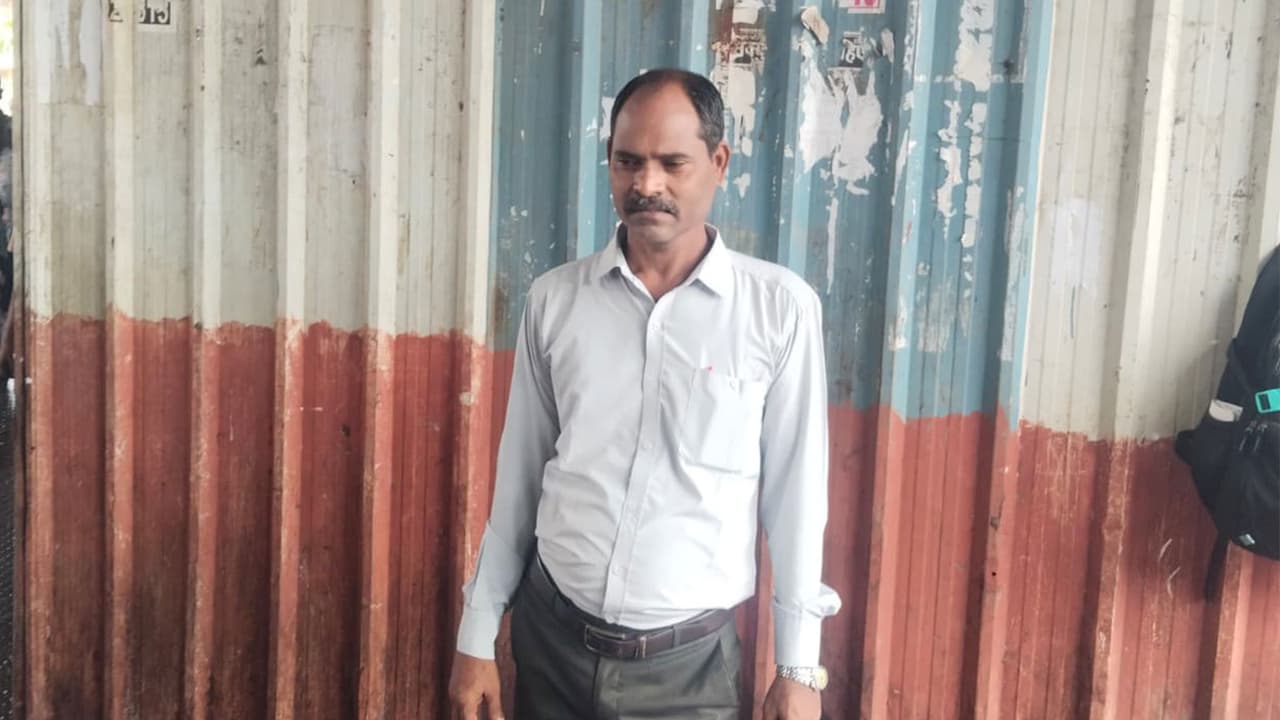
Mumbai’s Narendra Patil helps commuters at Dadar station daily, acting as a ‘human indicator’. In other news, the government has proposed a V2V communication framework to use technology for enhancing road safety and preventing accidents.
Thousands of people travel daily via local trains through Mumbai’s bustling Dadar railway station, often struggling with confusion during peak morning hours. To bridge this gap, a resident named Narendra Patil stands on the Dadar bridge every weekday from 9:30 AM to 11:30 AM, directing passengers toward trains bound for Virar, Borivali, or Churchgate before heading to his job in Mulund.
Narendra Patil stands on the Dadar bridge, guiding passengers who are unsure of their way, whether they need trains bound for Virar or Borivali.
He has been performing this service for about four years, standing there every morning to help commuters with directions.
He stepped into this role because of the lack of proper indicators, effectively becoming a “human indicator.”
Commuters who pass by regularly meet him and praise him for his efforts.
Narendra Patil spends two hours daily on the Dadar bridge guiding travellers before heading to Mulund for his job.
Narendra Patil spends two hours on weekdays at the Dadar Bridge helping travellers find the right platforms and trains doing so since 2022.
Patil helps the confused commuter by showing them the right direction to catch their trains.
Govt Proposes V2V Communication Framework for Road Safety
On the other hand, the Ministry of Road Transport and Highways issued a draft notification proposing amendments to the Central Motor Vehicles Rules, 1989, for the phased implementation of a vehicle-to-vehicle (V2V) communication systems framework aimed at enhancing road safety.
V2V communication enables nearby vehicles to exchange real-time information, including their speed, position, direction, acceleration, etc. “This information can provide warnings to drivers or vehicle systems in safety-critical situations, including sudden braking, forward-collision risk, unsafe lane changes and the approach of emergency vehicles,” the Ministry noted.
According to the proposal, the Department of Telecommunications exempted the required frequency range from licensing requirements through a specific directive. “The 5.875 GHz to 5.925 GHz frequency band has been considered for V2V and other Intelligent Transportation System applications. The Department of Telecommunications, through G.S.R. 466(E) dated 10 June 2026, has exempted the use of this frequency band from licensing requirements,” the Ministry stated.
The framework details how the technology functions beyond current safety setups. “Unlike conventional vehicle-safety systems, which primarily depend on onboard sensors and driver reaction, V2V communication can provide information beyond the direct line of sight. It is therefore expected to complement Advanced Driver Assistance Systems (ADAS) and support proactive accident prevention, connected mobility and future intelligent transport applications,” the Ministry added.
AIS-230 Standard and Use Cases
The AIS-230 standard covers factory-installed On-Board Units using Cellular Vehicle-to-Everything (C-V2X) technology in the 5.875 GHz to 5.925 GHz band. Its principal requirements include radio performance, frequency stability, output-power specifications, receiver sensitivity, Global Navigation Satellite System (GNSS) positioning, electrical requirements, electromagnetic compatibility, cybersecurity provisions, and road-safety application performance.
It provides for safety use cases such as Emergency Brake Alert, Forward Collision Warning, Wrong-way Driving, and Emergency Vehicle Alert.
Regulatory Background and Future Impact
Earlier, a dedicated Task Force constituted by the Ministry recommended using the 5.9 GHz ITS/V2X frequency range for road safety.
The Central Motor Vehicles Rules-Technical Standing Committee later considered the formulation of AIS-230 at its 56th meeting held on 7 May 2026, providing the technical foundation for regulatory implementation.
The proposed framework is expected to improve vehicle situational awareness, facilitate timely safety warnings and strengthen the use of connected technologies for reducing road-accident risks,” the Ministry added.
(Except for the headline, this story has not been edited by Asianetnews Editorial staff and is published from a syndicated feed.)