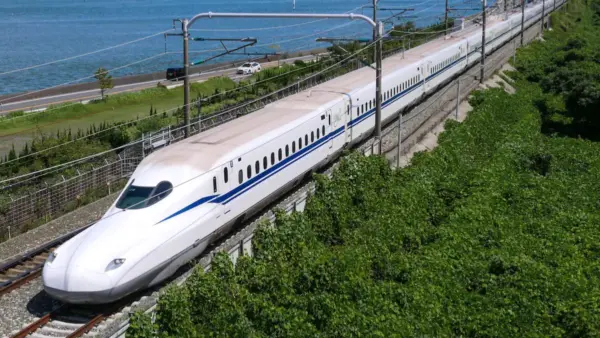
Mumbai-Ahmedabad High-Speed Rail Big update: In a significant economic development, India is nearing completion of its first high-speed rail corridor, the 508-kilometer Mumbai-Ahmedabad High-Speed Rail project.
According to an official statement released on Friday, this flagship venture will establish a standardized template for all future bullet train corridors across the country. Operating at a service speed of 320 kmph, the advanced transit network features 12 planned stations, slashing total travel time to approximately 1 hour and 58 minutes, with the first phase between Surat and Vapi scheduled for an August 2027 launch.
Details on Mumbai-Ahmedabad High-Speed Rail
The infrastructure breakthrough relies heavily on a design speed of 350 kmph, which is fully supported by cutting-edge rolling stock, modernized signaling, and precise train control systems. By successfully introducing this high-tier technological framework to the domestic transport sector, the government aims to revolutionize regional connectivity and establish a robust blueprint for future expansions.
How will Mumbai-Ahmedabad High-Speed Rail project help India?
The Mumbai-Ahmedabad High-Speed Rail project is creating the knowledge, capabilities and industrial ecosystem needed for future expansion, the government said.
“It is establishing a scalable approach for future high-speed rail expansion. As new corridors are developed, this foundation will help enhance connectivity. It will also help reduce travel times and contribute to long-term economic growth,” the statement said. Seven high-speed rail corridors, covering nearly 4,000 kilometres, have been identified for future development. The proposed network is expected to attract investments of around Rs 16 lakh crore.
Scaling upon a standardised template based on the MAHSR project, aims to implement proven engineering designs, construction methods, and operational practices. It will improve efficiency and accelerate project execution. Unified designs, components, and maintenance procedures will simplify spare-part management, training, and procurement across the network.
Foundations will be designed according to the exact soil characteristics of the spot and the remaining subsystems will follow common engineering standards.
“These include piers, viaducts, tracks, station structures, overhead electrification, and signalling systems. This approach will support faster construction across future corridors and will improve quality and reduce costs across future high-speed rail corridors,” the statement noted.
The Mumbai-Ahmedabad Bullet Train corridor includes 28 planned steel bridges overall. Officials said 14 of the 17 steel bridges planned in Gujarat have now been completed.