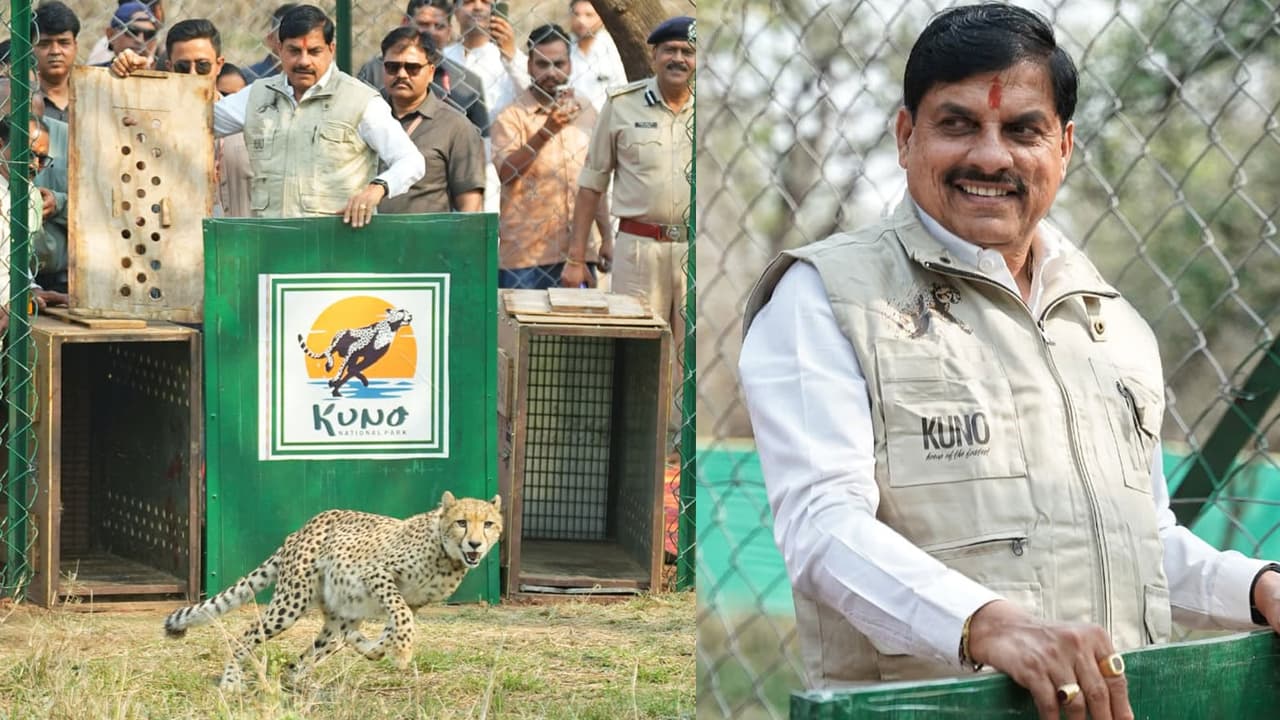
Two female cheetahs brought from Botswana were released into the open forest in Madhya Pradesh’s Kuno National Park. Chief Minister Dr. Mohan Yadav called it a big success of Project Cheetah. The total number of leopards in India has now reached 57.
Bhopal/Sheopur. May 11 was a very special day for wildlife conservation in Madhya Pradesh. Two more female leopards were freed from their enclosure and released into the open forest in Kuno National Park in Sheopur district. As soon as they came out of the enclosure, both the leopards ran towards the forest. Now these leopards will help in strengthening the eco-system of not only Madhya Pradesh but also the surrounding states.
Chief Minister Dr. Mohan Yadav reached Kuno National Park and he himself released these leopards in the open forest. During this, he said that the land of Madhya Pradesh has made leopards a part of its family.
Project Cheetah gets new momentum, number of cheetahs increases
The Chief Minister said that Prime Minister Narendra Modi had started ‘Project Cheetah’ in Kuno about three and a half years ago. Now this project is continuously moving towards success. He said that Madhya Pradesh is continuously making new records in the rehabilitation of cheetahs brought from Namibia, South Africa and now Botswana. Today the state has been recognized as ‘Cheetah State’ across the country. At present the total number of leopards in India has reached 57. Of these, 54 leopards are present in Kuno National Park and 3 in Gandhi Sagar Sanctuary.
Chief Minister Mohan Yadav said – Madhya Pradesh created a new history
Talking to the media after the Kuno tour, Chief Minister Dr. Mohan Yadav said that Madhya Pradesh has created a new history in wildlife conservation. He said that two female cheetahs brought from Botswana have been released into the open environment today. It symbolizes the spirit of coexistence and nature conservation.
Congratulating the people of Sheopur and Chambal region, the Chief Minister said that now the habitat of leopards has spread to about 5 thousand square kilometers. Many times leopards reach Rajasthan while running. He told that leopards are also visible in areas like Chambal, Gwalior, Shivpuri and Rajgarh. This is a matter of pride for the state.
The Chief Minister also praised Prime Minister Narendra Modi, Union Minister Bhupendra Yadav, forest department officials, medical staff and local people. He said that everyone together has played an important role in making Project Cheetah successful.
9 new cheetahs arrived from Botswana, 2 released into the wild
It is noteworthy that at the end of February this year, 9 new cheetahs were brought to Kuno National Park from Botswana. These include 6 female and 3 male leopards. After bringing them to India, all the cheetahs were first kept in quarantine. After this they were shifted to smaller enclosures so that they could adapt themselves to the environment and weather here.
Out of these 9 cheetahs, two female cheetahs have now been released into the open forest. It is believed that this will give new momentum to ‘Project Cheetah’ and another important chapter will be added in India’s wildlife history.
Botswana’s leopards will help in increasing genetic diversity
Wildlife experts believe that the cheetahs from Botswana have brought more genetic diversity. This will help in developing a healthy and long-lasting population of leopards in Kuno. Experts hope that these leopards will soon integrate completely into the environment of Kuno. In future, preparations are being made to settle them in other sanctuaries like Gandhi Sagar and Nauradehi also.
When and from where were leopards brought to India?
The return of cheetahs to India began on 17 September 2022, when 8 cheetahs were brought to Kuno National Park from Namibia. After this, 12 leopards reached India from South Africa in the year 2023. Now new leopards have also been brought from Botswana. He was brought to Gwalior by a special aircraft of the Indian Air Force. From there he was taken to Kuno National Park via helicopter.
The main objective of ‘Project Cheetah’ is to rehabilitate the extinct cheetah species from India, increase their numbers and prepare them to hunt and roam freely.