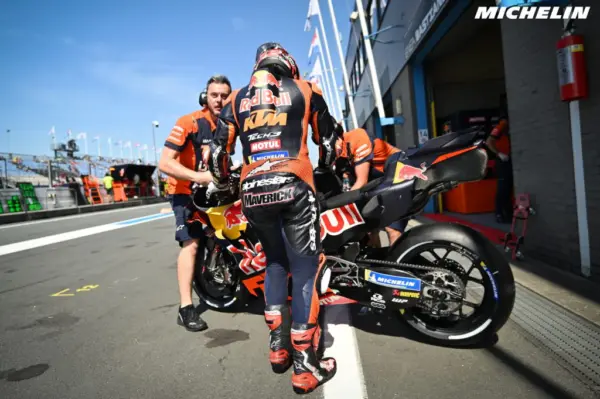
is on the verge of a seismic shake-up: radical new rules could see riders restricted to just one bike for part of race weekends, a move poised to redefine risk, strategy, and the very spectacle of the sport.
The proposal, now under serious review by ‘s decision-makers, aims to limit teams to a single machine during select practice sessions, while keeping the two-bike format for Saturday’s Sprint race and the flagship Sunday events unchanged. This bold idea is designed to cut spiraling costs, boost safety, and put the spotlight squarely on the ‘s most dramatic moments.
For years, teams and fans alike have watched transform, with sprints and back-to-back action pushing both machinery and riders to the edge. Now, as Liberty Media’s stewardship ushers in a new era, the conversation has shifted from mere spectacle to sustainability and safety. The heart of the debate: if a rider crashes on a Friday morning, they won’t be able to leap onto a spare bike and immediately return to the track. That single twist could dramatically alter the risk calculus during less crucial sessions, potentially tempering the all-out aggression that defines ‘s DNA.
Yamaha ‘s General Manager, Paolo Pavesio, has been quick to clarify the situation, dousing rumors of sweeping changes to the race format. “No change to the format of the races is planned,” Pavesio declared, cutting through the noise. “Sprint and will retain two bikes per rider. The reflection concerns only certain practice or preparation sessions.” His words offer reassurance to purists, but the implications of the one-bike concept are far-reaching. For Yamaha, the issue is not just about finances. “We seek to protect the main asset of MotoGP: the riders,” Pavesio explained, signaling that the safety of athletes is paramount as much as the bottom line.
The logic is straightforward yet profound. By restricting access to a backup machine during practice, organizers hope to see fewer laps, a reduction in risky maneuvers, and a sharp focus on qualifying and race-day excellence. Yet, Pavesio is adamant: “No one has decided that MotoGP will move to a single bike. It’s just a line of thought.” The debate remains wide open, a work in progress as weighs its future.
This isn’t happening in a vacuum. Sweeping technical reforms are already set for 2027, including a downsized 850cc engine, stripped-back aerodynamics, and the elimination of controversial ride-height devices-all part of an industry-wide reckoning with the relentless escalation of speed and complexity. “The bikes were becoming too fast for some circuits. Run-off areas are no longer sufficient, and spectators are sometimes too far from the action,” Pavesio stated, emphasizing that this is about clarity and safety, not neutering the thrill.
Ducati’s voice in the debate, Team Manager Davide Tardozzi, echoed the cautious optimism while urging careful consideration. “We have found a compromise, but there are still several months to precisely write the regulations,” Tardozzi said, reiterating that nothing is set in stone. Drawing on four decades of experience, he added, “With forty years’ experience in this paddock, I know that all teams will find solutions.” His pragmatism is grounded in the reality that has weathered countless changes before, adapting and thriving.
A major unresolved question looms over qualifying. Currently, a crash in practice is often a minor hiccup, as riders can hop onto a spare and salvage their session. Under the one-bike trial, a single mistake could derail an entire weekend, especially when it comes to securing a coveted Q2 spot. Tardozzi acknowledged the gravity of the potential shift: “A crash could indeed have more consequences. But every evolution has pros and cons. We’ll need to analyze all situations before making any final decision.”
At its core, this proposed reform is a test of ‘s ability to evolve without losing its soul. The push-and-pull between spectacle, safety, and cost control is at fever pitch. What’s clear is that fans won’t see fundamental changes to the races themselves-Sprints and Grands Prix will remain the crown jewels. But behind the scenes, a strategic revolution is brewing, one that could force teams to manage their machinery and risk-taking with unprecedented care.
Should this rule come to pass, it would reshape ‘s competitive landscape, placing new emphasis on precision, discipline, and calculated aggression. The high-wire act of balancing tradition with innovation is MotoGP’s latest, most unpredictable race-and the entire world of is watching to see who will master it.