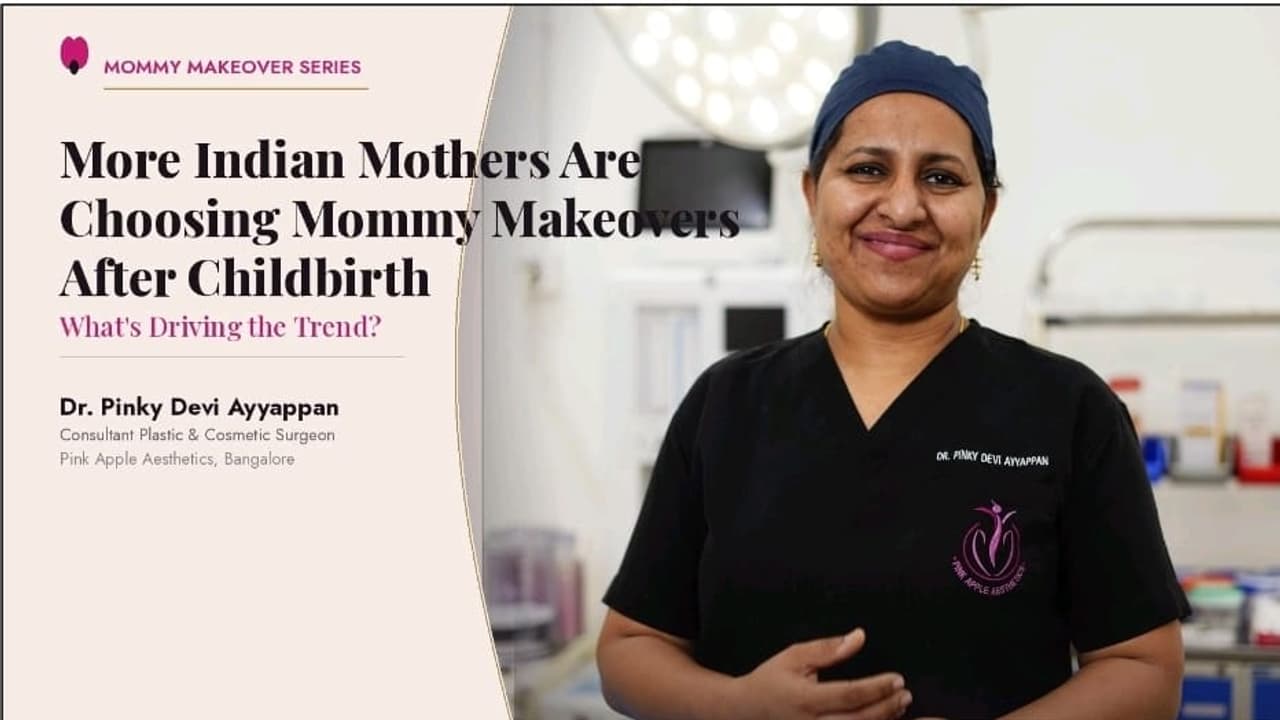
Interest in Mommy Makeovers is rising in urban India as informed, independent mothers seek solutions for post-pregnancy body changes. Combining procedures like tummy tucks and breast lifts, it addresses physical changes beyond diet and exercise, while emphasising safety, realistic expectations, and personalised care.
There is a quiet shift happening in my consultation room, and I suspect it’s happening in clinics across urban India too. Increasingly, the women who walk in are not there for anti-ageing concerns or a pre-wedding glow-up. They are new mothers, often a year or two postpartum, asking a version of the same question: is there something that can be done about the body pregnancy left behind?
The procedure they are often asking about has a name that sounds almost casual for something so clinical — the Mommy Makeover. It isn’t a single surgery but a customised combination of procedures designed to address the specific physical changes that pregnancy and childbirth can bring. And across metros like Bangalore, Mumbai, and Delhi, interest in it appears to be rising steadily, even if the numbers here are still modest compared to more established markets like the United States, where organisations such as the American Society of Plastic Surgeons (ASPS) have tracked the category for years.
This isn’t a story about vanity, in my experience. It’s a story about a generation of Indian women who are more informed, more financially independent, and more willing to talk openly about their post-pregnancy bodies than their mothers ever were.
By Dr. Pinky Devi Ayyappan, Consultant Plastic and Cosmetic Surgeon, Pink Apple Aesthetics, Bangalore
What Pregnancy Actually Does to the Body
Pregnancy is, by any medical measure, a remarkable physiological event. It’s also one that leaves lasting physical changes for many women, regardless of how fit or healthy they were beforehand.
The abdominal skin and muscles stretch considerably to accommodate a growing uterus, and for many women, they don’t fully return to their pre-pregnancy state afterward. A condition called diastasis recti — a separation of the abdominal muscles along the midline — is common, and in some cases persists well beyond the postpartum recovery period.
Breast tissue also undergoes significant change. Volume often shifts during and after breastfeeding, sometimes leading to a loss of fullness or a change in shape and position, commonly described as breast sagging or ptosis. Localised fat deposits, particularly around the abdomen, hips, and flanks, are another frequent concern patients raise with me.
It’s worth being clear about something here: diet and exercise remain genuinely important, both for general health and for supporting recovery after childbirth. But they have limits. Stretched skin, separated muscle, and altered breast tissue do not always respond to lifestyle changes alone, no matter how disciplined the effort. This is a physiological reality, not a reflection of a woman’s willpower.
So, What Exactly Is a Mommy Makeover?
I think of a Mommy Makeover as an umbrella term rather than a fixed protocol. It typically refers to a combination of procedures — commonly a tummy tuck (abdominoplasty), breast lift (mastopexy), breast augmentation, liposuction and vaginal tightening — tailored to what an individual patient actually needs.
That word “individual” matters enormously to me. Not every woman requires all four procedures. Some may need only a tummy tuck to address abdominal skin and muscle separation. Others may be more concerned with breast volume or shape and opt for a lift alone, with or without augmentation. The combination, sequencing, and even whether surgery is done in a single session or staged across multiple procedures, depends entirely on my assessment of the patient’s anatomy, health status, and goals.
Why the Interest Is Growing Now
A few converging factors seem to explain why this conversation is louder today than it was a decade ago.
Access to information is probably the biggest one. Women today research procedures extensively online before ever booking a consultation, and are far more likely to arrive already familiar with terms like diastasis recti or mastopexy than patients were even five years ago.
Surgical technique has also evolved. Advances in anaesthesia protocols, minimally invasive liposuction methods, and post-operative pain management have made recovery more predictable than it once was, though it still requires real downtime and should never be assumed to be quick or effortless.
Financing options have expanded too, with many clinics, including my own, now offering structured payment plans that make elective procedures more accessible to middle-income patients, not just the affluent few.
Perhaps most significantly, there is a broader cultural shift underway. Aesthetic treatments that were once discussed in hushed tones are now openly covered in mainstream lifestyle media.
And many women, having spent years prioritising a child’s needs, are beginning to view post-pregnancy body concerns as a legitimate form of self-care rather than an indulgence.
Separating Myths from Reality
Given how quickly this topic has entered mainstream conversation, misconceptions have kept pace. A few deserve to be addressed directly.
Myth: Mommy Makeovers are only for celebrities. Reality: While celebrity disclosures have brought visibility to the procedure, the patients I see span a wide range of professions, income levels, and backgrounds.
Myth: Surgery is a substitute for diet and exercise. Reality: It isn’t. Surgery addresses structural changes — loose skin, separated muscle, deflated breast tissue — that exercise cannot reverse. It works best as a complement to, not a replacement for, an already healthy lifestyle.
Myth: Recovery is always long and difficult. Reality: Recovery timelines vary considerably depending on which procedures are combined and an individual’s healing response. It is rarely instant, but it is also not uniformly prolonged for every patient.
Myth: Every patient undergoes the same set of procedures. Reality: As I mentioned earlier, the entire premise of a Mommy Makeover is customisation. Two women with the same broad concerns may end up with entirely different surgical plans.
What I Hear in the Consultation Room
What strikes me most these days is that women aren’t walking in with unrealistic expectations anymore. They’ve done their research before they ever sit down across from me. They understand this isn’t about looking a certain way overnight — it’s about addressing specific changes that simply didn’t resolve on their own, no matter how hard they worked at it.
A large part of any consultation, honestly, is spent explaining what surgery cannot do. Patients often assume a tummy tuck will also help them lose significant weight, and I have to be upfront that this isn’t what the procedure is designed for. Setting that expectation early on tends to matter more for long-term satisfaction than almost anything else we discuss.
If there’s one thing I repeat often, it’s this: the best outcome isn’t the most dramatic one. It’s the one that’s appropriate for a woman’s body, her anatomy, and what she’s actually hoping to feel better about. That conversation — about realistic, individual goals — matters more to me than any single procedure we eventually settle on.
A Word on Safety
Because a Mommy Makeover often involves combining multiple procedures, patient safety considerations are central to how I approach planning. I typically look for a stable body weight before proceeding, since significant weight fluctuation after surgery can affect results.
Completion of breastfeeding is generally advised beforehand, both for breast-related procedures and for overall recovery.
A thorough health assessment — covering everything from prior medical history to current fitness for surgery and anaesthesia — is a standard part of individualised surgical planning in my practice. This is also why consulting a qualified, board-certified plastic surgeon, rather than a general practitioner offering cosmetic add-ons, is considered essential by professional surgical bodies. None of this replaces a proper in-person consultation, where a surgeon can assess a patient’s specific anatomy and health profile.
About Pink Apple Aesthetics
I run Pink Apple Aesthetics in Bangalore, where a meaningful share of my practice today involves post-pregnancy consultations of exactly this kind. Over time, I’ve come to see this as a distinct area of care rather than a subset of general cosmetic surgery — one that requires a different kind of conversation, since patients are often navigating new motherhood, body image, and practical questions about recovery time alongside their surgical decision.
My approach with these patients starts well before any discussion of procedures. It begins with understanding what has actually changed physically, what a patient’s health history and breastfeeding timeline look like, and what she is hoping to feel better about — rather than assuming every new mother wants the same outcome. Some patients leave a consultation deciding to wait another year. Others proceed with a single procedure rather than a full combination. Both are common, reasonable outcomes.
If there’s a philosophy I’d want readers to take away from Pink Apple Aesthetics’ approach, it’s that a Mommy Makeover consultation should feel more like a thorough medical evaluation than a sales conversation. That, to me, is what responsible post-pregnancy cosmetic care should look like, regardless of which clinic a woman ultimately chooses.
The Bottom Line
The rise of Mommy Makeovers in India reflects something larger than a passing aesthetic trend. It points to a generation of mothers who are more willing to ask questions about their own bodies, and more comfortable seeking evidence-based answers rather than following whatever their neighbourhood aunty suggests.
Cosmetic surgery, however, remains a deeply personal decision — never one to be taken on impulse or social pressure. What matters most, as with any medical decision, is realistic expectations, thorough education, and an individualised consultation with a qualified professional who can walk a patient through what is and isn’t right for her specific body.