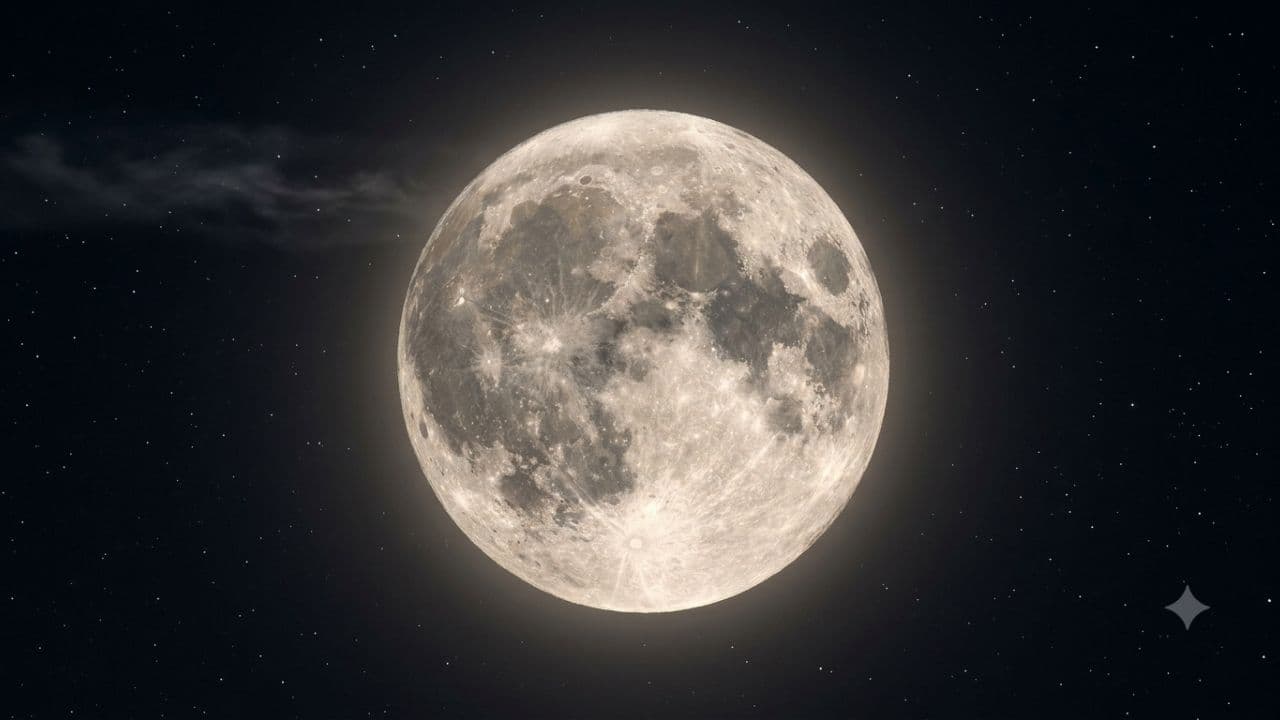
Experts are seriously worried about the growing pile of man-made junk on the Moon. A recent Falcon 9 rocket crash has kicked off a major debate on how this space garbage could threaten future lunar missions and crucial science experiments.
Scientists are raising an alarm about the growing pile of man-made objects on the Moon, as humanity’s space exploration enters a new phase. On August 5, a piece of a Falcon 9 rocket, weighing about 4,000 kilograms (or 8,800 pounds), crashed onto the lunar surface. The impact kicked up so much moon dust that it was visible even from Earth. According to estimates, there are already about 3,000 man-made objects scattered across the Moon. As lunar exploration ramps up, this number is only expected to grow. Experts are saying we need a more responsible approach before the Moon becomes a permanent junkyard.
Almost 200 tonnes of man-made junk on the Moon
Since the space age began, about 200 tonnes of man-made objects have either been left behind or have crashed on the Moon. Many of these are historically important. They include the landing modules from America’s six Apollo missions, the Soviet Union’s Lunokhod rovers from the 1970s, and China’s Yutu 1 and Yutu 2 rovers from the 2010s. But along with these, there are many objects that were never supposed to be there. Space historian Jonathan McDowell believes that many rocket parts and other objects, abandoned in orbits between the Earth and Moon since the early missions, may have eventually crashed on the Moon.
Yeast Infections: Why Monsoon Can Trigger Vaginal Health Woes? Find Out Now!
Rocket parts are crashing on the Moon
Four years before the Falcon 9 piece hit the Moon, a part of China’s Long March 3C rocket had also crashed on the far side of the Moon. Experts warn that as lunar exploration activities increase, such incidents could become more common. With various countries and private companies now sending missions, the area around the Moon is getting more crowded.
“We are in a transition phase,” said McDowell. He pointed out that the world has moved from an era where only the US and the Soviet Union explored the Moon to one with many nations and private players. However, he noted that international regulations have not kept up with this change.
Creatine: Top 5 Foods to Boost Muscle Growth Naturally! Find Out Now
No specific law for Moon waste
Mariette Valdivia LeFeort, a policy officer at the Royal Astronomical Society, said that human activities on the Moon are governed by the UN’s 1967 Outer Space Treaty. Article 9 of the treaty asks countries to conduct space exploration in a way that avoids ‘harmful contamination’. But the treaty doesn’t clearly define what ‘harmful contamination’ is. There is no specific international law or a comprehensive waste management system for the Moon. There’s also no limit on how much waste is allowed, and no rule that says all abandoned objects must be removed.
Lunar dust could be a big problem
The Moon’s surface area is about 38 million square kilometres, which is comparable to the size of Asia, Earth’s largest continent. But the Moon’s gravity is only about 17% of Earth’s. So, when an object crashes, the lunar dust it kicks up travels very far and takes a long time to settle. This could become a huge problem when permanent human settlements and scientific labs are set up on the Moon. The constant crashing of rocket parts could cause dust to settle on scientific instruments or interfere with highly sensitive experiments.
Scientific evidence could also be lost
The arrival of man-made objects and the creation of new craters from large rocket impacts are changing the Moon’s natural environment. The Moon is naturally hit by meteorites, and their impact is part of its geological history. Scientists study these natural impacts to understand the Moon’s past. But repeated man-made impacts can alter the Moon’s physical and chemical environment. This could destroy or hide important scientific evidence that has not yet been studied.
Was the Falcon 9 crash just a lucky miss?
Gregory Radicek, a space law expert at Australia’s Bond University, says the Falcon 9 incident is an opportunity to discuss responsible exploration. He pointed out that the rocket part not hitting an important scientific instrument or a historic site wasn’t due to planning, but was just pure luck. He warned that the space industry might only start taking these dangers seriously when there’s a huge financial loss or loss of human life. He added that the industry might not feel as much pressure if only scientific or aesthetic value is lost.
How did the Falcon 9 get to the Moon?
The part of the Falcon 9 rocket that crashed on the Moon was abandoned in a high Earth orbit in January 2025. This was after it deployed Firefly Aerospace’s Blue Ghost and iSpace’s Resilience lunar landers. Since it was in an orbit relatively close to the Moon, the Moon’s gravity influenced it several times. Eventually, its orbit changed, and it crashed onto the lunar surface. McDowell explained that it’s difficult to accurately predict the future orbit of an object left in this specific region between the Earth and Moon. Over many orbits, small uncertainties can build up, eventually sending the object on a collision course with either the Moon or Earth.
More responsibility needed in the future
McDowell mentioned that since the January 2025 launch, SpaceX has been trying to move the rocket stages used for lunar missions into a more distant orbit around the Sun. The hope is that the current practice of abandoning rocket stages near the Moon will change as exploration becomes more active. In this new space age, with more countries and private companies heading to the Moon, experts agree that it’s essential to create international laws and waste control systems to protect the lunar environment.