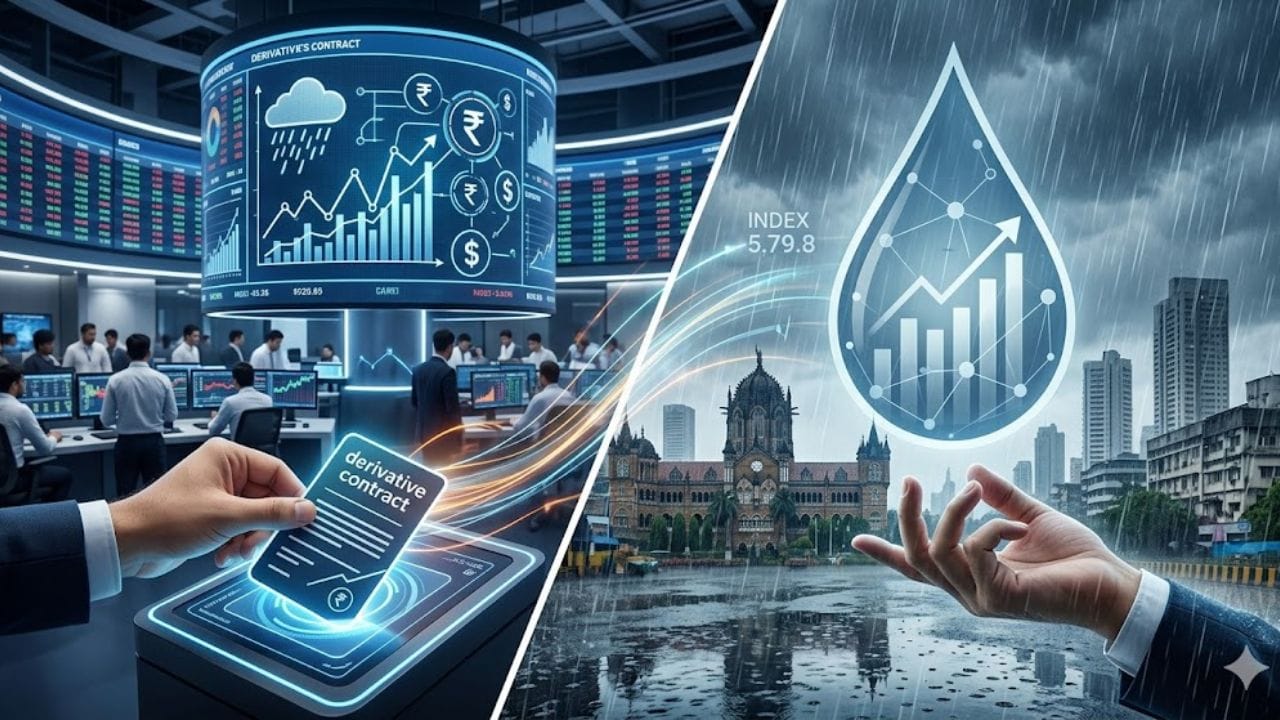
Weather Derivative Market
Agricultural commodity exchange, National Commodity and Derivatives Exchange (NCDEX) has launched India’s first exchange-traded weather derivative contract, named “RAINMUMBAI”. This contract is based on the rainfall data in Mumbai. This data will be taken from India Meteorological Department (IMD). Arun Raste, MD and CEO of NCDEX, said that India has lived with the uncertainty of monsoon for centuries. RAINMUMBAI will provide every stakeholder with a regulated, scientific tool to manage this uncertainty.
How will the market work?
According to the exchange, this contract is designed to help market participants hedge financial risks arising from fluctuations in rainfall. This contract will be cash-settled and will track the difference in actual rainfall from the long-period average (LPA) of the city during the monsoon season. Only contracts for the months of June, July, August and September will be available for trading, which will track the monsoon pattern of Mumbai. These contracts are based on the scientifically developed ‘Cumulative Deviation Rainfall’ (CDR) model.
It measures the difference in actual rainfall from the Long Period Average (LPA) during the monsoon months (June to September). This model and product was developed in collaboration with IIT Bombay. However, NCDEX has also acknowledged liquidity concerns, and has appointed a ‘market maker’ to ensure that these contracts remain liquid for traders.
What is weather derivative?
Weather derivatives are contracts that allow businesses and investors to hedge risks arising from unpredictable weather conditions, such as temperature, snowfall or heat waves. NCDEX’s RAINMUMBAI is the first of its kind rain-based contract. It can be used as a supplementary product of insurance. While insurance pays out after a physical damage or loss occurs, weather derivatives pay out based on predetermined weather data. In this case, if the rainfall in Mumbai is different from the historical average, payment will be made.
These products are used extensively across the world in sectors such as agriculture, power, construction, logistics, tourism and energy, where changes in weather can have a significant impact on revenues. For example, a power company may use rainfall-linked derivatives to protect against losses from low electricity demand during an unusually cold monsoon, while an agricultural lender may protect itself against reduced agricultural production due to low rainfall.