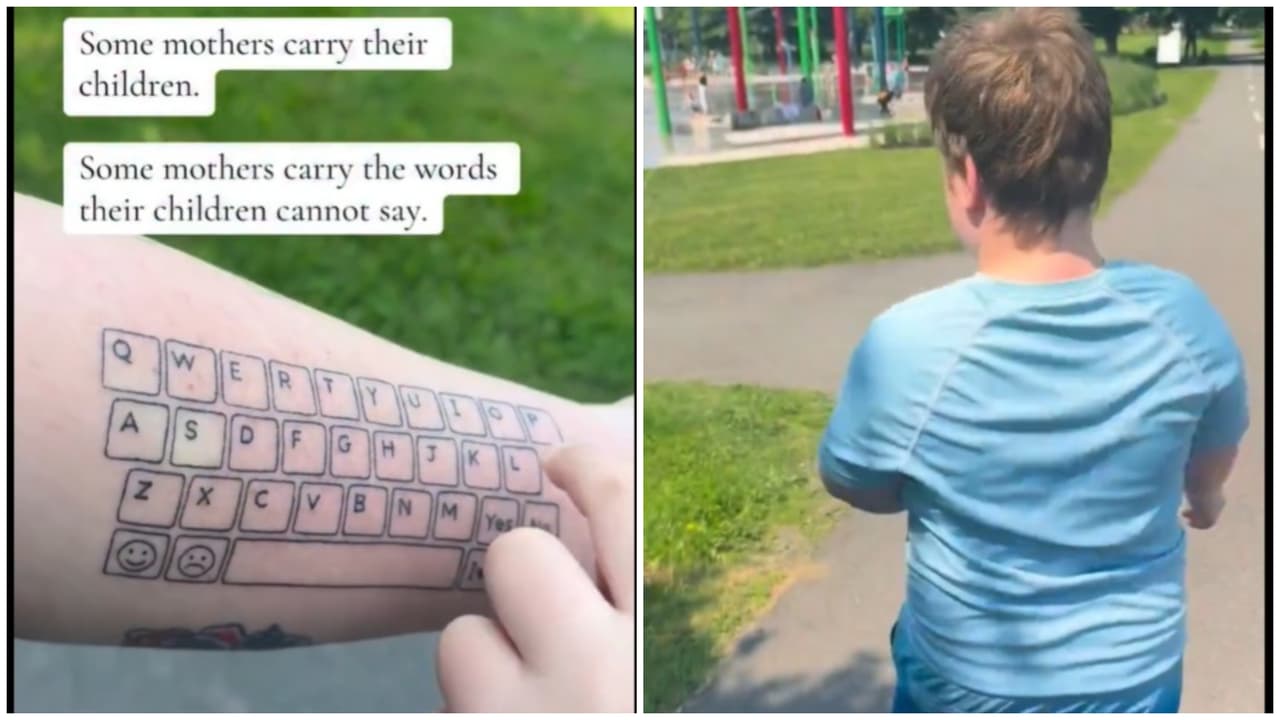
A Canadian mother got a keyboard tattoo on her forearm after her non-speaking son’s AAC tablet died during a meal. The idea has since helped them communicate privately and drawn interest from families and responders worldwide.
Jessica Fletcher was dining out with her 11-year-old son, Hunter, when the batteries in his Augmentative and Alternative Communication (AAC) device suddenly died. The tablet allows Hunter to communicate by selecting words and symbols, but with the device powerless, the pair were unexpectedly left without their usual means of communication.
Jessica was understandably upset. Hunter, however, remained unfazed.
Instead, he grabbed a napkin, sketched a keyboard on it and began pointing to the keys to communicate what he wanted to order.
For Jessica, the moment sparked an idea that would transform the way mother and son communicate.
“That sparked the idea for me that I can’t limit him to technology because technology does fail us,” Fletcher told CTV News in Canada.
Scroll to load tweet…
Determined to create a backup that could never run out of battery, Jessica teamed up with a tattoo artist and had a keyboard permanently inked onto her forearm.
The tattoo features letters along with symbols including a happy face, a sad face and an “I heart you” button.
When Jessica finally showed Hunter his new communication tool, his first typed word was perhaps the most touching one possible: “Mama.”
The tattoo has since helped ease much of the frustration surrounding their communication. Whenever the two are together, Hunter can simply tap the corresponding keys on his mother’s arm to express what he wants to say.
But the ingenious idea offers something his electronic communication device cannot — privacy.
While Hunter’s AAC device speaks his selected words aloud, the tattoo allows the mother and son to communicate quietly, creating a private channel for their conversations.
Jessica shared a video of Hunter using the tattoo to communicate with her on Facebook on July 8, and the emotional moment quickly captured the internet’s attention.
“When we remove communication barriers, we’re giving non speakers the chance to show us who they really are,” Jessica told the Canadian news station.
Hunter’s school friends were so touched by the idea that they wanted keyboard shirts of their own, allowing them to communicate with him during school.
Most touching of all, Hunter’s school friends want keyboard shirts, too, “so they can talk to him on the playground and be able to whisper and tell their secrets,” Fletcher said.
Jessica subsequently partnered with a clothing company to produce shirts featuring keyboards printed down the sleeves. The concept has attracted interest from parents, nurses, doctors and first responders around the world who want to make communication easier for autistic children in schools, hospitals and family settings.
Tattoo artists have also stepped forward, offering to ink similar keyboards on parents for free.
For Jessica, however, the tattoo represents far more than ink on skin. It is a lifeline for her son, a bridge between them and a powerful reminder that communication should never be limited by whether someone can speak.
“I’d give my body a thousand scars if it gave my son one more way to communicate,” Jessica said.