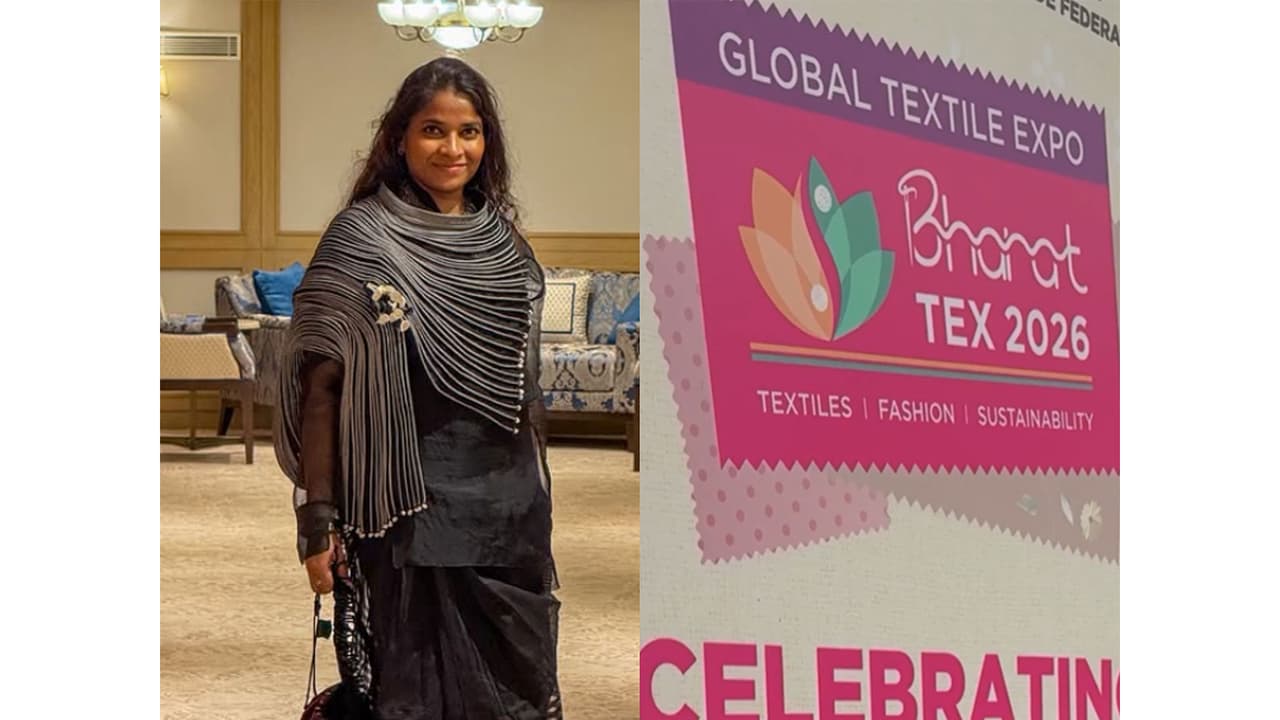
Designer Vaishali Shadangule emphasizes preserving the soul of Indian craft—handlooms and artisan skills—while evolving its expression for a global audience. The goal is to modernize the conversation around the craft, not the craft itself.
Indian craftsmanship should remain profoundly Indian. What needs to become global is the language through which we present it. For me, there are two very different things: the soul of a garment and the expression of that soul. The soul should NEVER change. The expression should evolve continuously. The soul includes everything that makes a piece impossible to reproduce anywhere else in the world, viz. our handloom traditions, our weaving techniques, our natural fibres, the knowledge accumulated over centuries, the human touch of our artisans, and the philosophy behind every craft. These are not only our heritage, they are India’s greatest competitive advantage. They are what nobody but India has, and the attributes towards which the global luxury market is moving to: a unique opportunity for us to put India textiles back to where they have been for centuries. The moment we compromise them, we stop being unique.
What can evolve is the way we translate that heritage for today’s global consumer. That means contemporary silhouettes, styling, functionality, communication and storytelling. A woman in Paris, Tokyo, New York or Milan is not buying an ethnographic object. She is buying something that reflects who she is today. Our responsibility is therefore not to modernise the craft. It is to modernise the conversation around the craft.
Innovation Within Tradition: The Vaishali S Journey
This is exactly the journey we have followed at Vaishali S. We never asked our weavers to abandon centuries-old techniques. Instead, we challenged ourselves as designers to imagine new possibilities for those techniques. Every collection begins at the loom and not in the sketchbook. Sometimes we even develop entirely new weaving structures together with our artisans because innovation can happen within tradition, not outside it. That transforms the artisan from a supplier into a true co-creator. We give proper higher prices to them.
This is the shift that countries like Italy and France have done when in the 70ies they scaled up their artisans by empowering them and giving them a different language to their excellencies. I believe this is an important shift for India too. Too often we think of handloom as something to preserve. I believe we should think of handloom as something to invent with. Because heritage only remains alive when every generation contributes to it.
From Local Looms to Global Runways
When my collections are presented during Paris Haute Couture Week, international audiences rarely ask where the fabric comes from first. They ask why it looks unlike anything they have ever seen. They tell me how great women feel into them. Only afterwards do they discover that every thread has been woven by hand in India. That moment changes the conversation. Indian handloom is no longer perceived as traditional. It is perceived as contemporary, Innovative, and luxurious.
Bharat Tex 2026: A Platform for Global Ambition
It is this very philosophy, heritage as the unshakeable soul, and presentation as the evolving expression, that made Bharat Tex 2026 such a significant moment for me. It was truly inspiring to witness the sheer scale and energy of Bharat Tex 2026 wherein 100+ knowledge sessions were running in parallel during 14th to 17th July 2026 at Bharat Mandapam, New Delhi, bringing together policy makers, global brands, industry leaders and innovators under one roof. Amid this incredible confluence of ideas, I had the privilege of being part of one of the core sessions – Indian Brands, Global Ambitions: Redefining Retail Growth Beyond Borders, held on 16th July 2026, which was both insightful and inspiring.
Government Vision and Industry Alignment
The Hon’ble Minister of Textiles spoke passionately about India’s vision for the textile and handloom sector, emphasizing that our greatest strength lies in the skill of our artisans and craftsmen. He stressed the importance of continuously improving quality so that Indian textiles remain globally competitive while preserving their authenticity. I felt strongly empowered because all the growth values of Vaishali S Couture are deeply aligned with the ones he stressed.
The Path Forward: Traceability and Empowerment
Uplifting of our craftsmen by ensuring they receive fair value and recognition for their work. Traceability, creating transparency, trust, and deeper appreciation for Indian craftsmanship and natural products. Sustainability, which is anyway deeply rooted in India’s traditional textile practices and needs to be preserved and enhanced. Giving proper blockchain based, something we have been working at Vaishali S, traceability would take India away from some bad practices of the past which have been spoiling our image.
For me, the discussion reaffirmed a belief I have always held: while a few designers are reaching remarkable size in India, India’s future lies in supporting those smaller ones that are really starting to be known abroad and for the right reasons. Scales will follow. For this reason Vaishali S Couture is the only brand that has been accepted all top global fashion weeks including Milan, NY, Paris Haute Couture, and even Barcelona western bridal, at luxury level, where slow fashion counts, the only one really known abroad. The whole textile sector will benefit from this enhanced branding, and the whole sector of weavers will have a large social impact.
A Collective Vision for the Future
Bharat Tex has emerged as a remarkable platform that brings together policymakers, industry leaders, designers, manufacturers, buyers, and innovators to collectively shape the future of Indian textiles. It reflects India’s ambition to become a global leader while remaining deeply connected to its craft heritage. I was equally encouraged by the remarks of Javed Ashraf (IFS), Chairman, ITPO, who spoke about taking Indian textiles and craftsmanship to the world through thoughtful preparation, strong curation, and strategic presentation while organizing exhibitions abroad with the right storytelling and international standards so that global audiences can truly appreciate India’s textile heritage.
I was also delighted to hear from officials of the Ministry of Textiles about the various schemes and initiatives being undertaken to strengthen the sector, especially for MSMEs, artisans, and designers. Bharat Tex 2026 reaffirmed for me that India’s textile story is only just beginning to be told the way it deserves, viz. rooted in heritage, yet spoken in a language the world can embrace. As designers, artisans and policymakers move in the same direction, I am confident that Indian craftsmanship will not merely be preserved, but celebrated as one of the world’s true benchmarks of luxury.
Disclaimer: The views and opinions expressed in this article are solely those of Vaishali Shadangule, an acclaimed Indian fashion designer known for championing traditional handlooms and sustainable couture, and do not necessarily reflect the views of ANI. (ANI)
(Except for the headline, this story has not been edited by Asianetnews Editorial staff and is published from a syndicated feed.)