Micron and SanDisk closed their fiscal year 2026 with record revenue and profit gains.
- Micron expects memory supply-demand conditions to tighten further through fiscal 2027 and 2028.
- SanDisk is also seeing demand outpace supply, with customer allocation expected to continue beyond 2027.
- Morningstar sees the current memory boom extending into 2028 before a major supply-driven downturn emerges.
Micron Technology, Inc. (MU) silenced its critics, delivering its strongest quarterly performance yet, with sales surging 379% year over year, and gross margin reaching 86.8%, while warning that the current memory squeeze will intensify next year and persist through at least 2028.
Those were remarkably bullish signals, suggesting memory companies could keep minting money, while demand for advanced chips and servers from AI and cloud players shows little sign of slowing yet. Whether the stocks rise in tandem is a different story.
The results, along with those from peer SanDisk Corp. (SNDK) last month, have settled the debate: there’s no slowdown on the horizon for now. The concern capped gains in Micron and SanDisk shares recently, after both stocks had rallied sharply from April 2025 through their peaks in June 2026.
Micron’s Bullish Signal
“Industry demand has strengthened since our last earnings call, and we expect memory and storage supply demand conditions to be much tighter in fiscal 2027 and 2028 than they were in 2026,” Micron CEO Sanjay Mehrotra said on a Wednesday call with analysts.
In June, he told analysts the memory crunch would last past 2027 but struck a softer tone than he did on Wednesday.
Micron’s fourth-quarter revenue climbed 31% quarter over quarter to $54.23 billion, while sales rose a staggering 256% to $133.19 billion over the fiscal year 2026. The company is projecting around $61.5 billion in sales in the current quarter.
“We expect higher gross margins beyond fiscal (first quarter) for the remainder of fiscal 2027, with a more moderate rate of price increases,” CFO Mark Murphy said.
The initial reaction to Micron stock was underwhelming, with shares dipping 0.6% in Thursday’s premarket session, suggesting investors may have already priced much of the strong report into the stock ahead of the results. However, many retail traders believe the stock would run higher in due course.
MU remains about 12% below its all-time high level from late June. On Stocktwits, the retail sentiment for MU shifted to ‘extremely bullish’ from ‘bullish the previous day.
How Does SanDisk Compare?
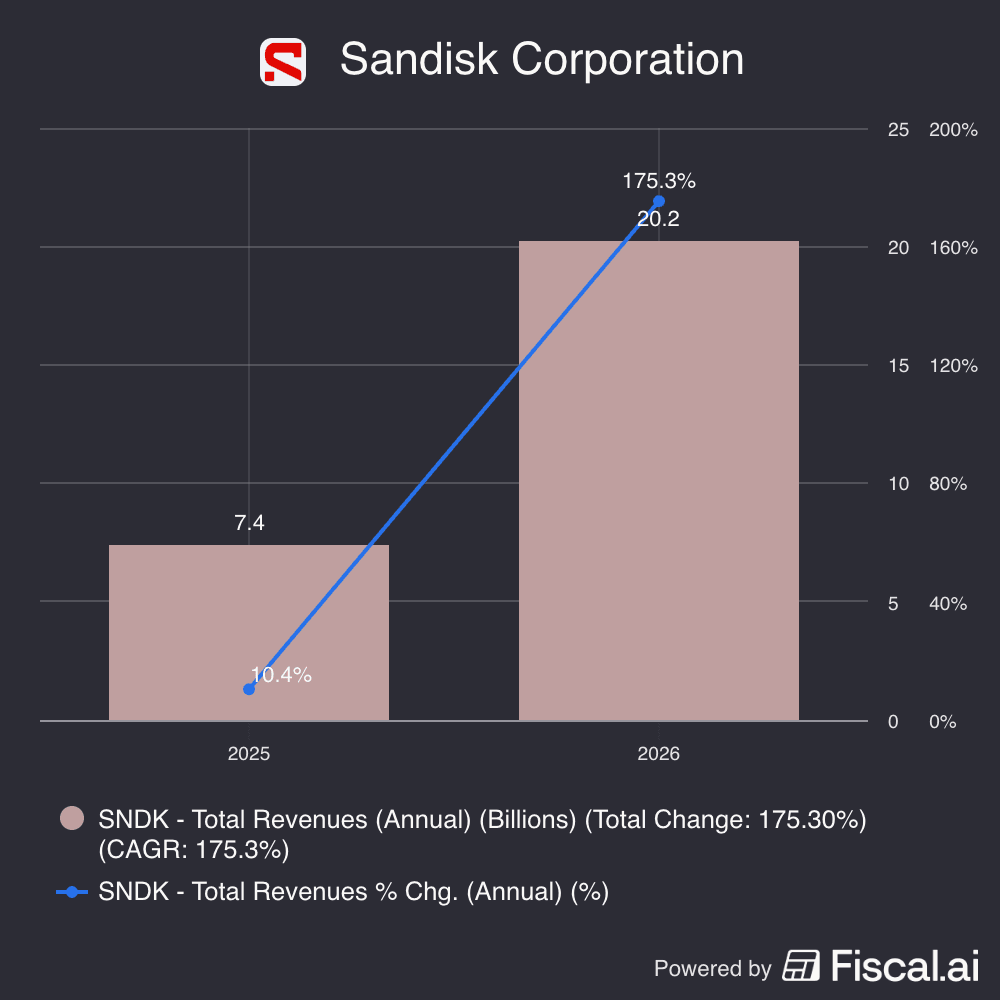
SanDisk’s fourth-quarter revenue rose at a higher clip, rising 51% sequentially and 372% year over year to $8.97 billion, according to results issued on Aug. 5. On a full year basis, sales rose 175% to $20.25 billion.
SanDisk posted a gross margin of 84.6% in the quarter compared to 26.2% in the Q4 a year ago. The company will issue Q1 results on Oct. 29. SanDisk CEO David Goeckeler said at the time that “demand from our customers is growing faster than our supply,” with bits expected to remain on allocation beyond 2027.
The company expects “very robust demand through the end of 2027, and into 2028.”
SanDisk shares are down about 26% from their all-time high, also set in June, suggesting the stock may have more room to run. However, analysts see greater upside in Micron, with consensus estimates from Koyfin implying 42% upside for MU versus 23% for SNDK.
Micron primarily supplies DRAM and high-bandwidth memory (HBM) which have a greater role in AI data centers, while SanDisk focuses more on NAND-based storage products such as SSDs, flash drives and memory cards.
Micron trades at 6.6 times 12-month forward earnings, compared with 8.1 times for SanDisk, making Micron the lower-valued name on a forward earnings basis.
Analysts’ View On Memory Supercycle
In a new report, Morningstar said Micron’s latest results reinforced its view that the memory market remains in an exceptionally strong upcycle, but signs of moderation are emerging.
Micron is seeing “the highest pricing growth we’ve ever seen in the modern memory market,” while quarter-on-quarter pricing growth is already slowing. Morningstar remains bullish on the next four quarters, but said the deceleration suggests “a peak is on the horizon,” which it expects around early 2028.
Looking further out, Morningstar expects the current boom to eventually give way to the traditional memory cycle. A “massive amount of new supply” coming online through 2030 should put downward pressure on memory prices, with supply potentially doubling by 2028 and triggering a steep pricing decline across 2029-31.
Higher capital spending would also bring heavier depreciation, weighing on margins, according to the firm.
Morningstar cut its fair value estimate for Micron to $700 from $850, citing moderated near-term growth expectations and its forecast for a steep downturn beginning in 2029.
Patrick Moorhead, CEO of Moor Insights & Strategy, argued that Micron’s results suggest the memory upcycle remains strong despite concerns. “Not a slowdown,” he wrote in an X post, highlighting that more than 75% of Micron’s 2027 output is already committed.
Ben Bajarin, CEO of Creative Strategies, blamed the margins guidance for the stock’s drop. “The irony should not be lost on us that the memories industry has averaged single digit margins and folks are mad its not going to 90 lol,” he posted on X.
MU and SNDK stock are up 273% and 633%, respectively.
For updates and corrections, email newsroom[at]stocktwits[dot]com.<