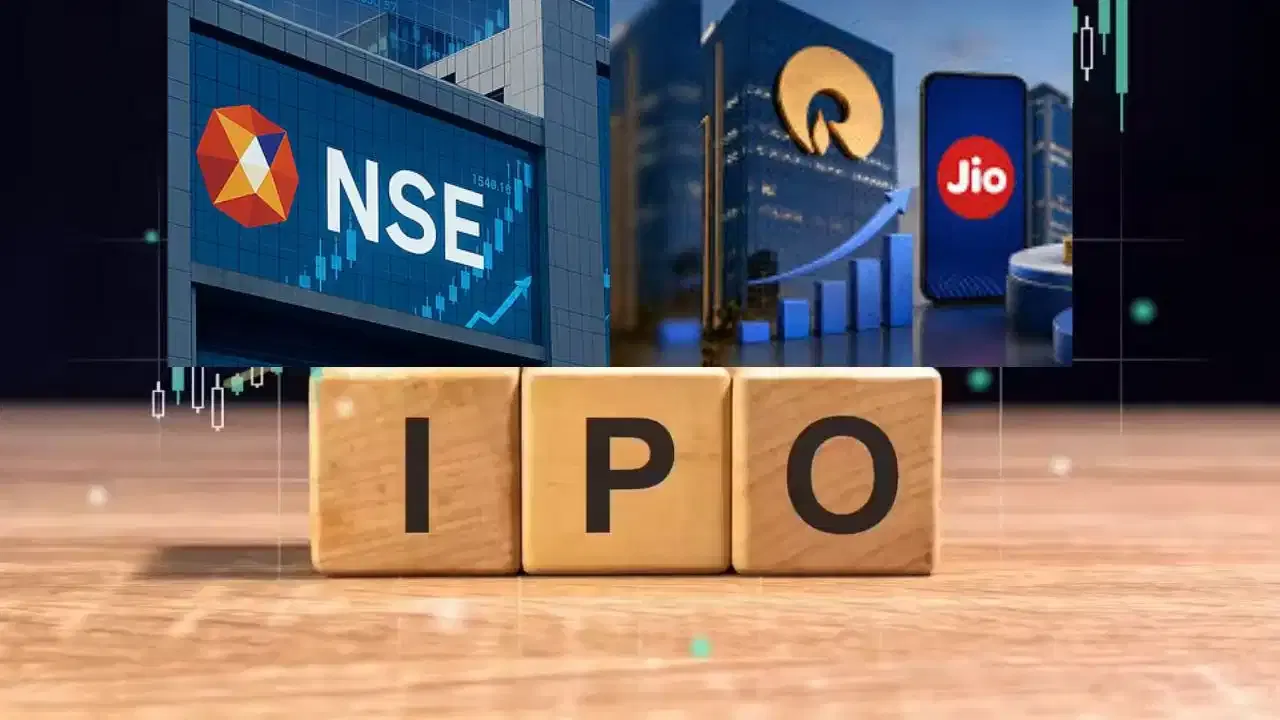
Reliance Jio and NSE are bringing IPO
The two big IPOs coming in India, Jio Platforms and NSE are related to the thinking of retail investors. Now the $7 billion question is whether this engagement will last. If gray-market prices are to be believed, the $3 billion IPO of National Stock Exchange of India Limited (NSE) and the $4 billion debut of billionaire Mukesh Ambani’s telecom and digital media empire — both are likely to attract considerable interest from local investors. These investors are looking for some excitement which is currently not available in the secondary market.
While global capital was chasing the AI semiconductor boom in Taipei and Seoul — which caused Korean stocks to triple and Taiwanese equities to double — India’s benchmark index has gone nowhere in the past two years. What is worse is that the war in Iran has badly affected the weak balance of payments of this energy importing country. The huge fall in the rupee has driven away foreign capital.
But now that peace talks have started between America and Iran, all eyes are on individual share buyers of India. They have recently started to come back after retreating from the market. Common investors need to regain their lost enthusiasm, and this is where the similarities and differences between the two IPOs become important.
Similarities between NSE and Jio IPO
Both NSE, India’s largest exchange, and Ambani’s Jio Platforms Ltd. have a strong competitive advantage: they are dominant players in industries where there are essentially only two large companies (duopoly), and it is very difficult for new competitors to enter because regulations are so strict.
NSE’s rival is the 151-year-old BSE Limited (formerly known as Bombay Stock Exchange), which accounts for only 7 per cent of the total cash-equity turnover. Jio’s more than 500 million subscribers — and its media empire with a strong hold on cricket (an obsession in the country) — puts it far ahead of its nearest rival, Bharti Airtel Ltd.
Indian investors are well aware of these two companies. As long as there is capital control in India, people in the local market will have to depend on NSE to create wealth.
In the case of mobile wireless, it is difficult to think of anyone other than Jio setting the price of data. Even in new technologies like satellite broadband, national security concerns may give Ambani an advantage over Elon Musk’s Starlink or Jeff Bezos’ Amazon.
What is the difference between the two IPOs?
- There are some important differences between the two IPOs. The NSE listing, which was significantly delayed due to governance scandals at the exchange, is entirely a matter of stock sale by existing shareholders. At the same time, Jio will raise new money, some part of which will be used to repay the debt of about $ 3 billion.
- In mature markets, the difference between an ‘offer-for-sale’ and raising fresh capital is merely a technical process. But in the current delicate environment of India, this is a completely different matter. Since the NSE listing is designed purely as an ‘offer-for-sale’, there will be no fresh cash infusion into the exchange’s coffers.
- What is worse is that those reducing their stake include foreign giants like Morgan Stanley and Temasek Holdings Private Limited. At a time when New Delhi is trying hard to attract money from Indians based abroad to manage the weakening rupee, there is a danger of NSE IPO becoming an exit route for foreign capital.
- In contrast, Ambani’s Jio is a company attracting new funds. However, for Jio to succeed, those selling NSE shares — Indian banks and insurance companies, foreign institutions, ultra-rich private investors — will have to give up some profits. (Since NSE had submitted its draft papers to the regulator a day before Jio, the general expectation is that it may hit the market first.)
- If he prices the offer too high and hurts retail investors, the heat will not be limited to Ambani alone; It will also reach Silicon Valley and trouble everyone from Sundar Pichai to Mark Zuckerberg.
Jio’s global investors
Alphabet Inc. and Meta Platforms Inc. Jio is also a big supporter, as are Saudi Arabia’s public investment fund, KKR & Co. And many other sovereign wealth funds and private-equity firms are also involved.
Although none of them are selling their shares in the IPO, they will be able to record the profit in their books. For Google alone, the $4.5 billion stake purchased six years ago is now worth $10 billion — and could be even more if share prices continue to rise after the listing.
Jio’s success will also help Ambani’s flagship company, Reliance Industries Ltd, pave the way for its next big public float — consumer commerce. It will still take some work to separate India’s largest retail company, because competition in grocery, fashion and electronics sales is much greater than in telecom. This is why it is even more important to keep retail shareholders happy.