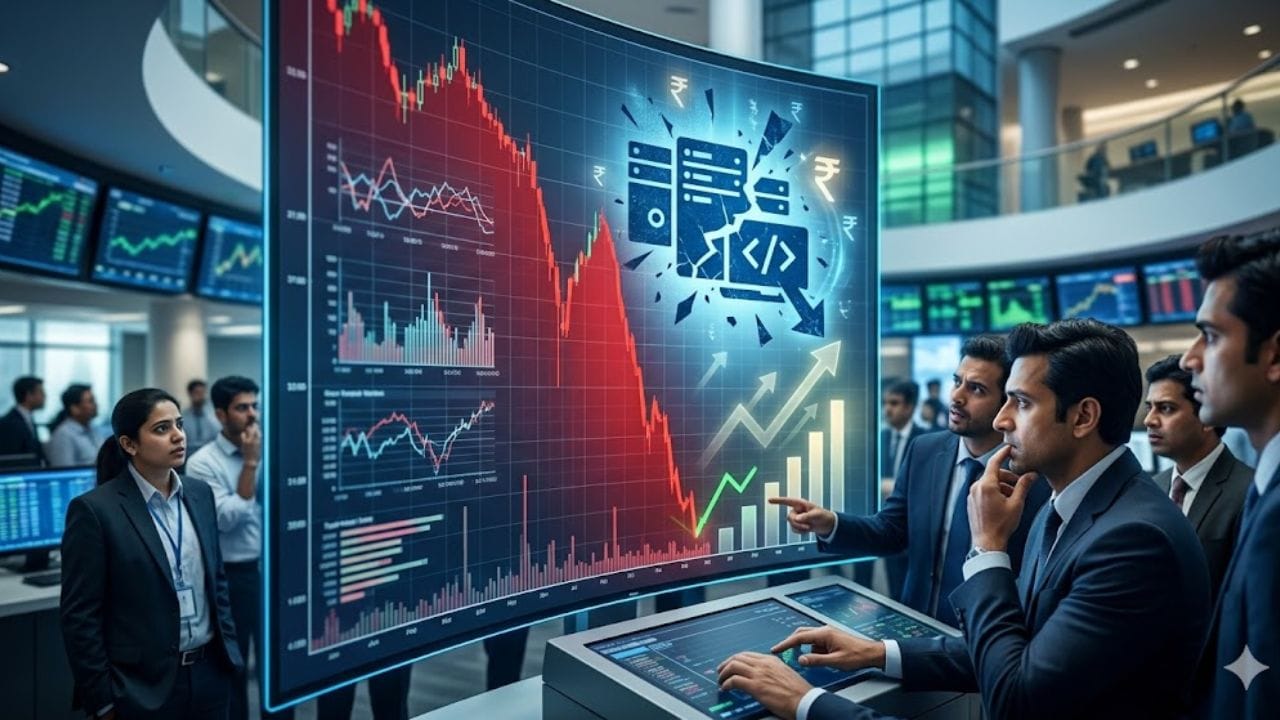
Such earthquake or difficult times are rarely seen. Which has put the IT sector companies in a lot of trouble. The crisis has wiped off Rs 17.6 lakh crore from the total market capitalization of India’s top 10 digital and technology services exporting companies, pushing valuations to levels not seen since the global financial crisis.
The Nifty IT index fell from its cycle high of 46,089 on December 13, 2024, to a low of 27,078 on May 14, 2026, due to systemic concerns over Generative Artificial Intelligence (AI), reduced discretionary spending and slow earnings growth.
The value of IT sector giant Tata Consultancy Services (TCS) alone reduced by more than Rs 8 lakh crore. The special thing is that since then till now there has been a decline of 50 percent in the shares of the company. Infosys fell 45 percent, while HCL Technologies and LTIMindtree saw a decline of at least 40 percent.
Shares of Wipro, Mphasis and Coforge have seen a decline of more than 30 percent. All other companies in the index have fallen by at least 25 percent. After falling 20 per cent in February and 5 per cent in March, the Nifty IT index showed signs of stabilization. There was an increase of 1 percent in April, whereas it has declined by 1 percent so far in May.
A case is being made for counter-thinking
Due to this decline, the share of this sector in the mutual fund portfolio reached an eight-year low of 6.7 percent in April. This kind of ignoring of the sector by institutional investors is itself becoming a signal for those investors who go against the general thinking of the market. PPFAS Mutual Fund, led by experienced fund manager Rajiv Thakkar, is one of the few fund houses that is going against the grain of the market.
He increased his investment in the technology sector by 1.2 percentage points to 12.2 percent in April. At the Grow India Investor Festival 2026 in Mumbai, Shankaran Naren of ICICI Prudential Mutual Fund recently described the current state of the IT sector as “a upside opportunity in terms of valuations”. At the same time, he also acknowledged that the risk of real disruption from AI still remains.
Vibhor Singhal of Nuvama also has a similar cautious but positive opinion. He says that the results of the fourth quarter (Q4) of the financial year 2026 remained stable, and mid-cap IT companies once again outstripped their larger competitors in terms of growth. The process of getting new deals was good for most of the companies, although the companies continuously said that it is now taking more time for the clients to take decisions.
After the recent sharp decline, we find valuations very attractive. Reverse DCF analysis shows that terminal growth projections are very low. We are positive on the sector from a medium to long-term perspective — however, volatility is expected to remain in the short term.
Singhal has also made a historical comparison. IT stocks are now responding more to AI-related developments around the world rather than their fundamentals and performance. He said that we see the current skepticism as a repeat of previous tech cycles — 2016–17 being the most recent example — and we expect Indian IT companies to emerge stronger as Gen AI becomes more widespread.
The question of AI disruption
The downside is based on a structural tension: Generative AI will undermine traditional Indian IT distribution that has depended on laggard gains and mass production for decades. Siddharth Tipnis, partner and technology sector leader, Deloitte India, argues that three interacting forces are now reshaping the competitive scenario.
AI is simultaneously undermining the economics of the traditional distribution pyramid. And enterprise customers are gradually shifting purchasing behavior from “people supplied” to “results achieved” – increasing momentum toward value-based and consumption-oriented value determination.
Tipnis says this means that AI should not be seen simply as a productivity tool, but as a fundamental restructuring of professional services business models. Roles focused on commodity execution such as junior application development, QA and testing, L1/L2 support, and transaction-oriented distribution are facing increasing automation risks and pricing pressures.
Short term pain, long term opportunity
Singhal of Nuwama does not deny this change. He admits that IT services companies are currently facing a decline in their revenues due to generative AI, but he argues that this is an inflection point, after which the total potential market could grow to $300-400 billion by 2030.
The bottom line is this: No matter where AI evolves, the need for systems integrators capable of customizing the inputs and outputs of enterprise software will persist. According to his assessment, this is not an existential crisis, but just a difficult phase to go through.
IT stocks have shown sensitivity to rupee depreciation as a weak currency increases the rupee value of dollar-denominated revenues. Moreover, attractive valuations have also attracted short-covering. But a sustained re-rating would require clarity on the revenue impact of AI and signs of improvement in non-essential technology spending globally.
For now, the sector stands at a crossroads. Valuations are at their lowest, institutional stakes are at an eight-year low, and a handful of contrarian investors are quietly accumulating shares, while the buzz about AI-driven change shows no signs of slowing down.