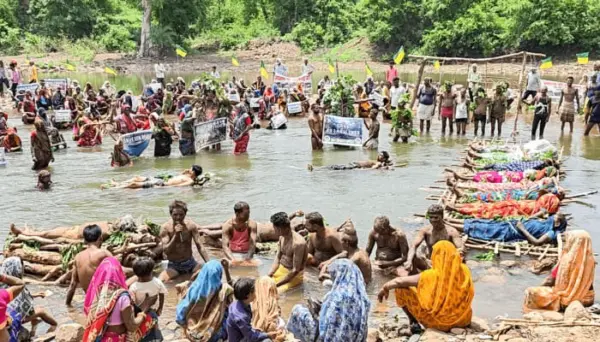
The Madhya Pradesh police on Sunday removed protesters from the banks of the Barana river near Kupi village and ended a nearly fortnight-long agitation against the Ken-Betwa Link Project and other irrigation schemes, abruptly concluding the symbolic ‘pyre satyagraha’ and related demonstrations.
The unique protest, which began on July 3, was primarily led by tribal women from Gond and Kol communities, along with activist Amit Bhatnagar, who had been on an indefinite hunger strike. Protesters employed unique Gandhian-style methods, including ‘chita satyagraha’ or funeral pyre protest, where participants lay on symbolic pyres to signify they had already died after losing homes, fields, and forests; ‘jal satyagraha’, standing in the river; and ‘faansi satyagraha’ with nooses around their necks.
Additional Superintendent of Police Aditya Patle said a team comprising police, administration, and doctors conducted medical check-ups at the site. Women protesters were peacefully seated in buses and dropped back to their homes. “This is an under-construction bridge, and due to the rains, the river’s water level has risen. Therefore, the area was not considered safe,” Patle stated. Authorities denied any arrests or detentions, though some protesters claimed leader Amit Bhatnagar was detained.
The Ken-Betwa Link Project, India’s first river interlinking initiative under the National Perspective Plan, aims to transfer surplus water from the Ken River to the Betwa River. The Rs 44,605 crore project seeks to provide irrigation to over 10 lakh hectares, drinking water, and hydropower, particularly benefiting the drought-prone Bundelkhand region spanning Madhya Pradesh and Uttar Pradesh. It also involves the Daudhan Dam, which will partially submerge areas of the Panna Tiger Reserve.
Protesters alleged inadequate rehabilitation, insufficient compensation, violations of land acquisition norms, environmental safeguards, and loss of livelihoods, forests, and cultural identity for affected families in Chhatarpur and Panna districts.
Protestors claimed assurances given by the administration during an earlier agitation in April had not been fulfilled. Demands included higher compensation, land-for-land resettlement, and proper implementation of rehabilitation policies. The administration has maintained that the project is being executed as per law and offers significant developmental benefits.
The 15-day protest drew significant attention for its symbolic intensity but ended with the site cleared, and demonstrators sent back to their villages. The episode highlights ongoing tensions between large infrastructure projects and the concerns of local tribal communities in the region.