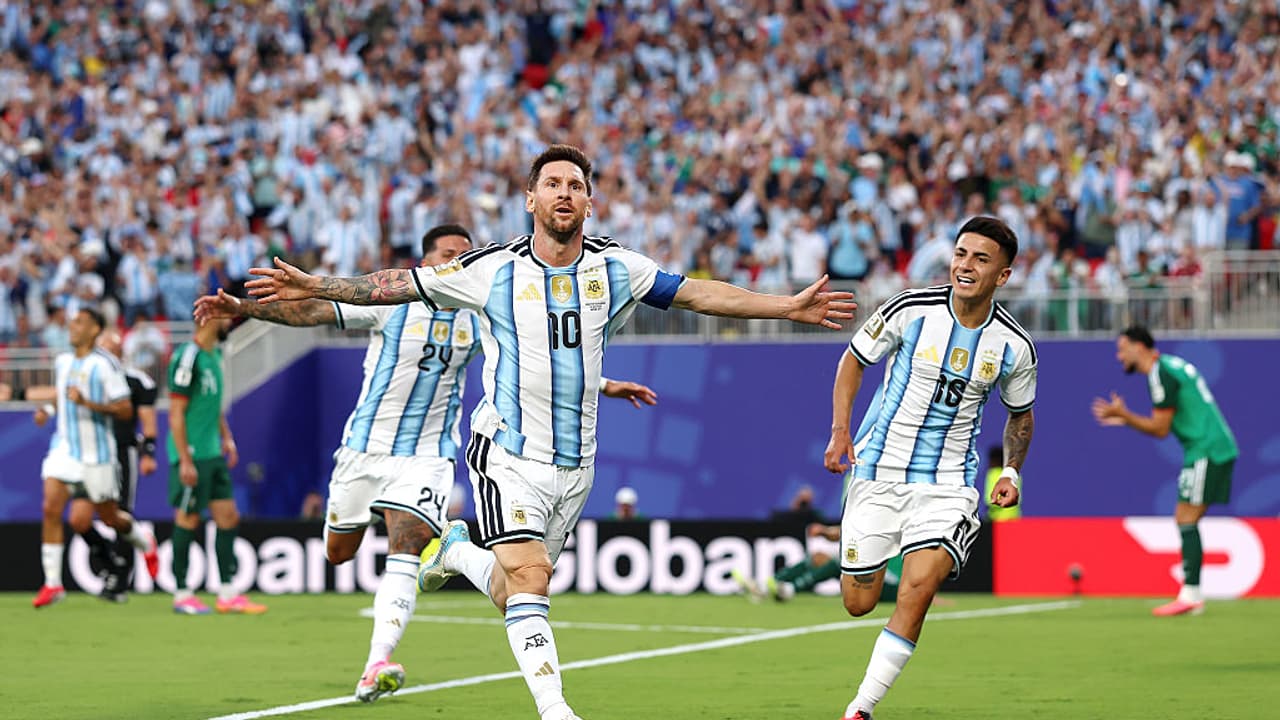
Lionel Messi equaled the record of most goals in the World Cup with 16 goals by scoring a hat-trick in his 200th international match. He also became the first male player to play in six World Cups and the oldest player to score a hat-trick in the tournament.
Kansas City: Argentina captain Lionel Messi is breaking all the World Cup records one by one. Messi scored a brilliant hat-trick while playing his 200th international match against Algeria at Arrowhead Stadium in Kansas City. With this hat-trick, he equaled the record of 16 goals of Germany’s Miroslav Klose in terms of scoring most goals in the World Cup. Earlier, France’s Kylian Mbappe had overtaken Messi by scoring two goals against Senegal in a match, but now on the basis of this hat-trick, Messi has left him behind. Messi scored goals in the 17th, 60th and 76th minutes of the game. This is the first World Cup hat-trick of his career.
By entering this match, Messi became the first male player in football history to play 6 different World Cups. With this, he further improved his own record of playing most matches in the World Cup to 27. In the 17th minute of the match, Messi gave Argentina the lead by scoring a brilliant curving shot on a brilliant through pass from Rodrigo de Paul. With this goal, Messi also became the youngest and oldest player to score a goal for Argentina in the World Cup.
At the beginning of the second half, Messi overcame Algeria’s defense and scored his second goal and put Argentina ahead 2-0. With this goal, he equaled the great Brazilian player Ronaldo by scoring 15 goals in the World Cup. Soon after, he completed his hat-trick and equaled Miroslav Klose’s record of most goals with 16. With this hat-trick, 38-year-old Messi also became the oldest player to score a hat-trick in the World Cup.
In this match, Algeria gave a tough fight to Argentina, but due to the tremendous form of Messi and the excellent saves of goalkeeper Emiliano Martínez, Argentina managed to win. Now Lionel Scaloni’s Argentina team aims to win two consecutive World Cups, so that they can create history by becoming the third country to do so after Italy (1934, 1938) and Brazil (1958, 1962).