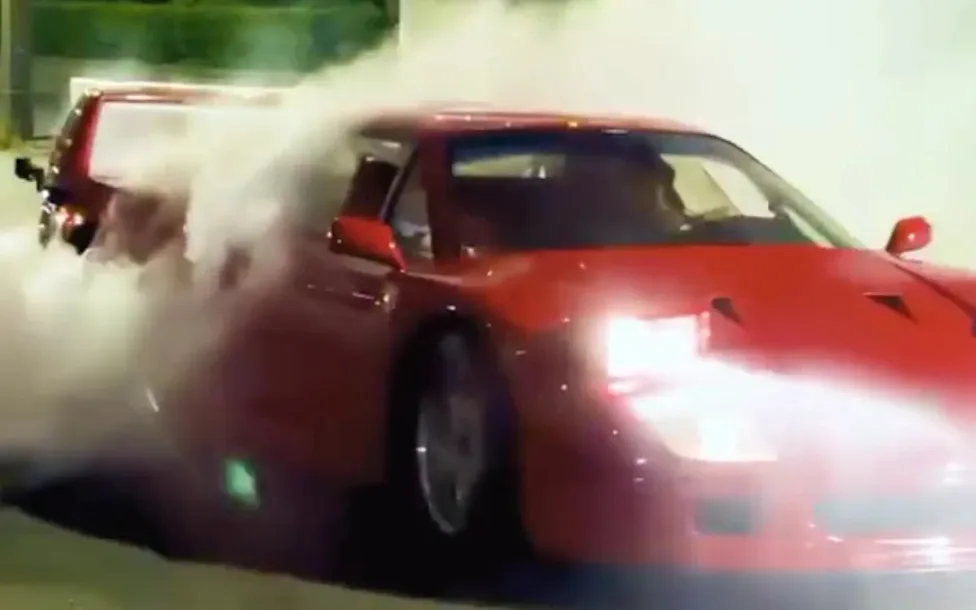
Lewis Hamilton’s Ferrari F40 has apparently graduated from restoration project to daily driver. A video shot outside Ferrari’s Maranello plant on September 1 shows a red F40 easing through the factory gates and onto the cobblestones outside, with a handful of mechanics in matching red uniforms stopping mid-shift to film it on their phones. The clip’s caption identifies the driver, dressed head to toe in black, as Hamilton, though the footage never actually shows his face clearly enough to confirm that independently.
Regular readers already know this car. Hamilton as a decades-old barn find he tracked down and shipped straight to Ferrari’s own technicians for a nut-and-bolt rebuild. What’s new here isn’t the car, it’s the send-off. This is the first footage circulating publicly that shows the finished F40 actually leaving the building where it was brought back to life, with Ferrari’s own staff treating the moment like it’s worth stopping work for.
The Detail Everyone’s Zooming In On
Freeze the video at the right frame and the F40’s tiny front plate resolves into a shape a lot of viewers read as “44,” the number Hamilton has raced under since Formula One introduced permanent car numbers in 2014, and the same one he ran back in his karting days. A separate clip of the same car making the rounds that week describes the rear plate as yellow, which is worth pausing on. Italian plates are white front and rear with a blue EU band; a yellow rear plate paired with a white front plate is a British convention, not an Italian one. If that description holds up, the F40 that just rolled out of Ferrari’s own factory may be registered in the UK rather than in Italy or Monaco, and doing it with a personalized 44 to boot.
That detail is exactly what tripped up the comments under the reveal video. One viewer said flatly, “that cant be his actual plate,” while another wrote “I was expecting Monaco plates though” — a reasonable guess, since Hamilton has based himself there for years and Monégasque registrations are the default for cars in his circle. A UK plate on a car photographed leaving an Italian factory isn’t scandalous. Owners register classics wherever makes sense for insurance, tax residency, or wherever the car will actually live. But it’s a small, genuinely interesting tell about where this particular F40 is headed once the paperwork catches up with the restoration.
Not This Car’s First Trip Off the Lot
This also isn’t the first time the finished car has surfaced in public. Months before Hamilton’s Instagram reveal, the same red F40 turned up and then weeks later. So the factory-gate footage almost certainly isn’t the car’s first drive. It’s more likely a return trip to Maranello for follow-up work, a service visit, or simply Hamilton swinging by his employer’s front door in his own toy. Classiche restorations don’t wrap the day a car first turns a wheel; certification and fine-tuning can stretch on for months after a car is technically driveable.
Why Ferrari’s Own Mechanics Did the Work
Handing a 30-year-dormant F40 to Maranello’s own technicians instead of an independent restorer matters for reasons beyond bragging rights. Ferrari’s factory heritage division, Classiche, cross-checks a car’s chassis and engine numbers against the original build sheets before it will touch a restoration, and a car that passes muster comes out the other end with a Certificate of Authenticity, known inside the hobby as the Red Book, that spells out exactly what’s original and what’s been replaced. For a model where matching numbers and unmolested bodywork swing auction estimates by six figures in either direction, that paperwork is worth more than any detail job.
It also means that whoever eventually sells this F40 — Hamilton has given no indication he plans to, and he’s already floated the idea of of his own — will be selling a car with a factory-verified paper trail and a seven-time world champion’s name attached to the provenance file. Auction houses build entire marketing campaigns around less.
The Car Enzo Signed Off On
None of this would be happening if the F40 weren’t already one of the most significant Ferraris ever built. It was the model the company rushed into production for its 40th anniversary in 1987, and the last new Ferrari Enzo Ferrari personally approved before he died the following year. No power steering, no ABS, barely any sound insulation — just a twin-turbocharged V8 wrapped in composite bodywork over a tube frame, built in a run just north of 1,300 cars. Clean, unrestored examples already trade for seven figures at auction, and a factory-documented restoration with this kind of ownership history won’t hurt that number if this particular car ever changes hands.
The Takeaway
Whether or not the plate turns out to be exactly what it looks like, the bigger story is what Hamilton is signaling by letting this footage exist at all. He didn’t need Ferrari’s mechanics filming him on his way out the door, and he didn’t need a personalized plate on a car he’d already shown off twice before he ever posted about it. Sold cars don’t get number plates that double as personal branding. This one very much did — and for a driver who spent last September telling reporters he’d given up on owning cars entirely, that’s about as close to a mission statement as he’s offered since.