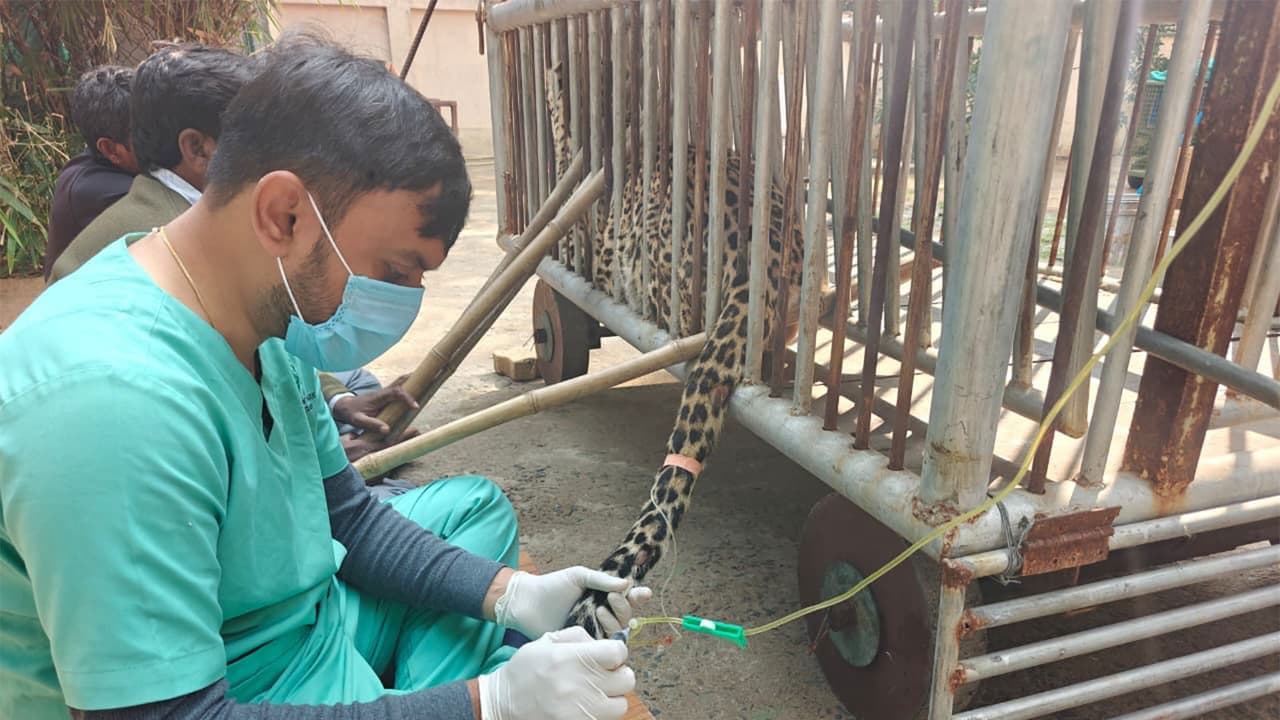
A leopard, paralysed in a road accident in Gujarat’s Aravalli district, has remarkably recovered after specialised treatment at the GEER Foundation. Despite its recovery, it will remain in captivity due to residual effects from the spinal injury.
A leopard that suffered severe spinal injuries in a road accident near Shamlaji in Aravalli district has made a remarkable recovery following months of specialised veterinary treatment and rehabilitation at the Gujarat Ecological Education and Research (GEER) Foundation in Gandhinagar.
According to the Gujarat Chief Minister’s Office, the Forest and Environment Minister, Arjun Modhwadia, congratulated the GEER Foundation team for the successful rescue, treatment and rehabilitation of the injured leopard. The leopard was seriously injured late on January 19 in an automobile accident on the Kheracha-Khodambha Highway. The Forest Department’s rescue team recovered the animal and shifted it to a departmental facility, where Veterinary Officers of the Department of Animal Husbandry provided immediate treatment.
The Leopard’s Critical Condition
“The leopard’s condition was critical. It was completely paralysed in both hind limbs, could not stand and was forced to drag its hindquarters using its forelimbs. Given the severity of its neurological condition, the animal was referred for advanced investigation and specialised wildlife veterinary care,” said B.P. Pati, IFS, Director of the GEER Foundation.
Diagnosis Reveals Severe Spinal Trauma
On January 20, the Aravalli Forest Division approached the GEER Foundation. The leopard was taken to the Referral Centre, Teaching Veterinary Clinical Complex, Rajpur, Himatnagar, Kamdhenu University, for radiographic examination. The animal was carefully anaesthetised before the procedure. Radiographs revealed a traumatic lumbosacral fracture-dislocation at the L7-S1 region, with suspected involvement of the lumbosacral articular elements. The area is closely associated with nerve roots responsible for functions involving the hind limbs, tail and pelvic region. The injury explained the animal’s severe paralysis and inability to stand.
“The spinal trauma was accompanied by multiple other injuries, including a significant lower-jaw injury. The leopard developed drooping of the lower lip, severe soft-tissue damage and infection involving the oral and gingival tissues. It initially struggled even to consume food and water, adding to the risk posed by its neurological injuries,” Pati added.
Intensive Treatment and Rehabilitation
After being brought to Indroda Nature Park in Gandhinagar, the leopard was admitted to the GEER Foundation’s veterinary hospital. A specially designed treatment cage provided a controlled, low-stress environment. Human interaction was minimised, while the animal was monitored through distant observation. Its movement was carefully restricted to prevent further injury to the lumbosacral region.
The veterinary team provided intensive daily treatment, including postural management, controlled positioning, nutritional support and feed supplementation. Signs of recovery began to emerge within days. Within three days, the leopard voluntarily started taking food and water. By the fifth day, it was passing urine and faeces normally. Within a week, its aggressive and defensive responses towards approaching personnel had returned, indicating improvement in its overall strength and behaviour.
A Timeline of Recovery
“After about 20 days, the leopard began raising its body using its forelimbs. Around the 40th day, it was able to stand on all four limbs, though it still struggled to bear weight on its hind limbs. By approximately the 50th day, its posture had become more natural. At around two months, the leopard began walking inside the treatment enclosure. About two months and 15 days after the accident, it had regained its natural body posture and normal gait,” said Amit Naik, IFS, Deputy Director at the GEER Foundation.
Decision Against Release into the Wild
Despite the recovery, the leopard continues to show slight postural deviation and tail drooping, suggesting residual effects of the spinal injury. Considering the challenges it could face in hunting, movement, territorial defence and avoiding threats in the wild, authorities decided against releasing it into a free-ranging environment. The leopard has therefore been retained at Indroda Nature Park, where it can live in a naturalistic environment under appropriate care and supervision.
“The case highlights the importance of timely rescue, advanced diagnostic imaging, specialised wildlife veterinary treatment and prolonged rehabilitation in giving severely injured wild animals a second chance at life,” said Pati.
GEER Foundation’s Role in Wildlife Healthcare
The GEER Foundation has a dedicated Veterinary Hospital providing comprehensive healthcare to captive wildlife and supporting rescue, rehabilitation and emergency response for free-ranging wild animals across Gujarat. GEER Foundation is developing a state-of-the-art modern wildlife veterinary hospital at Indroda Nature Park to strengthen wildlife healthcare infrastructure in the state. The facility offers advanced diagnostic, surgical, critical-care and rehabilitation services, including digital radiography, ultrasonography, a dedicated operation theatre, ICU, pathology laboratory, neonatal care unit, OPD, recovery rooms, pharmacy and a reference library.
In 2026, it successfully carried out more than 10 wildlife rescue, emergency treatment and rehabilitation operations across Gujarat. Among these were the rescue and treatment of three adult leopards from life-threatening situations and specialised referral care for two critically ill leopard cubs.
The team has also undertaken wildlife-safeguarding responsibilities during the movement of the Prime Minister’s convoy at the 52 Wing Air Force Station, Deesa, demonstrating its readiness to handle critical wildlife emergencies. (ANI)
(Except for the headline, this story has not been edited by Asianet Newsable English staff and is published from a syndicated feed.)