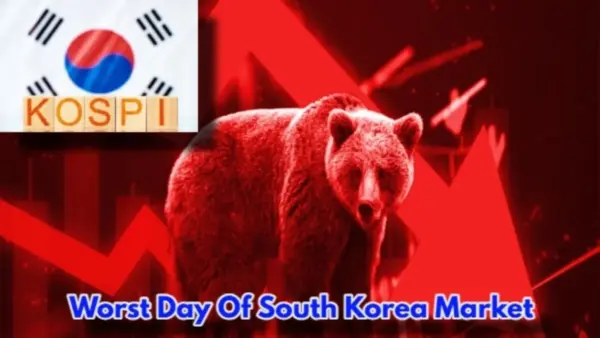
Nearly a month after South Korea overtook India to become the world’s sixth-largest stock market, the KOSPI witnessed its steepest single-day crash in July.
The benchmark index has erased a significant portion of its gains, correcting more than 27% from its June peak.
KOSPI remained as the world’s best-performing major equity market in 2026 due to euphoria around artificial intelligence investment. However, the index has plunged into a bear market, as it shed a quarter of its value since late June, as per Reuters report.
Experts believe that South Korea’s KOSPI decline is likely to weigh on investor sentiment for Indian stock market as Asian equities often move in tandem during periods of heightened risk aversion. However, some analysts argue that any foreign portfolio rebalancing away from AI-heavy markets could redirect capital flows towards other emerging markets like India.
KOSPI Crash From Its All-Time Peak
KOSPI has surged nearly 59% in 2026 so far, which is one of the biggest rallies in any equities market in the world this year. However, June marked a trend reversal as Seoul’s headline equity index fell more than 27% from its June peak. KOSPI surged to its all-time high of 9,385 on June 19 after starting the year at 4,424 points in January this year.
“The KOSPI’s recent decline was driven by several factors: profit-booking after a strong AI-fueled rally, especially in semiconductor stocks like SK Hynix and Samsung Electronics; concerns over stretched AI-related valuations prompting foreign investors to book profits; rising oil prices and global risk aversion due to Middle East tensions, including worries around the Strait of Hormuz; and heavy foreign institutional selling that triggered extreme volatility and trading halts,” stated Ruchit Thakur, Market Analyst, VT Markets.
Samsung, SK Hynix Biggest Constituent Of KOSPI
The KOSPI is a market capitalisation-weighted index, which means that its movement is determined by the aggregate market value of its constituent companies rather than each stock carrying equal weight.
“As a result, the largest companies have a disproportionate influence on the index, and their share price movements significantly impact both upward and downward trends.
Samsung Electronics and SK Hynix together accounted for nearly 58% of the index weight at their peak in June 2026, making them the primary drivers of the KOSPI’s performance. Both companies have been among the biggest beneficiaries of the global AI investment boom,” explained Siddharth Purohit, Fund Manager at InvestValue.
KOSPI Decline And Impact On Indian Stock Market
The bear market gripping the KOSPI is also likely to weigh on Indian stock market investors sentiment. “Since Asian markets tend to move together during risk-off periods, India could see some short-term FII selling as global funds turn cautious, though strong DII support should help cushion the fall. Indian IT stocks may face mild pressure if the Korean tech pullback signals broader concerns about global AI spending,” highlighted Ruchit Thakur.
However, he flagged crude oil price volatility as a bigger risk to India than KOSPI itself as Middle East-driven crude oil price has a ripple effect on the Indian economy, whether it is Rupee decline, inflation or RBI rate stance.
“India’s lower reliance on semiconductor exports, along with steady domestic SIP flows, adds resilience. Expect volatility over the next one to two weeks, with oil prices, FII flows, and earnings shaping the trend over the next three to six months,” added Ruchit Thakur.
Strong Earnings Season, Can Turn The Tide For Nifty, Sensex
Nifty and Sensex have underperformed in the year 2026 due to heightened geopolitical uncertainty led by Iran-US War. Crude oil price volatility also hurt the Indian stock market. Nifty has declined nearly 8% in 2026 so far, whereas BSE Sensex has corrected close to 9.55% year to date (YTD). Strong earnings season and lesser dependence on AI can act in favour of Nifty and Sensex.
“The investment landscape appears to be shifting. As earnings growth strengthens across India Inc. and foreign institutional investors gradually rebalance portfolios away from AI-heavy markets such as South Korea and Taiwan, India stands to benefit from incremental capital inflows. Moreover, the prolonged consolidation in Indian equities has made valuations relatively attractive, with the Nifty trading at approximately 20x one-year forward earnings,” stated Siddharth Purohit.