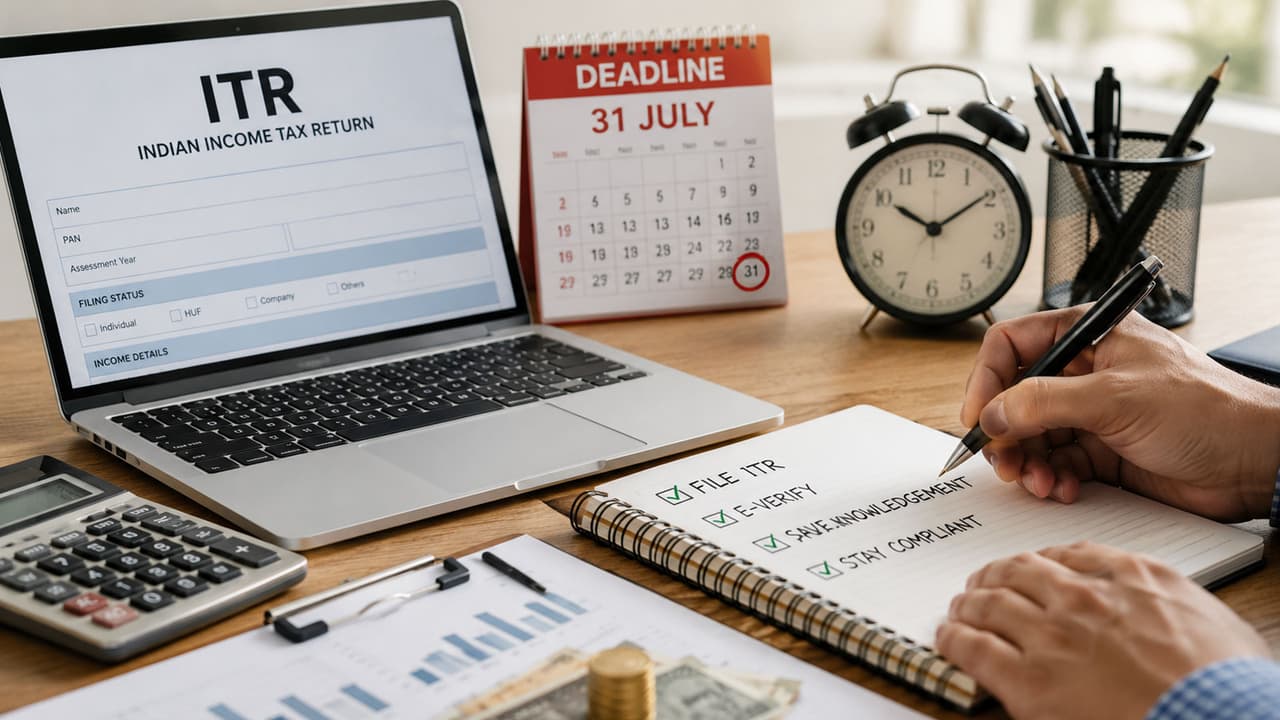
Before you submit your Income Tax Return, a final check is crucial. Small mistakes like using the wrong form, omitting income, or incorrect bank details can lead to delayed refunds and unwanted notices from the tax department.
A small error, such as selecting the wrong ITR form, missing an income source, or entering inaccurate bank information, might delay your refundor result in a warning from the tax department.
With the income tax return (ITR) filing deadline quickly approaching, taxpayers hurrying to complete their taxes should spend a few minutes to double-check the information before hitting the final ‘Submit’ button. A small error, such as selecting the incorrect ITR form, failing to include an income source, or entering incorrect bank information, might delay your refund or result in a warning from the income tax department.
Here are the important checks that every taxpayer should do before filing their return.
Verify personal information.
Begin by verifying your basic information, such as your PAN, Aadhaar, name, date of birth, cellphone number, and email address. Also, check that the bank account used to receive any tax refund is pre-validated and that the account data, including the IFSC code, are correct.
Ensure You’ve Selected the Correct ITR Form
Choosing the correct ITR form is one of the most crucial aspects in the filing procedure. The form you choose is determined on the type of income you get, such as salary, company income, capital gains, or foreign assets. Filing your return on the improper form may render it faulty, necessitating new compliance.
Match income with tax records.
Before submitting your return, check your income against Form 16, Form 26AS, the Annual Information Statement (AIS), and the Taxpayer Information Summary (TIS). While Form 16 provides pay information given by your employer, AIS may also include other income like as interest, dividends, or securities transactions that must be disclosed.
Report All Sources of Income.
Ensure that all taxable income has been reported on the return. Aside from salary, taxpayers should add savings account interest, fixed deposit interest, dividend income, rental income, pension, freelancing or consultant income, capital gains from stocks, mutual funds, or real estate, and income from virtual digital assets, where appropriate.
Verify TDS and tax payments.
Check that the Tax Deducted at Source (TDS) indicated in your return corresponds to the information provided in Form 26AS and AIS. Also, ensure that any advance tax or self-assessment tax paid during the fiscal year has been properly documented.
Claim eligible deductions.
Examine all deductions and exemptions that you are qualified to claim under the applicable tax law. This might include deductions for investments, health insurance premiums, supplementary NPS payments, house loan interest, and qualifying gifts, as appropriate.
Check Capital Gains Reporting Carefully.
Taxpayers who sold stocks, mutual funds, real estate, or other capital assets during the fiscal year must verify that capital gains are calculated and reported appropriately. Incorrect reporting may lead to future tax requests or notifications.
Disclose foreign assets and overseas income, if applicable.
Resident taxpayers with foreign bank accounts, overseas assets, or foreign income must report these facts on their income tax returns. Nondisclosure can result in fines under the Income Tax Act.
Verify Bank Account Details
Your tax refund may be delayed due to a minor miscalculation in your bank account number or IFSC code. Confirm that the right bank account has been specified to receive any refunds.
Pay the outstanding tax before filing.
If your tax computation indicates an outstanding liability, pay the self-assessment tax before completing the return. Check that the challan information are appropriately entered in the ITR.
Preview and E-verify the return.
Before submitting, examine your total income, deductions, tax liability, and refund amount. After filing, finish the e-verification procedure using the Aadhaar OTP, net banking, or any other applicable method. An ITR is regarded complete if it has been successfully e-verified.
Common Mistakes To Avoid
Tax experts urge taxpayers to avoid frequent errors such as selecting the improper ITR form, disregarding differences between AIS and Form 26AS, neglecting to declare interest or dividend income, inaccurately reporting capital gains, inputting incorrect bank information, or failing to e-verify the return. Filing far ahead of the deadline can also assist minimise last-minute portal congestion and mistakes.