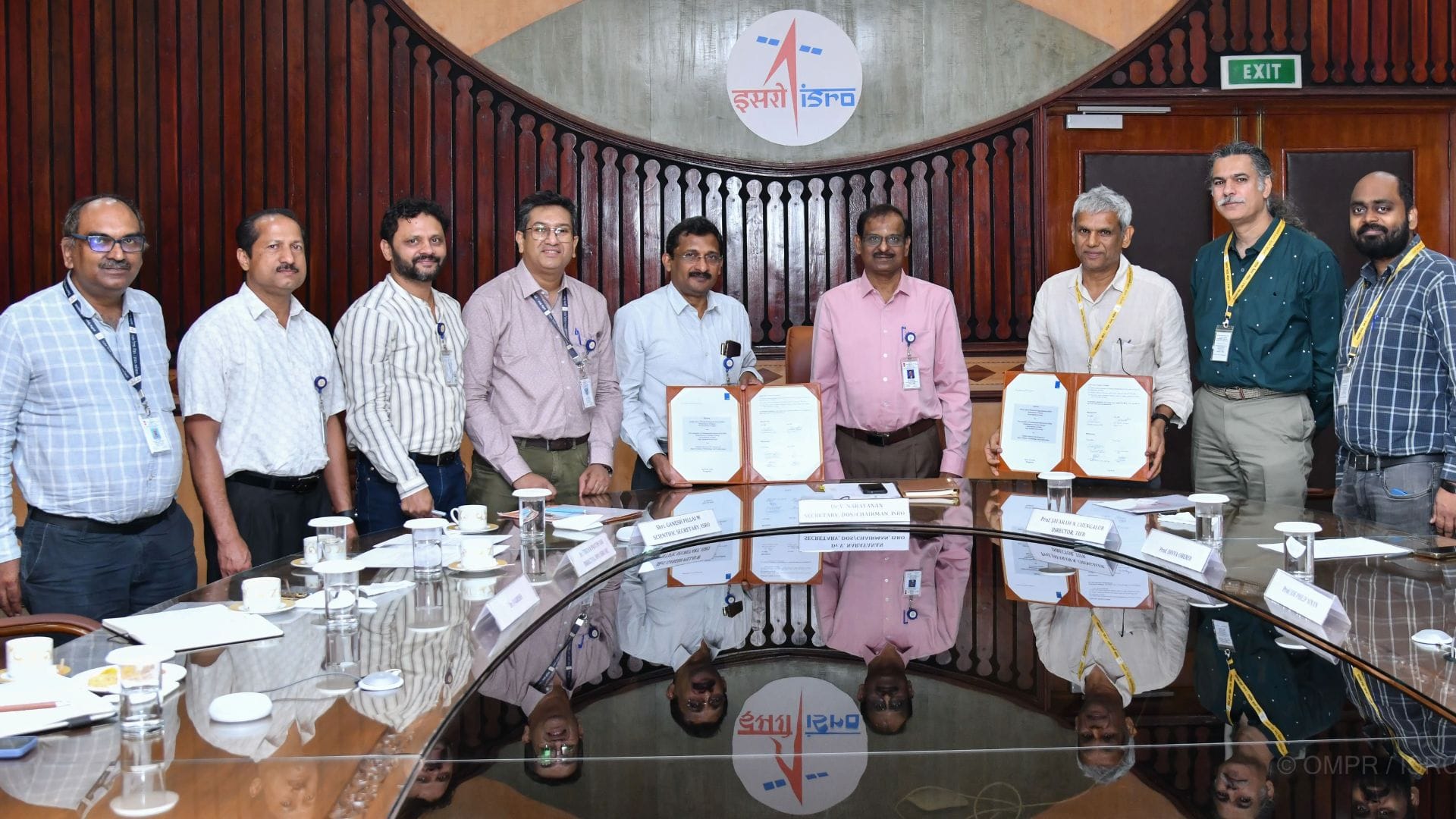
New Delhi: The Indian Space Research Organisation (ISRO) under the Department of Space (DOS) has signed a Memorandum of Understanding (MoU) with the Tata Institute of Fundamental Research, under the Department of Atomic Energy (DAE) towards scientific collaboration in the domain of space science, technology and exploration. The MoU was signed at ISRO headquarters in Bengaluru, presided over by ISRO Chairman and Secretary to DOS, V Narayanan. The MoU was signed by the Scientific Secretary to ISRO, Ganesh Pillai and Director of TIFT Jayaram Chengalur. The MoU establishes a formal framework for scientific collaboration between ISRO and TIFR.
ISRO and TIFR have shared an umbilical relationship in space science for several decades. TIFR played a crucial role in the formative days of the Indian space programme, by supporting the operations with early balloon experiments, as well as mission-specific partnerships such as AstroSat, with TIFR contributing to three of the five payloads on board. The MoU provides a structured multi-year collaboration in ground and space-based scientific exploration. The MoU bridges a critical gap in the formal framework for science collaboration. The collaboration between ISRO and TIFR would facilitate the materialisation of the nation’s target to achieve excellence in space science.
Why India needs nuclear technologies in space
ISRO is one of the active operators on the Moon, and for extended missions that survive lunar nights, it is necessary to use nuclear heat sources. A radioisotope heater unit (RHU) was sneaked onto the Propulsion Module of the Chandrayaan 3 mission, to test the technology. The partnership enhances India’s might in space exploration by fostering a seamless pipeline between academic excellence and space infrastructure. By co-developing indigenous hardware and joint testing facility, the reliance on foreign entities reduces. TIFR plans to leverage national space and ground-based technological capabilities to propose projects that translate fundamental scientific knowledge into tangible advancements aligned with national initiatives.