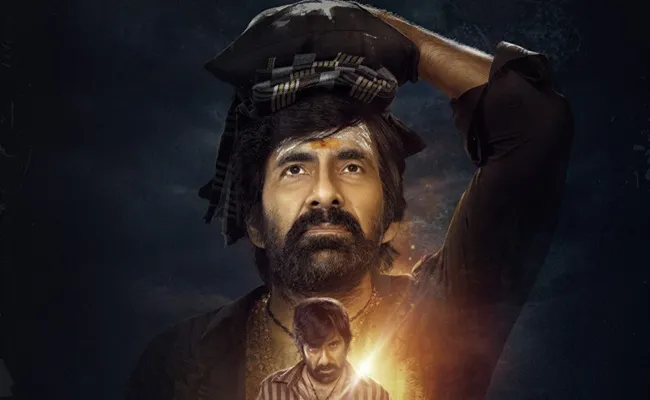
Ravi Teja and director Shiva Nirvana have explored very different genres throughout their careers. With Irumudi, both step out of their comfort zones and attempt a different kind of family drama by blending devotional elements with action, emotion and revenge.
Let’s find out how different Irumudi really is.
Story
Trinadh (Ravi Teja) is an Ayyappa Swamy devotee who lives with his wife Kaveri (Priya Bhavani Shankar) and daughter Mani (Baby Nakshatra) in a village near Sileru in Alluri Sitarama Raju district of Andhra Pradesh.
The village is troubled by a rowdy gang that creates nuisance and harasses schoolgirls.
When he is not observing the Deeksha, Trinadh drinks and often takes on the local rowdies. His daughter Mani suspects that something is wrong with Gayatri, the daughter of Guru Swamy (Sai Kumar), and tries to tell her father about it but is unable to do so.
One night, Gayatri does not return home even after midnight. What happened to her? Will Trinadh find her and teach the rowdies a lesson, or is there a bigger twist waiting?
Performances
Ravi Teja delivers his best performance in a long time.
In several of his recent films, he largely played roles designed around his mass image and familiar mannerisms. Irumudi, however, gives him an opportunity to bring out the actor in him.
He completely surrenders to the character and stays away from his usual mass antics. His emotional performance, particularly in the second half, is one of the film’s biggest strengths.
Baby Nakshatra is a great find and delivers a superb performance. Her scenes with Ravi Teja work particularly well and form the emotional backbone of the film.
Sai Kumar is effective in another important role. Priya Bhavani Shankar fits well as an ordinary wife. Swasika Vijay, as a sinister teacher, and Ramesh Indira, as an MLA, are convincing in their respective roles. Meesala Laxman and Ajay Ghosh are adequate.
Technical Aspects
The film benefits greatly from strong cinematography and music.
Vishnu Sharma captures the Sileru region and its surroundings beautifully while also creating the required mood for the thriller portions.
G.V. Prakash Kumar’s music is one of the film’s major strengths. Songs such as Mallepoola Pallaki Ekkinadu are effectively woven into the narrative instead of appearing as standalone numbers.
His emotional background score also works well in several key scenes.
Prawin Pudi’s editing is effective, while Sahi Suresh’s production design suits the rural setting.
Shiva Nirvana’s dialogues and screenplay work well for the most part, particularly in the emotional portions and in integrating the Ayyappa Deeksha thread into the story.
Highlights
Ravi Teja’s terrific performance
Father-daughter scenes
Emotional final portions
Ayyappa Deeksha backdrop
Drawbacks
Logical loopholes
Convenient writing
Zero police
Analysis
Irumudi is neither a regular title nor a regular film for Ravi Teja.
After trying several action dramas and mass entertainers with mixed results, Ravi Teja appears to be consciously exploring a different path. He first attempted a family entertainer with BMW, released earlier this year, and with Irumudi, he moves further into story-driven cinema.
There is no romantic track or duet with the heroine, and there is no separate comedy track either.
The film opens with the suicide of a girl and presents an important sequence from the climax before going back to the beginning of the story.
The film then gradually develops like a thriller.
The introduction of a rowdy gang that harasses schoolgirls, along with the suspicious activities of a schoolteacher, brings energy to the narrative and starts building curiosity.
The first half sets up the drama reasonably well, but the real kick comes with the Pallaki Ekkinadu song.
From that point until the end, the film becomes gripping and emotional.
This stretch also brings two twists that are likely to surprise regular audiences. The climax is handled even better and delivers the intended emotional impact.
What begins as a father-daughter family drama gradually turns into an action drama and eventually a revenge story.
However, Shiva Nirvana gives it a different treatment instead of turning it into a routine revenge actioner.
The integration of the Ayyappa Swamy Deeksha thread gives the film a distinct identity. More importantly, the director has written a strong role for Ravi Teja. These elements give Irumudi a fresh feel.
The film’s biggest weakness is its logic.
One major twist involving a key character is not very convincing. Considering the character’s background, it is difficult to believe that such a person would behave in that manner. The twist appears to have been written mainly for shock value.
Another reveal involving a different character is relatively predictable, as several films, including Rangasthalam, have used similar characters only to reveal them as villains towards the end.
The lack of police presence is another glaring issue.
The story is set in the present day, yet there is hardly any police involvement even after a girl goes missing. There is also no convincing investigation despite multiple deaths involving schoolgirls in the village. This comes across as convenient writing.
Despite these flaws, Irumudi works because Shiva Nirvana has chosen a story with a strong emotional core.
Overall, Irumudi works as a content-driven emotional action drama. The father-daughter relationship is handled with genuine emotion, while the Ayyappa Swamy Deeksha thread is blended into the narrative in a way that gives the film a different flavour. Most importantly, Shiva Nirvana brings out the actor in Ravi Teja while still retaining enough action to satisfy his image.