The commander of Iran’s joint military command issued a warning on Wednesday, stating that Iran would halt trade in the Gulf region if the United States does not lift its blockade on Iranian ports.
According to the U.S. Central Command, no vessels have successfully navigated past U.S. naval forces during the initial 48 hours of the blockade.
In a related statement, U.S. President Donald Trump asserted that the conflict in Iran is nearing resolution. He also claimed that China has agreed not to supply arms to Iran, despite ongoing reports suggesting otherwise. The Chinese Foreign Ministry has consistently denied allegations of military support to Iran.
Progress in Ceasefire Negotiations
Efforts by mediators to extend the ceasefire between the United States and Iran appear to be advancing, with expectations that both parties will soon reconvene for further negotiations, according to regional officials. However, a senior U.S. official clarified that no formal agreement to extend the ceasefire has been reached, emphasizing that engagement with Iran remains ongoing. The latest diplomatic initiative was marked by a Pakistani delegation’s arrival in Tehran for discussions.
Israel’s Military Operations in Lebanon
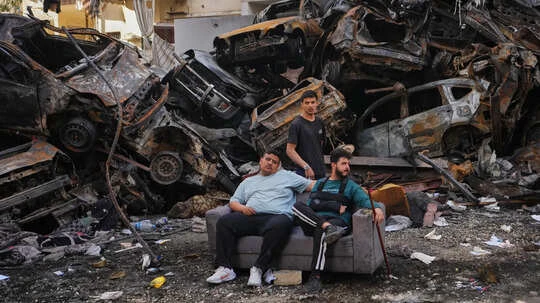
In parallel developments, Israel continues its military operations in Lebanon, where the death toll has reportedly surpassed 2,100. The Israeli National News Agency reported extensive airstrikes and artillery bombardments across southern Lebanon, where Israeli forces have encircled Hezbollah fighters. This escalation follows the first direct talks between Israel and Lebanon in decades.
UN Commends Israel-Lebanon Dialogue
The United Nations welcomed the recent Israel-Lebanon meeting as a significant step toward reducing violence in the region. U.N. deputy spokesman Farhan Haq remarked that maintaining dialogue is crucial for resolving outstanding issues and achieving stability. Despite these discussions, ongoing hostilities persist, as U.N. peacekeeping forces report continued attacks in the Israel-Hezbollah conflict.
Naval Expert Insights on Blockade Evasion
Naval security expert Joshua Tallis noted that while some vessels may attempt to evade the U.S. blockade by concealing their identities, the U.S. Navy possesses the capability to track these ships. He emphasized that the blockade’s effectiveness relies more on the overarching economic impact rather than individual vessel movements.
U.S. Economic Measures Against Iran
Treasury Secretary Scott Bessent warned of impending economic measures against Iran, stating that the U.S. is prepared to impose sanctions equivalent to military actions. Bessent indicated that the administration has communicated to international companies and governments that engaging in trade with Iran could result in severe penalties.
Ongoing U.S.-Iran Discussions
White House Press Secretary Karoline Leavitt confirmed that the U.S. has not officially requested an extension of the ceasefire with Iran, noting that negotiations are still active. The current ceasefire, established on April 7, is set to expire next Tuesday, with discussions about potential future talks likely to take place in Islamabad.
Rising Gas Prices and Economic Outlook
Amid rising gas prices, Bessent stated that Americans can choose how to allocate their tax refunds. He expressed optimism that gas prices could return to around $3 per gallon by the summer, contingent on the resolution of the conflict affecting oil supply.
U.S. Navy’s Enforcement of Blockade
The U.S. Navy has communicated to merchant vessels in the region that it is prepared to use force to enforce the blockade on Iranian trade. A Navy radio message indicated that ships violating the blockade would be boarded and seized.
Iran’s Warning on Trade Blockade
Iranian state media reported that the commander of Iran’s military command warned that the country would completely halt trade across the Persian Gulf, the Sea of Oman, and the Red Sea if the U.S. blockade on Iranian ports remains in place. This declaration underscores Iran’s commitment to defending its sovereignty.
Continued Hostilities and Humanitarian Impact
The ongoing conflict has resulted in significant humanitarian consequences, with reports indicating over 1.2 million Lebanese individuals displaced due to the violence. As hostilities persist, the situation remains dire for civilians caught in the crossfire.