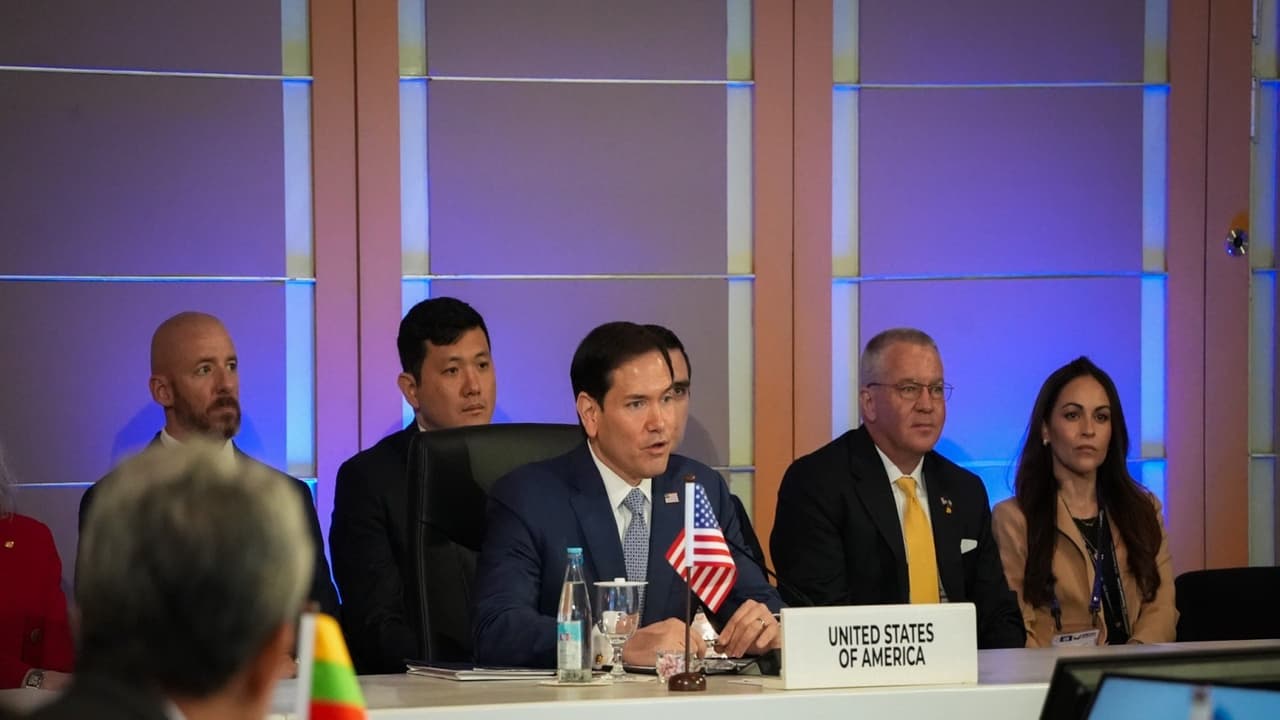
US Secretary of State Marco Rubio accuses Iran of failing to honour commitments and not being ‘serious about talks,’ despite Washington’s willingness to engage in diplomacy. He warned against allowing Tehran to control the Strait of Hormuz.
US Secretary of State Marco Rubio on Wednesday accused Iran of failing to honour commitments in negotiations reached with Washington last month and said Tehran was “not serious about talks,” while warning that allowing it to control the Strait of Hormuz would set a “very dangerous precedent” for international trade and freedom of navigation.
US committed to diplomacy, but Iran ‘not serious’
Speaking at the ASEAN Post-Ministerial Conference with the United States in Manila, Rubio said Washington remained committed to diplomacy and was willing to pursue a negotiated resolution with Iran. “I just want to reiterate once again, the United States is always committed to diplomacy. We are open-minded and always willing to engage in negotiated settlements of differences. And that remains true in the case of Iran,” Rubio said.
He said Iran had approached the United States through both direct and indirect channels for talks, but alleged that Tehran had failed to uphold its commitments. “Unfortunately, as of now, despite their direct outreaches – and Iran has been reaching out to the United States, both directly and indirectly, to engage in talks about settling the differences… even though we have reached agreements, they have not kept their commitments,” Rubio said.
“The problem we’re having right now is that they’re not serious about talks. If they’re serious, we’re serious. If they’re not, then we will do what is necessary to protect our interests, and also the interests of our allies,” he added.
Warning on Strait of Hormuz
Rubio also criticised what he described as Iran’s demand to control traffic through the Strait of Hormuz, calling the waterway an international maritime route that must remain open. “At its core, it’s very simple. Iran demands the right, which they do not have under any existing legal mechanism, to control the transit of traffic through the Straits of Hormuz. This is an international waterway,” he said.
‘A dangerous precedent’ for global trade
Warning of wider implications, Rubio said allowing any country to control an international shipping route through force would undermine global commerce. “If we create a precedent in the Middle East where a nation state can decide that they are going to control an international waterway, charge a toll, and if you don’t pay them, blow up your ships, we have created a very dangerous precedent which will repeat itself in other parts of the world, including in this region,” he said.
Rubio stressed that the issue extended beyond the Strait of Hormuz and concerned the broader principle of freedom of navigation. “So what is at stake here is not simply the issue of what’s happening in the Straits of Hormuz. It’s a very fundamental principle about freedom of navigation. And if that is threatened, then I think the global economy is threatened and the rules which have underpinned 150 years of international trade and commerce are also threatened. And that cannot be allowed to happen,” he said.
Consequences for broken commitments
Reiterating the US position, Rubio said Washington remained open to diplomacy but warned that there would be consequences if agreements were not honoured. “The United States remains open and willing to engage in positive, constructive negotiations and talks so long as the commitments that are made are kept. And when those commitments are not kept, which is what’s happened in this particular case, then there will be consequences,” he said.
The remarks come as tensions between Iran and the United States escalated after the collapse of the 14-point MoU, signed last month, aimed at ending the hostilities between the two sides and opening the pathway for further negotiations, particularly on Iran’s nuclear programme and the Strait of Hormuz. Its collapse renewed the conflict in West Asia, with the US striking Iranian military and civilian assets, and the Islamic Republic also targeting American bases across the Gulf in retaliatory strikes. (ANI)
(Except for the headline, this story has not been edited by Asianet Newsable English staff and is published from a syndicated feed.)