The nuclear deal between America and Saudi Arabia is under discussion.
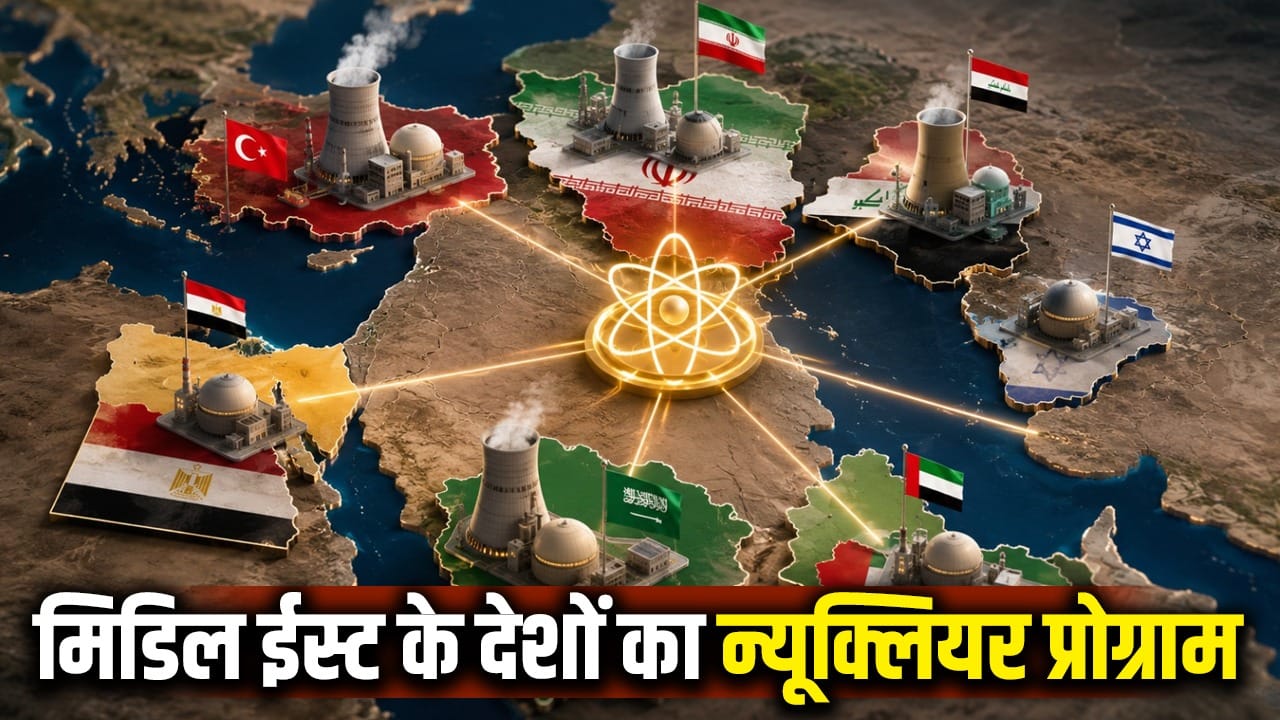
The latest nuclear deal between America and Saudi Arabia towards civil nuclear cooperation has intensified the debate. Because of this, the nuclear question of the Middle East is again at the center of the world. The reason is not just Iran’s uranium enrichment. Israel’s alleged nuclear capability, Saudi Arabia’s new ambitions, Türkiye’s nuclear power plants and Iraq’s old history are also part of this story.
Let us understand, under the pretext of Saudi Arabia-US deal, how far has the nuclear program of the Middle East countries reached, from Iran-Iraq to Israel-Türkiye?
What is the difference between nuclear program and nuclear weapons?
Not every country that produces nuclear power makes nuclear bombs. Low level enriched uranium is used for power plants. Uranium enriched to very high levels can be used to make weapons. That is why the line between nuclear energy and nuclear weapons is very sensitive. The International Atomic Energy Agency monitors the programs of many countries.

Israel is the most mysterious nuclear power
Israel has never officially said that it has nuclear weapons. But most of the world’s strategic and security experts believe that Israel has a stockpile of nuclear weapons. However, Israel neither clearly accepts nor clearly denies. It is also not a member of the Nuclear Non-Proliferation Treaty.
It is believed that the Dimona complex in the Negev desert has an important place in its nuclear program. A major part of Israel’s strategy is to make its adversaries assume that it has the capability to respond to the ultimate level. Israel has also been very aggressive regarding suspicious nuclear programs of other countries. In 1981, he attacked Iraq’s Osirak reactor. In 2007, a suspected nuclear complex in Syria was also targeted. Israel has also been putting pressure on Iran’s nuclear infrastructure for a long time.

Iran: Technologically at the forefront, but no weapons declared
Iran is the biggest center of the nuclear dispute in the Middle East. Iran is a member of the Nuclear Non-Proliferation Treaty. Iran says that its program is for electricity, medical and scientific needs. But America, Israel and many Western countries believe that Iran has developed the technical capability to produce weapons-grade material in a short time. Iran has enriched uranium up to 60 percent.Generally about 90 percent enrichment is required to make weapons, so the 60 percent level is considered very serious.

Iran’s Supreme Leader Mojtaba Khamenei.
Natanz, Fordow and Isfahan are among the major nuclear centers of Iran. It also has a nuclear power plant in Bushehr. There were reports of damage to some of Iran’s nuclear sites in recent conflicts. Yet the real question remains: how much enriched uranium does Iran have left and how soon can its nuclear capability be restored?
Saudi Arabia: Energy need or strategic message?
Saudi Arabia is not yet a nuclear weapons country. It is a member of the Nuclear Non-Proliferation Treaty, but Iran’s growing capabilities have changed Riyadh’s thinking. The Saudi leadership has previously said that if Iran acquires nuclear weapons, Saudi Arabia can also adopt a similar path. In this background, US-Saudi nuclear cooperation is being discussed in an important way in the world. An important framework has been created for civil nuclear cooperation between America and Saudi Arabia. It is generally being linked to Agreement 123 of the American Nuclear Cooperation Act.

Saudi Arabia and America have signed a nuclear deal.
The stated objectives of the deal are nuclear power generation, new technology and energy diversification. Saudi Arabia wants to reduce dependence on oil. It wants to save more of its domestic oil for export. But the dispute is about uranium enrichment. Saudi Arabia claims to have uranium reserves. If a country gets the capability to produce indigenous weapons, then it can get closer to the option of making weapons in the future. For this reason, some members of the US Parliament and nuclear non-proliferation experts are expressing concern over this agreement.

Turkey is building its first big nuclear power plant.
Türkiye: building power plants, not weapons programs
Türkiye’s nuclear story is different from that of Iran and Israel. Türkiye is a member of the Nuclear Non-Proliferation Treaty and has no evidence of possessing nuclear weapons. It is building its first big nuclear power plant, Akkuyu. This project is being developed with the help of Russian government company Rosatom. There are plans for four reactors. Türkiye’s logic is clear. It has to meet the increasing demand for electricity. Also, dependence on gas and oil imports has to be reduced. Therefore its program is mainly related to civil energy needs. Türkiye is also a member of NATO. For this reason its security situation is different from that of Iran or Saudi Arabia.

Iraq.
Iraq: unfulfilled dream and chronic disaster
Iraq’s nuclear history is the most warning example. Iraq had tried to acquire nuclear capability during the era of Saddam Hussein. In 1981, Israel attacked and destroyed the Osirak reactor near Baghdad. International investigations after the 1991 Gulf War revealed Iraq’s secret nuclear efforts. After this America laid siege here. Even Saddam Hussein was punished and his program was ended. Today Iraq does not have an active nuclear weapons program. Its use is mainly limited to medical, agricultural and scientific fields. International organizations also do not provide evidence of revival of nuclear weapons program in Iraq.
UAE-Egypt: No dispute on nuclear energy program
This Gulf country has established a nuclear power plant in Barakah. This country took the help of South Korea in this work. The UAE has voluntarily announced that it will not enrich uranium. Egypt is also working on a nuclear energy project with the help of Russia. This plant is being built in El-Daba. Therefore, there are no significant controversies at the international level regarding the programs of both the countries.
Is the Middle East heading towards a nuclear race?
Israel’s alleged weapons capability already exists. Iran has achieved advanced nuclear technology and a high level of enrichment. Saudi Arabia wants to set up a civilian nuclear infrastructure. Türkiye is building reactors for power generation. The situations of all these are different. Still, they impact each other. If Iran moves forward, Saudi Arabia feels pressure. If Saudi Arabia gets permission for enrichment, other countries can also make similar demands. Israel’s ambiguous nuclear policy continues to affect the security balance of the region.
The nuclear issue in the Middle East is not just a matter of science or electricity. It is a question of security, power, politics and trust. Saudi-America nuclear deal could be useful for energy. But with that, strict international monitoring, clear rules and transparency will be necessary. Otherwise the gap between civilian nuclear program and weapons capability will continue to narrow. The safest path to peace in the region is for all countries to avoid a nuclear arms race.
Also read: India or China, who is the real king of the generic drug market?