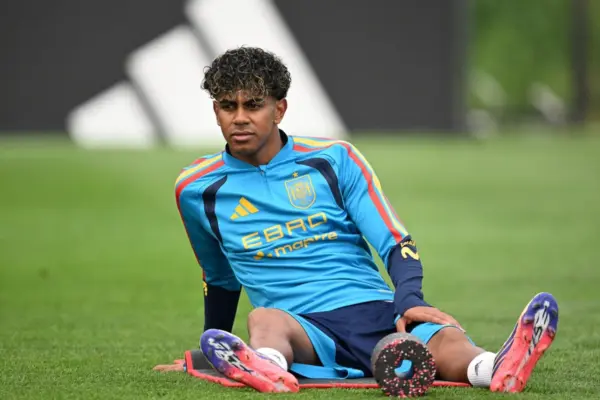
Spain were dealt a massive blow just ahead of the FIFA World Cup 2026 final against Argentina as Lamine Yamal did not practice with the main group on Friday and was seen with heavy strapping on his left thigh.
Spain started their preparations for the summit clash days after their semifinal win over France, but the Barcelona winger did not take part in the main session. According to reports, both Yamal and Pedro Porro trained lightly away from the group. Yamal suffered a heavy blow after he was brought down in the penalty box by LucasDigne in the 22nd minute, resulting in the spot-kick that was converted by Mikel Oyarzabal. While the youngster played the entire game, reports claimed that his pain intensified afterward and was treated by Spain’s medical staff at the team hotel in Dallas. However, it seems unlikely that the injury will prevent him from playing, as the teenager is still expected to feature in the final against Argentina.
Meanwhile, FIFA, football’s world governing body, has launched an investigation over a controversial banner displayed by Argentina’s players after their FIFA World Cup 2026 semifinal win against England in Atlanta on the disputed Falkland Islands, which had caused a war between the two countries a few decades back.
FIFA launched the probe after the Falkland Islands Government described as ‘insensitive’ the banner members of the Argentina team took out following their win against England, according to reports in the English media.
During their wild celebrations after the full-time whistle at the end of the match in which Argentina made a fine comeback after a goal deficit to win 2-1, a group of Argentina players held up a banner which read: “Las Malvinas son Argentinas (The Falklands are Argentine).”
This is the second time that Argentina’s players have raised this controversial issue during the ongoing World Cup. A few days back, they had sung a chant referencing the Falklands in the wake of their 3-2 victory over Egypt in the round of 16.
“The banner has sparked backlash from the UK, with many believing that it was offensive to the 255 British soldiers who were killed during the Falklands War in 1982,” the Mirror newspaper said in a report.
A statement from the UK Government issued on Thursday morning reiterated: “The World Cup might not be ours, but the Falkland Islands definitely are.”