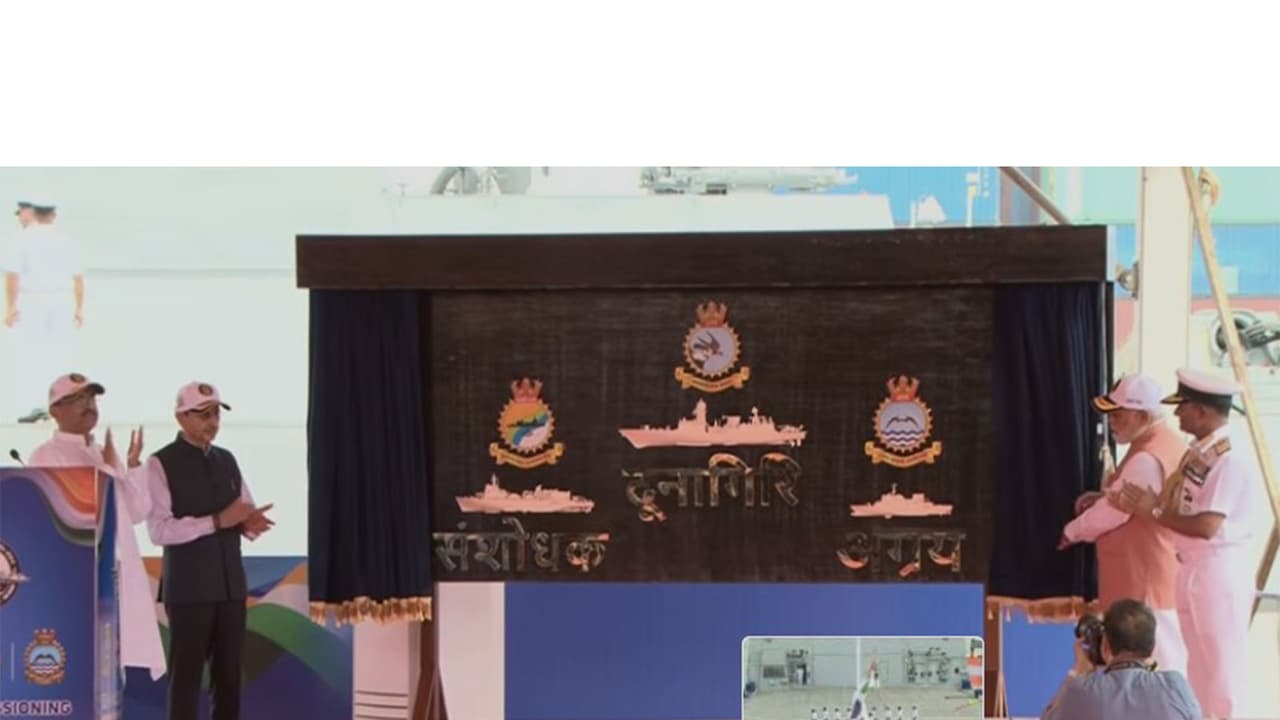
PM Modi commissioned three frontline naval platforms—INS Dunagiri, INS Sanshodhak, and INS Agray—in Kolkata. Navy Chief Admiral Krishna Swaminathan said this shows India’s warship-building capability is gaining speed in self-reliance.
Chief of the Naval Staff (CNS) Admiral Krishna Swaminathan said that the commissioning on Sunday of three frontline platforms – INS Dunagiri, an advanced stealth frigate; INS Sanshodhak, a survey vessel (large); and INS Agray, an anti-submarine warfare shallow water craft – shows that India’s warship-building capability is gaining new speed in modern technology, self-reliance, and self-confidence.
The three naval vessels were commissioned by Prime Minister Narendra Modi on Sunday. In his opening remarks, the CNS stated that these ships will greatly boost the Indian Navy’s capabilities and make its efforts to protect the nation’s maritime interests much more powerful and effective.
Navy Chief on India’s Growing Shipbuilding Prowess
He said the tri-commissioning in Kolkata, comes just 17 months after Independent India’s first tri-commissioning in Mumbai, and shows that “India’s warship-building capability is gaining new speed in modern technology, self-reliance, and self-confidence”.
Admiral Krishna Swaminathan extended his heartiest congratulations to the dedicated team at GRSE, industry partners, and MSMEs whose support made this successful tri-commissioning possible. Congratulating the Commanding Officers and crews of the three ships, he expressed confidence that the officers and crew will operate these ships with total confidence, sincerity and great energy, remaining always ready to defend the nation.
Aatmanirbhar Bharat in Maritime Sector: PM Modi
In his remarks, PM Modi said the strength of a nation’s military can be measured by its ability to become self-reliant and India seeks to become a producer and a manufacturer. He said nations that are manufacturers and largely self-dependent become decisive players on the global stage.
The Prime Minister said that West Bengal is poised to become a major hub for India’s blue economy and maritime manufacturing in the years ahead. He also said that a country with strong maritime strength is will have robust economic and strategic influence and India is preparing itself for this.
The three inductions are expected to significantly bolster the nation’s operational capabilities, enhance maritime domain awareness, and strengthen the security of our coastal waters against geopolitical threats.
Maritime Strength and a Developed India
The Prime Minister noted that the occasion coincides with the International Day of Yoga being celebrated across the world and expressed happiness at having the opportunity to visit the historic land of Bengal, which has played a pivotal role in shaping India’s intellectual, cultural and national renaissance and has connected India with the world through maritime routes for centuries. “The event represented an important milestone in the journey towards an Aatmanirbhar Bharat, a secure India and a developed India,” he said.
He pointed out that June 21 is also observed globally as World Hydrography Day and described it as a remarkable coincidence that India’s most advanced hydrographic survey vessel, INS Sanshodhak, is commissioned on the same day. Congratulating the Indian Navy, scientists, engineers, workers and all citizens of the country, PM Modi said the achievement reflected India’s growing technological and maritime capabilities.
“No nation can emerge as a major power without strong maritime capabilities. Development, security and prosperity are closely linked to the oceans. Most of the world’s trade moves through sea routes, while vast global data networks operate beneath the oceans,” PM Modi stated while emphasizing the importance of maritime strength in the modern world. He further noted that critical minerals, deep-sea resources and future sources of energy will increasingly be connected to the maritime domain. Therefore, he said, a nation’s economic and strategic influence is directly linked to the strength of its maritime sector. PM Modi stated that India fully understands this reality and is preparing itself accordingly. “The commissioning of the three naval platforms stands as testimony to the country’s growing capabilities and skills”, he remarked.
From Buyer to Producer
Recalling the commissioning of INS Vikrant, he said that it had marked the beginning of a new chapter in India’s maritime journey and announced India’s growing naval strength to the world. He noted that the journey from INS Vikrant to the commissioning of INS Agray, INS Dunagiri and INS Sanshodhak is not merely a story of new warships but also a reflection of India’s increasing self-reliance.
“All three vessels symbolize India’s commitment to indigenous design, manufacturing and innovation. Designed and built in India, the vessels showcase the talent of Indian industries, the expertise of Indian engineers and the hard work of Indian workers.”
PM Modi asserted that India does not wish to remain merely a buyer in the defence sector. “The strength of the nation’s military cannot be measured by its dependence on global markets but by its ability to become self-reliant. India seeks to become a producer and a manufacturer, because nations that manufacture become decisive players on the global stage,” he added.
Symbol of Indigenous Design and Manufacturing
Marked by the ceremonial breaking of the Commissioning Pennant and the maiden hoisting of the National Flag, the occasion brought together frontline combat capability, hydrographic excellence and shallow-water anti-submarine warfare strength in a single defining moment, a release said.
The three ships have been designed by the Indian Navy’s Warship Design Bureau as well as by Garden Reach Shipbuilders & Engineers (GRSE), and constructed by GRSE, with extensive participation by Indian industry, including more than 200 MSMEs. With an indigenous content of over 75 percent, these ships are a testament to India’s commitment to Aatmanirbharta, the release said. (ANI)
(Except for the headline, this story has not been edited by Asianet Newsable English staff and is published from a syndicated feed.)