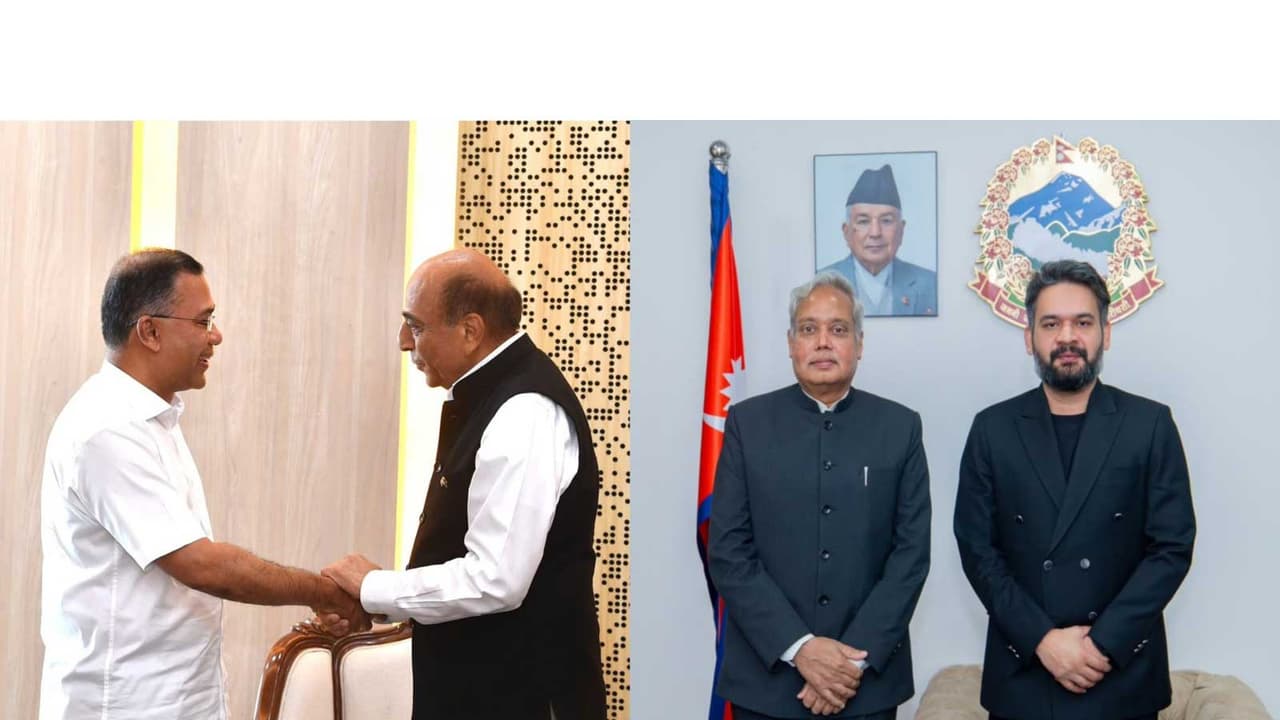
Indian envoys held high-level meetings with the Prime Ministers of Bangladesh and Nepal on the same day, reaffirming the ‘Neighbourhood First’ policy. Discussions focused on regional cooperation, bilateral development, and resolving diplomatic friction.
High-Level Dialogue in Dhaka
In Dhaka, India’s High Commissioner to Bangladesh, Dinesh Trivedi, paid a courtesy call on Bangladesh Prime Minister Tarique Rahman at the Prime Minister’s Office in the Secretariat. The meeting served as a crucial step to foster constructive dialogue and steer bilateral ties forward amidst recent diplomatic friction. Discussions touched upon enhancing people-centric cooperation across multiple domains, trade, and regional stability.
During the talks, the Bangladeshi side expressed hope that India would expedite the extradition process for former Prime Minister Sheikh Hasina, alongside reiterating requests regarding individuals sought in connection with domestic legal cases.
Emphasising the value of direct communication, High Commissioner Trivedi noted that dialogue between leadership remains the most effective pathway to resolving outstanding bilateral concerns.
The diplomatic dialogue between the two nations unfolded against the backdrop of a virtual press interaction by former Bangladeshi Prime Minister Sheikh Hasina in New Delhi on August 5. Organised by the Foreign Correspondents’ Club of South Asia to mark the second anniversary of her ouster following the 2024 student-led uprising, the event triggered strong objections from Dhaka.
During her address, Hasina stated that she remains resolute about returning to her homeland in December to put the nation on the “right track” by restoring democracy, despite acknowledging the risk of imprisonment or a death sentence upon her return.
In a swift response, Bangladesh’s Ministry of Foreign Affairs registered a strong protest and condemned the statements, noting that the incident impacted public sentiment and complicated efforts to enhance bilateral cooperation.
Before the high-level dialogue, High Commissioner Trivedi held a one-on-one meeting with Bangladesh Foreign Minister Khalilur Rahman on Sunday, who was also present during Monday’s interaction alongside Prime Minister’s Foreign Affairs Adviser Humayun Kabir and other senior officials.
Addressing reporters in Dhaka on Sunday after inaugurating a children’s corner at the Indian Visa Application Centre, Trivedi expressed strong optimism regarding the engagement and emphasised the importance of direct dialogue. “I feel that when… when two leaders meet, a lot of problems are solved. Problems are sorted out when we talk to each other. And I have full confidence that people are together, and the solution will definitely happen… it will happen. I am very confident. There is nothing negative here; everything is positive,” the Indian envoy said.
Praising the Bangladeshi leadership, Trivedi added, “The Prime Minister of Bangladesh… we all respect him a lot. I have listened to his speeches many times, and he talks from his heart. This, I have seen. He is a people’s person. And our Prime Minister is also of the people.”
During the meeting, the Bangladesh Prime Minister welcomed the Indian envoy, who shared his experience of serving in Dhaka over the past two months. Tarique Rahman underlined the necessity of cultivating an enabling environment to advance bilateral relations between Bangladesh and India.
According to a statement issued by the Bangladesh Prime Minister’s Office, “Bangladesh expressed hope that India will expedite the extradition process of Sheikh Hasina.”
“At the same time, Bangladesh reiterated its request to India to return the killers involved in the murder of Shahid Osman Hadi,” the statement added, referring to the prominent figure of the July uprising who was shot at close range on December 12, 2025.
Addressing previous concerns, India had distanced itself from Hasina’s engagement, clarifying that the government had no role in the event held in the national capital.
Addressing a media briefing, Ministry of External Affairs (MEA) spokesperson Randhir Jaiswal stressed that the event was being organised by a “private media entity” and that New Delhi does not endorse any views that may be expressed there. “The interaction you refer to is being organised by a private media entity. The government has no involvement whatsoever in it. Neither does it endorse any views that may be expressed at the forum,” Jaiswal said.
The high-level meeting also coincides with India’s invitation to Prime Minister Tarique Rahman to attend the BRICS Summit in September in his capacity as the current chair of BIMSTEC.
Breakthrough Meeting in Kathmandu
Simultaneously in Kathmandu, India’s Ambassador to Nepal, Naveen Srivastava, paid a courtesy call on Nepal Prime Minister Balendra Shah at the Prime Minister’s Office in Singha Durbar. The 45-minute interaction marked a significant milestone as PM Balendra Shah–who had previously maintained a strict policy of avoiding individual, one-on-one meetings with foreign diplomats–broke his self-imposed rule to meet directly with the Indian envoy.
Ambassador Srivastava conveyed warm greetings from Indian Prime Minister Narendra Modi, emphasising a mutual dedication to cultivating a robust, multifaceted partnership. The discussions heavily centred on expanding cooperation in development projects, trade, energy, and infrastructure to reinforce the deep-rooted historical and cultural ties shared between the two nations.
Ambassador Srivastava extended his best wishes to Prime Minister Shah and reaffirmed India’s commitment to further strengthening bilateral relations.
In response, Prime Minister Shah emphasised the need to deepen historical ties between the two neighbouring nations and highlighted the value of joint collaboration across areas of mutual interest.
Releasing an official statement on the dialogue, the Nepal Prime Minister’s Office posted on X, “Ambassador of India to Nepal H. E. Mr Naveen Srivastava (@navsri6619) paid a courtesy call on the Rt. Hon. Prime Minister Mr Balendra Shah (@ShahBalen) at Singhadurbar today. On the occasion, discussions were focused on further strengthening Nepal-India relations, promoting bilateral cooperation and enhancing development partnership for the mutual benefit of two countries.”
Sharing details of the engagement, Ambassador Srivastava stated on X, “Honoured to call on Rt. Hon. Prime Minister of Nepal (@ShahBalen) this morning. Conveyed warm greetings from Prime Minister Modi ji (@narendramodi). Had an engaging & productive exchange of views on further deepening robust, multi-faceted India – Nepal partnership.”
What is India’s ‘Neighbourhood First’ Policy?
Coming on the same day, these coordinated diplomatic interactions underscore New Delhi’s active commitment to robust, continuous engagement with its immediate South Asian neighbours, prioritising direct communication and mutual development under the “Neighbourhood First” doctrine.
India’s “Neighbourhood First” policy serves as a cornerstone foreign policy initiative designed to give primary focus to diplomatic, economic, and security ties with countries in its immediate South Asian periphery.
Conceptualised in 2008, the approach was formally institutionalised and reinvigorated under Prime Minister Narendra Modi in 2014 to foster a peaceful, seamlessly connected, and mutually supportive regional environment.
The framework aims to foster regional stability, deepen economic integration, and expand infrastructural connectivity across immediate neighbours such as Bangladesh and Nepal through collaborative transit corridors, shared energy networks, and joint infrastructure, while actively managing shifting domestic political dynamics and broader strategic competition across South Asia.
(ANI)
(Except for the headline, this story has not been edited by Asianet Newsable English staff and is published from a syndicated feed.)