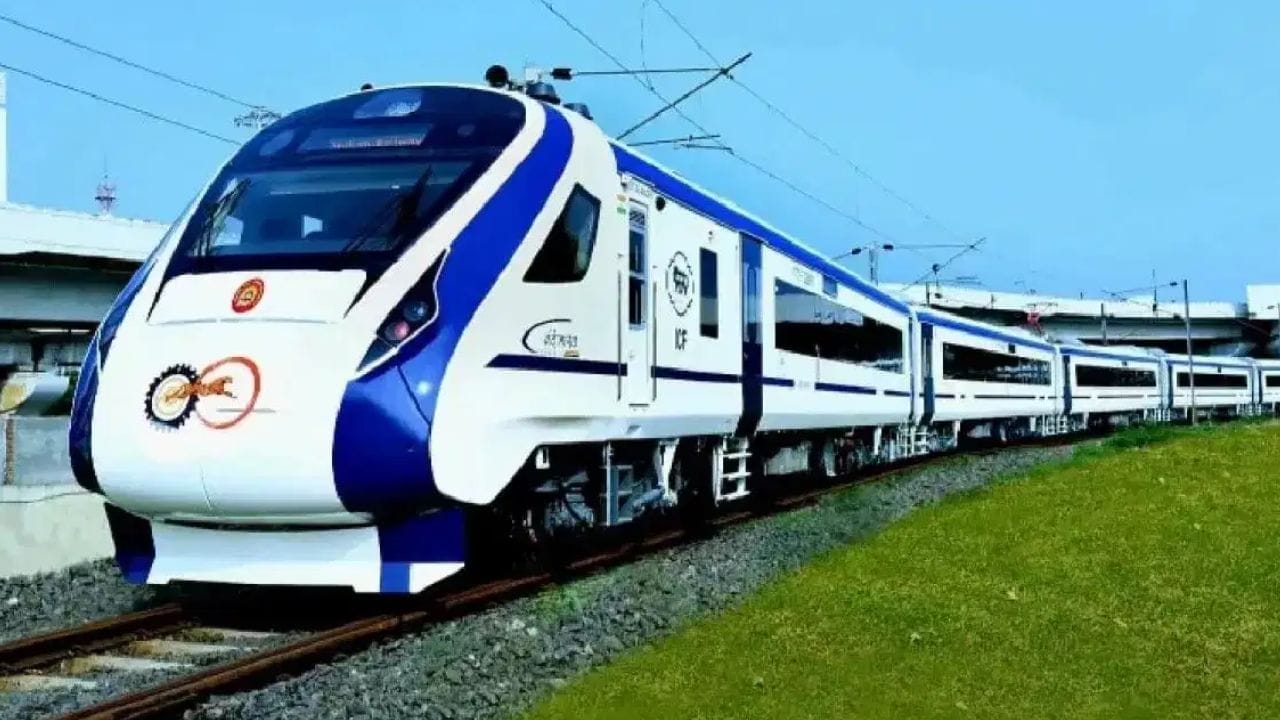
Semi high-speed train (symbolic photo)
The Cabinet Committee on Economic Affairs (CCEA), chaired by Prime Minister Narendra Modi, on Wednesday approved the Ahmedabad to Dholera semi-high-speed double line railway project of the Railway Ministry. This project, costing about ₹ 20,667 crore, will be the first indigenous technology-based semi-high-speed rail project of Indian Railways.
This new railway line, about 134 km long, will connect Ahmedabad, Dholera Special Investment Region (SIR), the upcoming Dholera Airport and Lothal National Maritime Heritage Complex with state-of-the-art rail connectivity. After completion of the project, the travel time between Ahmedabad and Dholera will be greatly reduced. This will provide more convenience to the passengers in their daily commute.
A new beginning in railway history
Railway Minister Ashwini Vaishnav said, ‘Ahmedabad-Dholera Semi High-Speed Rail Project is a new beginning in the railway history of India. It is not just a railway line, but a symbol of New India’s modern, fast and self-reliant transport system. This project based on indigenous technology will become the basis for expanding the semi-high-speed rail network across the country in the coming years.
World-class rail connectivity
Ved Prakash, Divisional Railway Manager (DRM) of Ahmedabad Division said that this project will give a new impetus to the industrial and economic development of Gujarat. He said, this project will provide world class rail connectivity to Ahmedabad and Dholera region. With this, passengers will get the facility of fast, safe and modern travel. Besides, employment, industry and logistics sector in the area will also get huge benefit. With this project, the distance between Dholera and Ahmedabad will be less than 1 hour and Dholera will be directly connected to the Ahmedabad Mumbai High Speed Rail Corridor.
The project will be completed by 2030-31
The project has been prepared in line with the Pradhan Mantri Gati Shakti National Master Plan, which aims to strengthen multi-modal connectivity and logistics efficiency. This project will directly benefit about 284 villages and about 5 lakh population. According to Indian Railways, this project will also make an important contribution in environmental protection. This will save approximately 0.48 crore liters of oil. There will also be a reduction in CO₂ emissions of about 20 million kg, which is equivalent to the environmental benefits of planting about 10 lakh trees. This project will be completed by the year 2030-31.