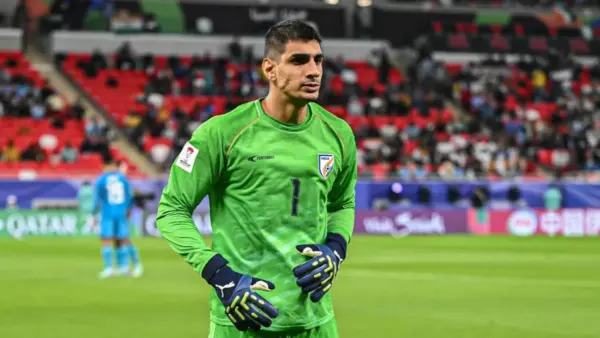
Indian football fans watching the FIFA World Cup 2026 have been left wondering when their own nation will finally make it to football’s biggest stage.
While countries with smaller populations, such as Cape Verde and Curaçao, continue to make progress and compete on the global stage, India’s absence remains a painful point among supporters.
The debate gained fresh momentum after Bengaluru FC and India national football team goalkeeper Gurpreet Singh Sandhu shared a thought-provoking message on his Instagram story. Rather than discussing the FIFA World Cup directly, Sandhu pointed towards a deeper issue that he believes lies at the heart of Indian football’s struggles.
His remarks have triggered conversations across social media, with fans, former players and pundits revisiting the long-standing question: Why does India continue to miss out on the FIFA World Cup?
Gurpreet Singh Sandhu’s Message To Indian Football Fans
In his Instagram story, Sandhu welcomed the growing conversation around India’s absence from the FIFA World Cup but argued that people are asking the wrong question.
According to the veteran goalkeeper, India’s failure to qualify for the World Cup is merely the final outcome of a much larger problem. He stressed that before dreaming about World Cup qualification, India first needs to become a regular participant in the AFC Asian Cup and consistently perform well in the tournament.
“To reach the World Cup we have to be regulars in the Asian Cup and then be regulars at the knockout stages of the same,” Sandhu wrote.
He further described qualification as a step-by-step process and urged fans to focus on the more pressing concern.
“The real question is, why did we not reach the Asian Cup?”
The statement quickly resonated with many supporters who believe Indian football often looks too far ahead without first fixing the foundations.
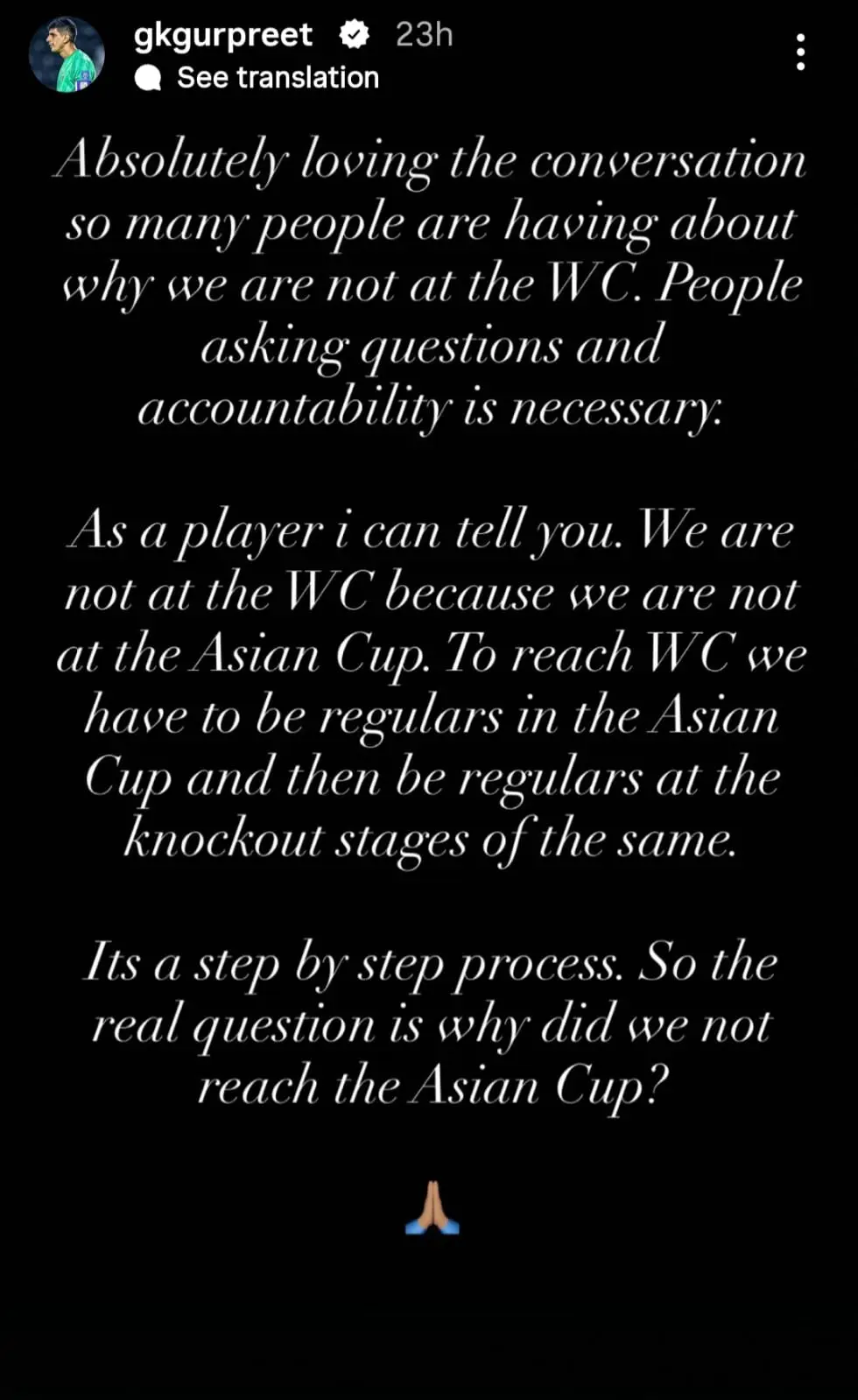
Image Credits: Gurpreet Singh Sandhu’s Instagram
Why The Asian Cup Is The Real Benchmark?
Sandhu’s argument highlights a reality that many football experts have repeatedly pointed out over the years. The AFC Asian Cup is the continent’s premier international competition and serves as the best indicator of a nation’s footballing strength within Asia.
Countries that regularly compete in the knockout rounds of the Asian Cup are often the same teams challenging for FIFA World Cup spots. Nations such as Japan, South Korea, Australia, and Saudi Arabia have built strong football structures and consistently translated continental success into World Cup qualification.
India, however, remains far behind that level. While qualifying for consecutive Asian Cups was considered progress, the next step was expected to be competitiveness. Instead, the Indian national football team has struggled to establish themselves among Asia’s elite nations.
India’s Disappointing AFC Asian Cup Record
The concerns raised by Gurpreet became even more relevant after India’s recent failure to qualify for the 2027 AFC Asian Cup.
The Blue Tigers endured a disappointing qualification campaign, finishing bottom of their group with five points from six matches. They managed just one victory while suffering three defeats and drawing twice.
Perhaps the biggest setback came in a 1-0 defeat against Bangladesh, India’s first loss to their neighbours since 2003. Although the campaign ended with a 2-1 victory over Hong Kong in Kochi, the damage had already been done.
Even when India qualified for the 2023 AFC Asian Cup in Qatar, the tournament exposed the gap between the Blue Tigers and Asia’s top teams. India lost all three group-stage matches and failed to score a single goal.
For many fans and pundits, those results perfectly support Sandhu’s argument. If India cannot consistently compete at the Asian Cup level, expecting World Cup qualification becomes increasingly unrealistic.
More Than Just A World Cup Problem
The bigger issue is that Indian football’s struggles cannot be attributed to one factor alone.
Questions continue to be raised regarding infrastructure, grassroots development, coaching standards, youth academies, talent identification and the overall football ecosystem.
Others point towards scheduling concerns involving the Indian Super League, while some critics believe administrative decisions by the All India Football Federation have slowed progress.
India’s current FIFA ranking of 138 reflects those challenges. Despite a population of more than 1.4 billion, the country continues to search for a formula that can consistently produce footballers capable of competing against Asia’s best.
The nation has produced icons such as I. M. Vijayan, Baichung Bhutia, Subrata Paul and Sunil Chhetri, but even they could not guide India to a FIFA World Cup appearance.
The Hard Truth Behind Gurpreet’s Observation
Sandhu’s message may sound harsh, but it reflects the reality of modern football. Qualification for the FIFA World Cup is not achieved through desire alone. It is usually the result of years of steady progress, stronger domestic systems and consistent performances in continental competitions.
For India, the path to the World Cup does not begin in FIFA qualifiers. It begins with becoming a regular force in Asian football. That is precisely the point Gurpreet Singh Sandhu was trying to make.
Before asking why India are not at the FIFA World Cup, perhaps the more important question is the one raised by the goalkeeper himself: why are the Blue Tigers struggling to even reach the AFC Asian Cup consistently?
Until that question is answered, the dream of seeing India on football’s biggest stage may remain just that a dream for thousands of football fans and enthusiasts in India.