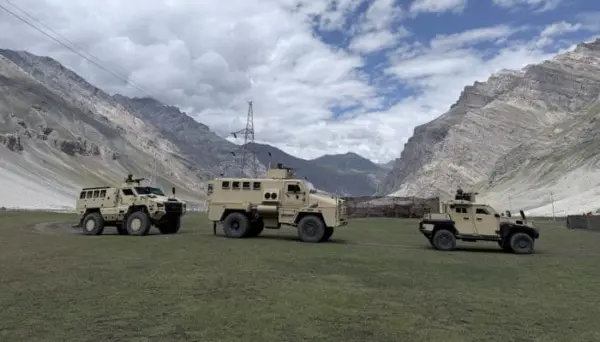
The Indian Army has showcased an impressive range of next-generation mobility vehicles, advanced communication systems, multi-layered surveillance platforms, indigenous drones, and modern weaponry during a high-altitude demonstration in the hills of Kargil on the banks of the Indus River.
The display left no doubt that the force stands fully at par with the armies of any modern nation in the world.
The soldiers of the Indian Army have long proved their unmatched courage, grit, and fighting spirit on some of the toughest battlefields on earthfrom the icy heights of Kargil in 1999 to the freezing heights of Galwan and beyond. Now, equipped with these advanced systems, they have become even more lethal against any adversary.
Among the platforms on display were Specialist Mobility Vehicles (SMVs), designed for the rapid movement of troops and logistics across extreme high-altitude terrain. They provide enhanced cross-country performance, greater payload capacity, and improved reliability in areas where conventional trucks struggle.
Compact All-Terrain Vehicles (ATVs) were also showcased, ensuring last-mile access in snow-bound, rocky, and steep environments, enabling patrols and quick reaction teams to reach otherwise inaccessible locations.
Rough-Terrain Vehicles (RTVs) further expand mobility across broken ground and steep gradients typical of the Kargil sector. Also on display were Vehicle-Mounted Mortar Systems (VMMS), which enable swift “shoot-and-scoot” fire support by integrating medium or heavy mortars onto mobile chassis. These systems allow rapid deployment and sustained indirect fire support without lengthy setup times.
Collectively, these platforms significantly enhance the Army’s ability to manoeuvre, sustain forces, and respond rapidly in high-altitude operations.
In the communications and surveillance domain, the Army demonstrated satellite communication vans and 30-metre mast-mounted surveillance vehicles.
VSAT-equipped satellite communication vans provide beyond-line-of-sight voice, data, and video connectivity independent of terrestrial infrastructurea critical capability in remote mountain valleys.
The 30-metre mast-mounted surveillance vehicles elevate electro-optical and radar sensors, extending line-of-sight observation over ridges and valleys.
Also showcased were the Army’s combined multi-sensor surveillance platforms and the indigenous Akashteer air defence control systema mobile, automated network that monitors low-level airspace and coordinates ground-based air defence weapons in real time.
A major focus of the demonstration was unmanned systems for surveillance, logistics, and precision strikesmany of which are now manufactured or assembled in India for the Indian Army.
Surveillance drones with a range of 15 kilometres provide persistent observation, target acquisition, and real-time video feeds over extended distances in mountainous terrain.
Ammunition-carrying and logistics drones transport munitions, medical supplies, and other essential payloads to forward locations, reducing reliance on vulnerable ground convoys at high altitudes. Some logistics drones are capable of operating effectively at altitudes of around 4,000 metres.
Short-range, all-direction drones with a range of 2 kilometres provide multi-axis coverage for local area surveillance and rapid response.
Indian-made First-Person View (FPV) drones give operators an immersive pilot’s-eye view for precise reconnaissance or attack in complex terrain and confined spaces. These systems are increasingly being produced domestically.
Also on display were indigenously designed and manufactured kamikaze (loitering) attack drones, including systems delivered under emergency procurement and developed by Indian startups. These one-way precision munitions are capable of high-speed terminal attacks, day-and-night operations, and effective performance in GPS-denied and electronic warfare environments. Recent deliveries have included FPV kamikaze variants optimized for anti-personnel and anti-materiel missions.
These systems reflect the Army’s shift toward mass-produced, low-cost, attritable unmanned assets that can be fielded and sustained at scale.
On the weapons front, the Army displayed mobile rocket launchers alongside a formidable mix of modern small arms, including the Finnish Sako TRG-42 precision sniper rifle with an effective range of around 1,500 metres, the American SIG Sauer SIG716 7.62 mm battle rifle, the Indian-made AK-203 assault rifle, and the Israeli Negev NG7 light machine gun.
The demonstration also featured modern anti-personnel and anti-tank mines, deep-search metal detectors, and protective mine shoes designed to minimize casualties during mine clearance operations.
With battle-tested soldiers who have repeatedly demonstrated extraordinary courage and sacrifice, now backed by cutting-edge mobility platforms, advanced sensors, drones, and superior firepower, the Indian Army has emerged as a force that is not only technologically on par with the world’s best but also significantly more lethal against its enemies.
The message from the heights of Kargil is clear: the Indian soldier remains the nation’s strongest shieldand today, that shield is sharper than ever.