Earlier this week, the Ministry of Power announced the third iteration of the Corporate Average Fuel Efficiency norms, or CAFE-3 as they are known in the automotive industry. And the numbers are tough: from 1 April 2027, a carmaker’s passenger vehicles will have to average 3.996 litres per 100 kilometres, or 25 kilometres per litre. By March 2032, that target rises to 3.3273 litres per 100 kilometres, equivalent to 30 kilometres per litre.
That sounds like a recipe for cars that suddenly return extraordinary fuel efficiency. But it isn’t quite that simple. Cars have become more fuel efficient over the years, but Indians are also buying larger and more expensive vehicles.
New safety and comfort systems on cars are heavier. An electric, ventilated seat weighs a few kilograms more than a manually adjusted seat. Coupled with things such as stronger air-conditioners and heavier steel used for improved safety, cars are heavier than before. And it takes more energy to move around that additional weight.
Despite improvements in fuel efficiency, some of those benefits have been lost. So what is a carmaker to do? This is where the ‘derogation factor’ comes in. Think of it as a ‘super-multiplier’. It increases the sales volume of those vehicles, and cleaner vehicles such as battery-electric vehicles have been given a significant multiplier. That multiplier is 3, so instead of counting each EV as a single vehicle, you count it as three, so your average fuel efficiency gets divided by a larger number.
A Mercedes-Benz, for example, can sell a few more fire-breathing, petrol-guzzling AMG vehicles simply because they’ve sold a couple of hundred of the GLC 400.
There is also the controversial aspect of CAFE-3, which is ‘credit trading’, that led to a rant from former NITI Aayog chairman and electric-vehicle advocate Amitabh Kant on X.
But for a mass-market manufacturer such as Kia Motors, a few thousand electric vehicles, as good as the Syros EV is, won’t cut the mustard if they are to meet overall CAFE-3 efficiency numbers.
And there are all sorts of other drivetrain technologies, from range extenders to plug-in hybrids.
So why have I brought up Kia? Simply put, Kia is betting strongly on regular hybrid vehicles. They said at their investor day in South Korea a few months ago that they will be launching several hybrids in India over the next few years. And while regular hybrids don’t have a massive ‘derogation factor’ — it is only 1.6 despite significant lobbying by some manufacturers who wanted 2 — the fact is that volumes of hybrids can be significant.
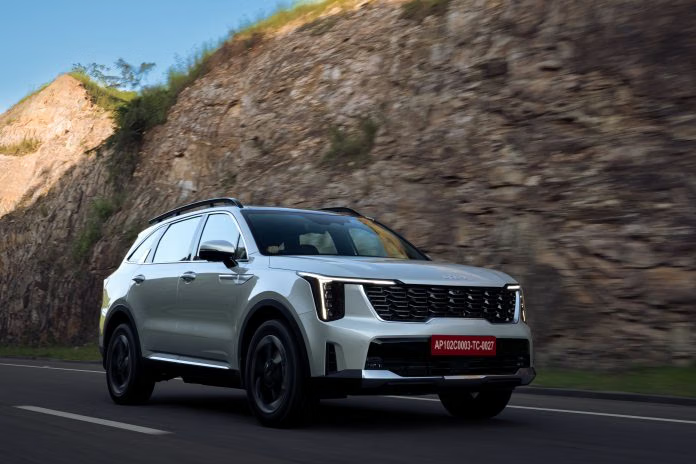
And I drove the first of the hybrids that Kia is bringing to India around Udaipur this past week. The new Kia Sorento. This is a large three-row SUV with both six- and seven-seat options, with showroom prices ranging from Rs 30 lakh to Rs 40 lakh for the hybrid, and quite clearly, it is aimed squarely at the king of the SUV hill, the Toyota Innova Hycross.
The Sorento’s hybrid promise comes with a catch
The Sorento has been a successful product for Kia across global markets over four generations, and India also gets a diesel model, which I didn’t drive but I did sit in.
So, on the basis of the Sorento, should you look at buying a hybrid? Tough one, actually. That is because the Sorento Hybrid does feel a bit lethargic on highways, the gearbox taking that extra (and noticeable) microsecond to kick down when you want the power to overtake.
A partial reason for this is possibly because I’ve become used to instant power delivery on almost every vehicle nowadays. But even for a hybrid, this is noticeable because Kia doesn’t use the e-CVT technology found on some other vehicles, such as the aforementioned Innova.
Is this a deal-breaker, though? Not at all. Once you get the hang of the system, which you will if you own a car, you learn how and where to accelerate on a highway. The kicker comes inside the city, though.
A vast majority of vehicles bought today spend their lives inside the city, and on the chaotic roads of Udaipur, where India’s booming car sales were palpably visible through the traffic, the Sorento shines, and you figure that it is geared toward urban driving.
And that is also evident in the fuel efficiency.
After all, hybrids are all about that. The batteries may be small, just a 1.49-kilowatt-hour on the Sorento, but urban start-stop driving, allowing you to constantly charge and discharge the battery, helped even this big, heavy vehicle easily cross 18-19 kilometres per litre, as against the 14-15 kilometres per litre I was getting on the highway. Again, I have to qualify that this was the first media drive, and I was driving enthusiastically on the highways. When I get the Sorento for a longer period of time, I’ll understand its fuel efficiency over normal urban usage and traffic.
The real hybrid advantage shows up in city traffic
The Sorento is a well-built vehicle, and the second-row of seats is supremely comfortable. However, the third row, like in almost any three-row car, is designed for shorter folks and only really meant to be used in a pinch. In my estimation, by launching in this price bracket, the Sorento does give owners of the Kia Seltos an upgrade path within the brand. Kia clearly feels that as India gets richer, it will buy more expensive vehicles, and the Rs 30-50 lakh bracket is surprisingly devoid of choice. It is pretty much either the Toyota Innova Hycross, maybe badged as the Maruti-Suzuki Invicto, or a second-hand luxury vehicle.
But back to hybrids. I will repeat myself from previous columns: if you can install a charger in your house or apartment, an electric vehicle is the way to go. I have a charger at my house, and I love having electric long-termers like the Maruti-Suzuki E Vitara right now. However, as more people consider buying an electric vehicle, they are discovering issues with the electrical infrastructure in their area or are having a flaming row with their resident welfare associations.
While I believe these will be resolved in the next few years, right now, electric vehicles are not for everyone given these issues. And these issues also impact plug-in hybrids, whether they’re strong hybrids or range extenders. So, in the short to medium term, hybrids are a way out for both carmakers and car buyers.
And the government has dangled a little carrot to carmakers as well — make your hybrid vehicle capable of running on flex-fuel and we will give you a derogation factor of 2.5. So the flex-fuel strong hybrid is something that is coming to a car showroom near you soon, but for now, the Kia Sorento is a pretty darn nice stopgap.