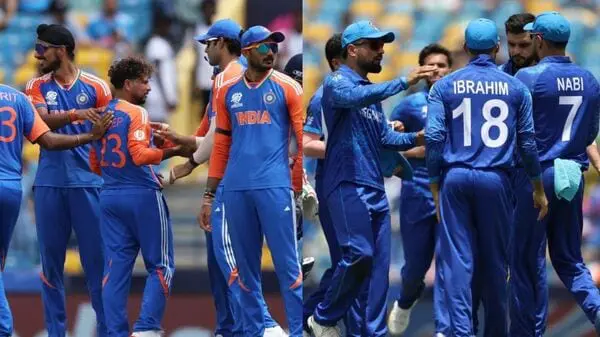
India and Afghanistan will renew their rivalry in the shortest format, as Afghanistan “host” a three-match T20I series in New Delhi’s Arun Jaitley Stadium.
The first of the three T20Is will be played on Sunday (13 September), followed by the second and third matches on Tuesday (15 September) and Thursday (17 September).
Afghanistan are hosting India in India because they have been unable to regularly stage international matches at home due to security and logistical concerns. As a result, the Afghanistan Cricket Board has used venues in other countries, including India, as adopted home grounds for its international fixtures.
Earlier this year, Afghanistan had toured India for a one-off Test series and a three-match ODI series.
Afghanistan lost the one-off Test in Mullanpur by an innings and 300 runs, and also suffered a 3-0 sweep in the ODI series. The Afghans will thus be hoping for a change of fortunes this time around.
What happened when India last played Afghanistan in a T20I?
India last took on Afghanistan during the 2024 T20 World Cup in June, in a Super Eight match in Barbados. Both teams had reached the second stage of the tournament after impressive group campaigns, with Afghanistan particularly making headlines after defeating New Zealand to progress from Group C.
India, meanwhile, had gone through the group stage unbeaten, finishing Group A with seven points (Their match against Canada was washed out due to rain).
Talking about the match, India won the toss and decided to bat first. Pacer Fazalhaq Farooqi struck early for Afghanistan as he removed the then skipper Rohit Sharma in the third over.
Rishabh Pant (20) and Virat Kohli (24) then forged a 43-run partnership off 25 deliveries, before Rashid Khan dismissed both of them in a matter two overs.
Pant was dismissed in the seventh over after being struck LBW, whereas Kohli departed in the ninth over after was caught by Mohammad Nabi at wide long-off. Rashid once again struck in the 11th over with the wicket of Shivam Dube, as the spinner finished with figures of 3/26.
Despite India losing wickets at regular intervals, Suryakumar Yadav stood tall and played a knock of 53 runs from 28 deliveries. He was involved in a 60-run stand with Hardik Pandya (32), which eventually took India to 181/8.
Afghanistan’s run chase
Afghanistan therefore needed 182 to win, but their chase never developed into a serious threat after India made early inroads.
Jasprit Bumrah provided the biggest blow with the new ball. He dismissed Rahmanullah Gurbaz and Hazratullah Zazai as Afghanistan slipped to 23/3 in the fifth over. Axar Patel also removed Ibrahim Zadran, who was dismissed for eight, leaving Afghanistan under pressure early in the chase.
Afghanistan’s middle order struggled to recover. Azmatullah Omarzai (26) and Gulbadin Naib (17) provided some resistance with a 44-run partnership, but both were dismissed before the innings could gather momentum.
Bumrah returned later to claim his third wicket, removing Najibullah Zadran, while Kuldeep Yadav and Arshdeep Singh also contributed important wickets.
Afghanistan were eventually bowled out for 134 in 20 overs. Bumrah finished with 3/7 from four overs, while Arshdeep Singh also took three wickets. The 47-run victory gave India an ideal start to the Super Eight stage.
Suryakumar was named Player of the Match for his 53, while Bumrah’s exceptional spell ensured Afghanistan never got close to India’s total.
The defeat, however, did not prevent Afghanistan from making history later in the tournament, as Rashid Khan’s side went on to reach their first-ever T20 World Cup semi-final, where they lost to South Africa.
India, who beat England in the semi-final, went on to end their 11-year long ICC trophy drought, beating South Africa by seven runs in the final.