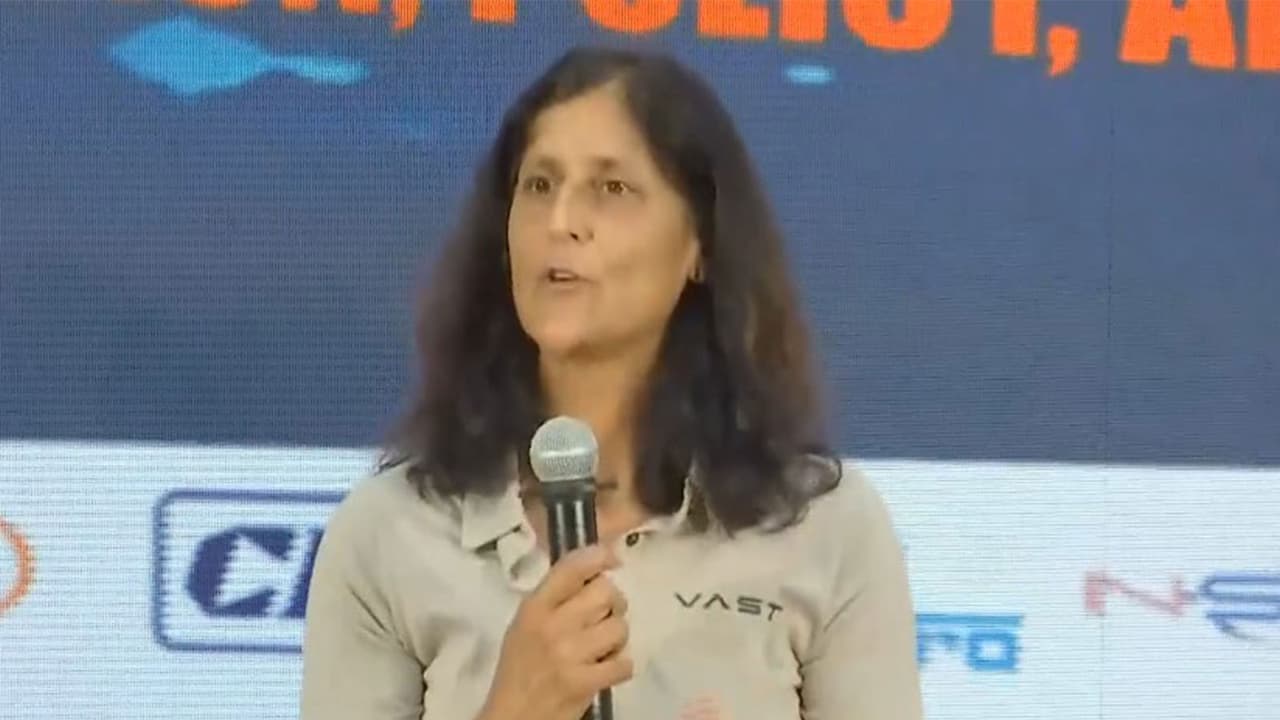
NASA astronaut Sunita Williams said India is ‘ready for the challenge’ of building future space stations, stressing the need for advanced tech, autonomous systems, and international cooperation as human spaceflight moves beyond the ISS.
Technological Needs for Future Missions
Onboard Databases for Autonomy
Reflecting on her experience aboard the ISS, Williams said astronauts cannot simply rely on a database or search engine in space in the same way people on Earth can.“It’s a great question. I think everybody in this room has had a question in their mind, and then pulled out their phone and was able to find the answer. That’s not as easy on the International Space Station. We don’t have that database up there to help us answer all the questions, so we rely on good communications with the ground. So I’m hoping that new technologies will allow us to have that database with us on our future space stations, so we could just look something up,” Williams added.She said such a database would not merely be useful psychologically, but could become important for solving technical problems during missions, particularly as spacecraft travel farther from Earth.“And why is that important? It’s not just important psychologically — it’s nice to just know the answer to something. But in reality, it’s like, ‘How do I fix that?’ I’m sure a lot of people in the audience have also looked up, ‘Somebody else has had this thing break — how does it get fixed?’ If we could have a database of that, we could be a little less reliant on the folks on the ground. And as we move farther and farther away from Earth, and we have delays in getting answers, this becomes critical when we’re trying to fix things or take the next step,” she added.
Reliable 3D Printing in Microgravity
Williams also underlined the importance of reliable 3D printing for future space missions, noting that even something as basic as printing on paper becomes complicated in microgravity.“Along with that is 3D printing — reliable 3D printing. In space, that’s hard. And just to give context, it’s hard to print on paper in space as well. That might sound funny, but I’m sure there are people out there who have wrestled with the printer. Yes, we wrestle with the printer in space because it relies on gravity. So we have to rethink how machines operate and how to make a machine that doesn’t need gravity. Here on Earth, that’s how we design everything,” Williams added.
Autonomous Scientific Analysis
The retired US Navy officer said another major lesson from her missions was the need for astronauts to carry out scientific analysis autonomously rather than constantly sending data back to Earth.“Finally, I think one of the more recent takeaways was — and this became very real to me — that every time we did an experiment, we had to send data back to the ground or send part of that experiment back for analysis. We need to be able to do that ourselves, autonomously, if we are going to take those next steps. That includes everything from medical tests to answers for some of the experiments we have up there,” Williams added.She said future spacecraft would need onboard databases and machines capable of analysing information without depending entirely on Earth.“Rather than relying on the ground to have all the answers and relying on down-mass capability, we need to have all those databases and that ability in space — to have machines that can do that analysis,” she said.“So there are a lot of technological advancements that would be great to have on the future space station,” Williams added.
A New Chapter for Space Stations
Williams also said commercial space stations could provide an opportunity to develop and implement new ideas more quickly, while maintaining safety and reliability.“One thing I really like — you might have seen I had a shirt on that says ‘Vast’ — one of the nice things I like about these future space station ideas is that we can do things a little quicker,” she said.“Of course, we want to do things safely and reliably, and that has created some bureaucracy in our processes. Not to mention, it’s busy up on the space station, and we don’t have a lot of time to change things because we have things that have been processed for long periods of time,” Williams added.Calling the transition to new space stations “a new chapter”, she said both commercial and government-led projects could benefit from lessons learned on the ISS.“So this is a new chapter and a new way to start with brand new space stations, whether they are commercial or government space stations — things to keep in mind for the infrastructure as we start,” she said.
Challenges and Future Investments
Williams said it would be difficult to introduce some of these technologies into the ISS at this stage, given that parts of the station have been operating for more than 25 years.“I think it would be very difficult to implement some of these ideas on the International Space Station at this juncture. It has been flying for over 25 years, parts of it, and we have had some advancements, but it’s been a little tough to continue. As we look to the end of the International Space Station, we also have to think about what types of investments we want to make,” she added.Williams said future investments would need to support broader exploration goals, including missions to the Moon.“Things have been working, so I don’t think folks in the U.S. government want to invest in making all of these advancements unless they are helping us in our pursuits of exploration,” she said.“So if some of these things help enlighten us on how we are going to build our moon base, then yes, they will probably do it, but it all just takes some time. So from the ground up, I think we have the opportunity to implement some of these ideas,” Williams added.
Reflections on a Career in Space
Earlier in the session, Williams spoke about her own career and the evolution of human spaceflight, saying she was fortunate to be part of the construction of the ISS and work with international partners.“I was very lucky in my career, and I see some youngsters out there who I hope will have the same type of career. I got to be part of the construction of the space station, working with our international partners and actually putting it together,” she said.“It’s no easy feat, and I know India is ready for the challenge as well, along with commercial companies all over the world, including VAST, who will be building space stations. It’s hard work, but we can do it. There are smart human beings out there,” Williams said.She said her three missions exposed her to the construction of the ISS, international cooperation, scientific experiments and the operation of a new spacecraft.“My first mission was really about the construction of the space station. On my second mission, I got to capitalise on the international cooperation, fly up with our Russian partners, and do a lot of experiments on the space station,” she said.“And my last mission was, of course, flying a brand new spacecraft. Again, this is what India is going to be doing, what VAST is going to be doing as an example — not easy things. Sometimes those things come with a couple of hiccups, but the good side of those hiccups is you get to do amazing science and maybe some more spacewalks in the process,” Williams added.
Long-Term Scientific Payoffs
Williams said experiments conducted in space can take years to yield results, citing capillary-flow research as an example of how scientific work from earlier missions can contribute to future space systems.“So we did everything in space. Starting from my first flight, we did experiments that sometimes take many, many years. Capillary flow, for example, may help design future systems for space fluid transfer,” she said.“That will be a result of some of the work we did on my very first flight, and I saw some of those mathematical models come to fruition on my most recent flight, where we used that capillary flow science to figure out how to feed plants hydroponically and deliver the correct nutrients to those plants, which we might need in future space stations or on a moon base eventually,” Williams said.“All of these experiments don’t just happen right now. These are things that happen over time,” she added.She also recalled research involving stem cells, DNA sequencing, materials science and biology aimed at understanding how humans can live and work in space for extended periods.“We did some stem cell research up there, we did DNA sequencing, lots of materials science, lots of biology experiments on ourselves so we can understand how to keep people in space for a long period of time,” Williams said.Williams said space exploration brings together a wide range of disciplines, from construction and international relations to advanced technical research.“So it’s a myriad of things that go on in a space endeavour — starting with construction and international relations, all the way to all the technical parts of it,” she said.“And I’m super excited for future spaceflight, because we have learned so much over the last couple of decades, and we have a springboard from that for these new, modern space stations and new transportation systems, which I know India is ready to take on, as well as a lot of other countries and companies,” she added.The session also featured Group Captain Angad Pratap and Tom Shelley, Vice President, Crew Partnerships, VAST Space, and focused on the future of space exploration, scientific research, commercial space stations and human spaceflight. (ANI)(Except for the headline, this story has not been edited by Asianet Newsable English staff and is published from a syndicated feed.)