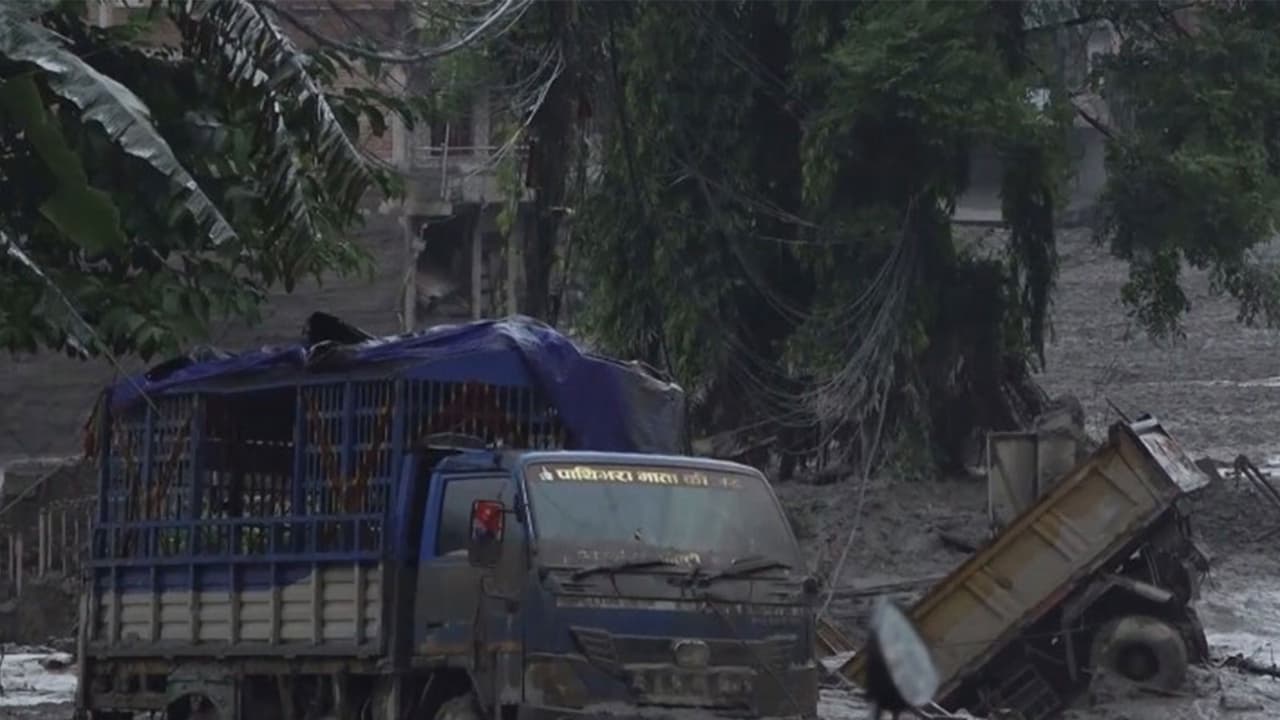
NDRF says no adverse flood impact on Indian border territories following flash floods in Nepal. Agencies are monitoring water levels in sensitive districts. India has sent large-scale relief supplies and has kept rescue teams on standby for Nepal.
India on High Alert, No Adverse Impact Yet
National Disaster Response Force (NDRF) Inspector General Narendra Singh Bundela on Thursday said that there has been no adverse flood impact reported in Indian border territories following the flash floods in Nepal, adding that agencies are closely monitoring water discharge levels across sensitive districts such as Kushinagar and West Champaran. Speaking to ANI on domestic preparedness, IG Bundela stated that state governments and the Central Water Commission (CWC) are maintaining continuous vigil and field-level sensitisation has been completed. “The State Government is already monitoring this. As of now, there has been no adverse impact. The CWC (Central Water Commission) is also monitoring the water level discharge. After reviewing the situation, the State Government has made additional deployments and diverted state resources. The District Magistrate has already taken action at the field level and completed sensitisation. So, this is currently being monitored to see what further possibility of flooding there might be,” Bundela said. “The border districts–such as Kushinagar and West Champaran–which could be affected initially, are also already being monitored. For that, we have reserve teams on standby. If anything like this happens, in coordination with the State Government, they will be deployed immediately,” the official added.
India’s Assistance to Nepal
Regarding India’s disaster assistance to neighbouring Nepal, the NDRF official highlighted that large-scale relief supplies have already been delivered via two Indian Air Force (IAF) aircraft, while four specialised rescue teams have been kept on reserve in Ghaziabad for rapid deployment if requested. “Relief material is a separate matter. Relief material is already being provided on a large scale by the Government of India. Supplies have already been delivered via two Air Force aircraft. The Government of India and the Ministry of External Affairs are handling that. But if a rescue team is required, that decision is taken based on actual requirements. If that need arises, we have kept our teams in reserve,” Bundela explained. “We have already kept four NDRF teams on reserve in Ghaziabad. Whenever an incident occurs in a neighbouring country, and there is a possibility that India might send assistance, keeping that in mind, we keep teams ready in reserve so that if a requirement arises, we can deploy them from there,” he added.
Flood Trigger and Regional Preparedness
A sudden flash flood in Nepal and a glacial lake outburst flood (GLOF) near the Nepal-China border have triggered heightened flood preparedness across Bihar and Uttar Pradesh, with the National Disaster Response Force (NDRF) deploying 20 teams in the two states and authorities closely monitoring the likely downstream movement of floodwaters through the Gandak River. The NDRF has placed its teams on high alert amid the possibility that the flood wave generated in Nepal could travel downstream through the Gandak River and affect vulnerable districts in Bihar and Uttar Pradesh. According to the NDRF, a sudden rise in the water level of the Trishuli River at Furke Khola in Nepal, around 160 kilometres from the Indian border, has been reported amid suspected GLOF activity near the Nepal-China border. The Central Water Commission has advised authorities in Bihar and Uttar Pradesh near the India-Nepal border to remain alert and maintain close monitoring of the Gandak River. Nine NDRF teams have been deployed in Bihar and another 11 in Uttar Pradesh for flood warning and response operations.
Devastation in Nepal
Nepal has been hit by devastating flash floods triggered by a massive surge in the Bhote Koshi River, causing loss of life, displacement and extensive damage to infrastructure, including homes, roads, bridges and hydropower facilities. According to Nepal Embassy sources, 175 bodies have been recovered so far, while many people, including locals and tourists, remain missing. Around 476 people from 28 countries have been reported missing, though the figures are still being verified as search and rescue operations continue. The disaster was triggered when an avalanche blocked the flow of the Lhende tributary of the Bhotekoshi, striking Timure near the China border at Rasuwagadhi and sending a violent surge downstream towards Syaphrubesi without warning. With no rainfall reported in the area, residents had no warning before the flood struck.
Humanitarian Aid Stepped Up
India has stepped up humanitarian assistance for Nepal, with the Ministry of External Affairs stating that a second flight carrying 37.5 tonnes of Humanitarian Assistance and Disaster Relief (HADR) material, medicines and food packets has departed for the flood-hit country. Earlier, the Embassy of India in Nepal handed over 10 tonnes of relief materials to Nepal authorities. Prime Minister Narendra Modi and External Affairs Minister S Jaishankar have also expressed solidarity with Nepal and assured all possible assistance. (ANI)
(Except for the headline, this story has not been edited by Asianetnews Editorial staff and is published from a syndicated feed.)