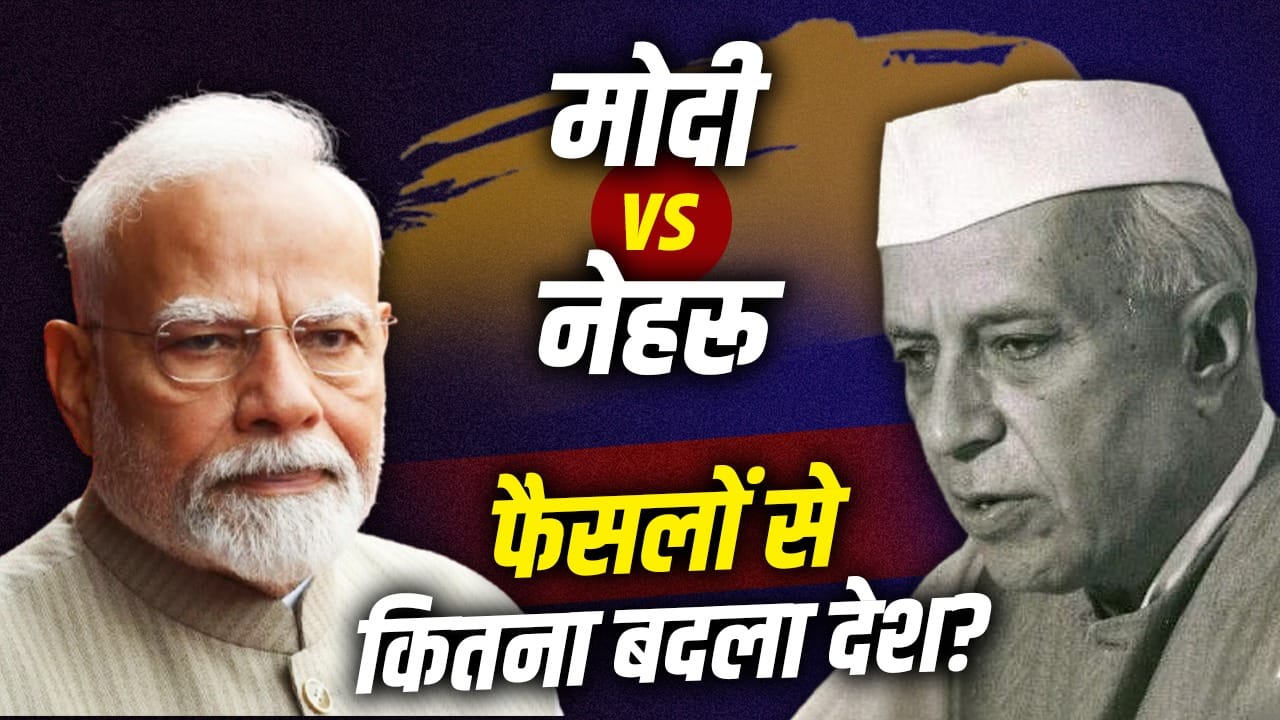
modi vs nehru
On coming 10th June, Prime Minister Narendra Modi remains the PM of the country for a long time. Pandit Nehru Going to break the record. He will break this record as the elected PM. General elections in independent India were held after many years in the year 1951-52. Nehru remained in office as PM since 1947 and led the country. Actually, it is meaningless to compare the two Prime Ministers. Because everyone who sat on this chair tried to do better according to their capacity and time, but as the elected PM, Modi is now going to break Nehru’s record, so it is natural that there will be discussion. After all, India is a capable democracy and this is its beauty.
Let us, on this pretext, discuss India of 1947 versus India of 2026. Do you know what changed in the country due to Nehru’s foundation and Modi’s decisions?
Broken country, great hope
India became independent in 1947. There were huge challenges before the country. The pain of partition was fresh. About 1.4 crore people migrated from here to there. The economy was in shambles. There was immense poverty. The literacy rate was also nothing special. Only about 18-19 percent people were educated. The average age was around 32 years. The country had less industries. Farming was dependent on monsoon. There was a huge shortage of food grains. Health services were very weak. Roads, electricity and irrigation were very limited. At such a time, Pandit Jawaharlal Nehru took command of the country. His work was like laying the foundation of a new building. The country had to be given the direction of constitution, democracy, institutions and development.
What did Nehru do for India?
Nehru strengthened democracy. The Constitution came into force in the year 1950. The first general elections were held in 1951-52. At that time crores of poor and uneducated people voted. This was one of the world’s largest democratic experiments. Nehru laid emphasis on institutions. Institutions like Election Commission, Supreme Court and Parliament became stronger. He promoted scientific thinking. Atomic Energy Commission was formed in the year 1948. IIT Kharagpur started in the year 1951. AIIMS was built in Delhi in the year 1956. The University Grant Commission was established in the same year. These institutions later gave India doctors, engineers, scientists and policy-makers.
What did Nehru call the temple of modern India?
Projects like Bhakra-Nangal, Hirakud and Damodar Valley helped in irrigation and electricity. Nehru saw these dams and power projects as temples of India. He laid emphasis on heavy industries. Steel plants like Bhilai, Rourkela and Durgapur were built. India created an industrial base through the public sector. Nehru adopted non-alignment in foreign policy. India tried to maintain a balance between America and the Soviet Union. This gave India the recognition of independent foreign policy.
What were the limitations of Nehru era?
Nehru’s policies are also criticized. State control was too much. The beginning of the License-Permit Raj is considered to be associated with this period. The pace of private industries remained slow. The China war in 1962 was a big setback for India. Questions were raised on defense preparedness. Yet it is true that Nehru gave an institutional foundation to a poor, scattered and new country. He laid the foundation of democracy, science, education and industry. Denying this is like hiding the truth.
India of 2026, big market, digital power
By the year 2026, India had changed a lot. India became the world’s most populous country. The population exceeded 140 crores. India became the fifth largest economy in the world. Airports increased. Mobile and internet became common. Digital payments should reach villages. India started looking strong in space, pharma, defense and technology. This is the India whose foundation was laid by old leaders but its pace was accelerated by new decisions. Narendra Modi’s era as PM is known for this rapid change.
What did Modi change as PM?
After 2014, Modi government started schemes on a large scale. The biggest change was seen in digital and direct delivery. Under Jan Dhan Yojana, more than 50 crore bank accounts will be opened by 2024. With Aadhaar and mobile, DBT i.e. Direct Benefit Transfer system got strengthened. Government money started going directly into people’s accounts. UPI changed India’s payment system. This tool, which was started in the year 2016, will reach the common man’s pocket by 2024. UPI transactions worth more than Rs 13 thousand crore took place in the financial year 2023-24. From tea vendors to big businessmen are taking money through QR code. Swachh Bharat Mission made cleanliness a mass movement.
According to government claims, more than 11 crore toilets were built. More than 10 crore LPG connections were given under the Ujjwala scheme. Under the Ayushman Bharat scheme, health cover of up to Rs 5 lakh was given annually to eligible families. Under PM Kisan, eligible farmers are getting assistance of six thousand rupees annually. There are many such social schemes, which are reaching the last person in the country.
Infrastructure gained momentum
Modi government laid emphasis on roads, railways, electricity and airports. The length of national highways increased from about 91 thousand km in 2014 to more than 1.4 lakh km by 2024. The number of airports also almost doubled. Vande Bharat trains showed a new picture of rail travel. Work was done on providing electricity to villages and providing connections to homes. Jal Jeevan Mission emphasized on tap water. In the year 2019, there were around 3 crore tap connections in rural houses. In government documents, this number has been stated to be more than 14 crores by the year 2024.
Modi took many big policy decisions
Modi government took many big and controversial decisions. Demonetization happened in the year 2016. GST came into effect in the year 2017. Article 370 was removed from Kashmir in the year 2019. Triple talaq law came. Women’s Reservation Bill passed in the year 2023. Ram temple was consecrated in the year 2024. These decisions had a major impact on the direction of politics, society and governance. Supporters call him decisive leadership. Critics question the impact and manner of some decisions.
Science, security and foreign policy
India’s global image appeared more aggressive and confident during the Modi era. India presides over the G-20 in the year 2023. Chandrayaan-3 made a successful landing near the south pole region of the Moon. During the Covid period, India administered more than 220 crore vaccine doses. Emphasis was laid on self-reliant India and Make in India in the defense sector.
What is the real comparison?
There cannot be a direct comparison between Nehru and Modi. Nehru had a new and poor India. Modi had already formed institutions, big market and technology. Nehru laid the foundation. Modi emphasized on speed, scale and digital system. Nehru’s India Institute was being built. Modi’s India is pursuing the politics of delivery and identity. One era made the country stand. The second round tried to make it run faster.
In simple words, India of 1947 was struggling. The year 2024 is the India of aspiration. Nehru laid the foundation of democracy, science, education and industry. Modi gave a new turn through digital governance, infrastructure, welfare delivery and major political decisions. The story of India is not the story of any one leader. This is the result of the hard work of many generations. Nehru gave the basis. Modi gave momentum in many areas. The real need of today is that the foundation should be strong and the flight should also be balanced. Only then will we be able to move forward towards becoming a developed India by the year 2047.
Also read- Nehru vs Modi on Kashmir, hit many targets with one stone, 70 years old promise fulfilled, end of conspiracies of PAK-separatists.