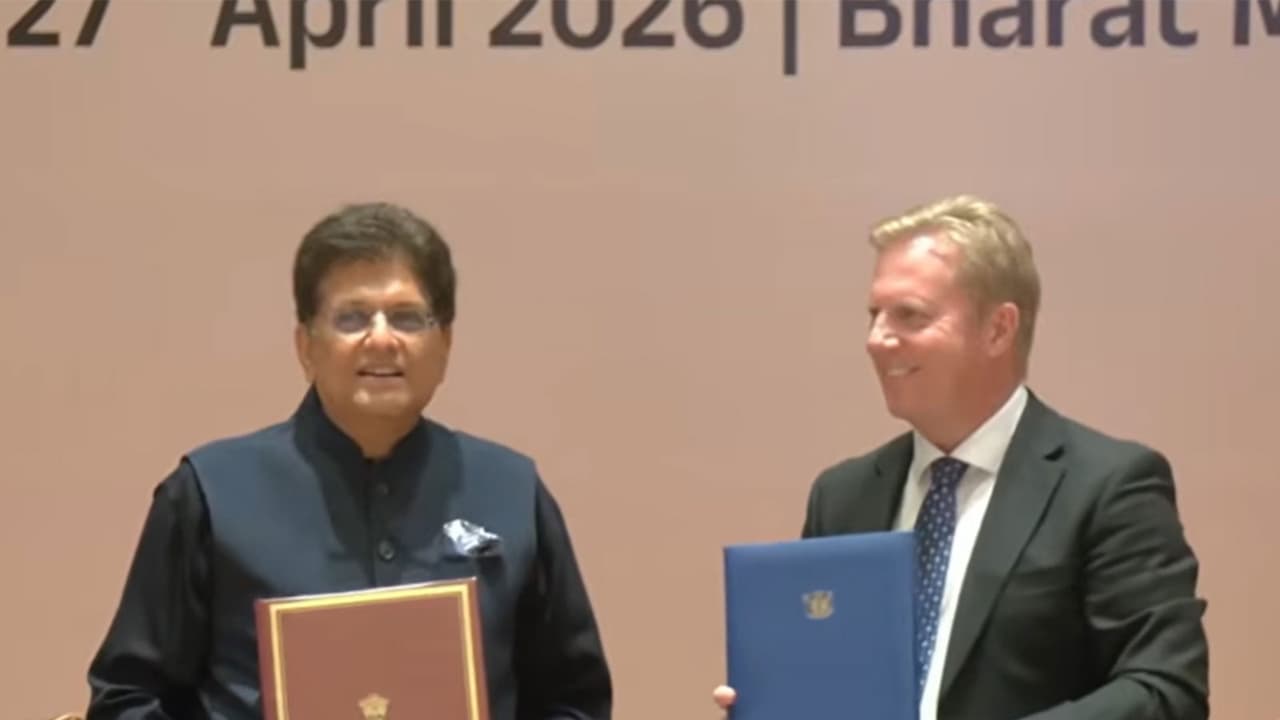
The new India-New Zealand FTA aims to stabilise bilateral trade, offering 100% duty-free access for Indian exports. It also covers services, a USD 20 billion investment commitment from NZ, and is seen as a strategic gateway to Oceania markets.
The India-New Zealand Free Trade Agreement (FTA), signed on Monday, is expected to stabilise bilateral trade flows and bring “predictability to trade flows”, with Rubix Data Sciences calling it a “timely intervention” amid recent moderation in trade momentum.
A ‘Timely Intervention’ Amid Moderation
Rubix said the FTA comes as a “timely intervention in a bilateral trade relationship that has shown strong growth, but also recent signs of moderation.” Bilateral merchandise trade between the two countries had crossed the USD 1 billion mark in FY2025, but “this momentum softened in FY2026, with total goods trade easing to USD 1.06 billion during April-February,” the report noted.
Highlighting the significance of the pact, Rubix said the agreement “is expected to provide greater stability and predictability to trade flows while creating a framework for long-term growth.”
Expanded Market Access for Indian Goods
The FTA will significantly expand market access, with New Zealand set to eliminate tariffs across all tariff lines.
According to Rubix analysis, “the FTA ensures 100% duty-free access for Indian exports, with New Zealand eliminating tariffs on all 8,284 tariff lines from entry into force.” This is expected to benefit labour-intensive sectors such as textiles, apparel, leather, and footwear, while also boosting exports in engineering goods, automobiles, pharmaceuticals, and chemicals.
Addressing Trade Dynamics and Imbalance
Rubix also pointed out that the agreement comes against the backdrop of changing trade dynamics. “India’s goods exports to New Zealand… saw a correction in FY2026… reflecting demand normalisation after a strong performance in the previous year,” it said.
At the same time, imports have remained relatively strong, leading to a sharp narrowing of India’s trade surplus. The analysis noted that the surplus declined “from USD 203 million in FY2024 to USD 9.4 million in FY2026 (April-February).”
Beyond Goods: Services, Investment, and Mobility
The agreement also goes beyond goods trade, covering services, investment, and mobility. Rubix highlighted that New Zealand has offered commitments across multiple services sectors, along with “a long-term investment commitment of USD 20 billion and new pathways for students and skilled professionals.”
Evolving Trade Structure and Strategic Gateway
From a structural perspective, the report said trade between the two countries is evolving. “India’s exports to New Zealand are becoming more concentrated in value-driven sectors,” while imports are increasingly focused on “core raw materials… reflecting demand linked to construction, recycling, and industrial energy needs.”
The FTA is also seen as strategically important, with Rubix noting that New Zealand can act as a gateway to the wider Oceania region, helping India expand its presence in Pacific markets.
Overall, Rubix said the agreement has the potential to unlock untapped trade opportunities while stabilising a relationship that has recently seen fluctuations in momentum. (ANI)
(Except for the headline, this story has not been edited by Asianet Newsable English staff and is published from a syndicated feed.)